FATE HACK – EVOKE – KILLING WITH KINDNESS

Standard

I’ve pondered this in a previous blog or two, but now I’m going to explore it in full: I propose an alternative to the Fate Core skill Rapport. I give to you:

EVOKE
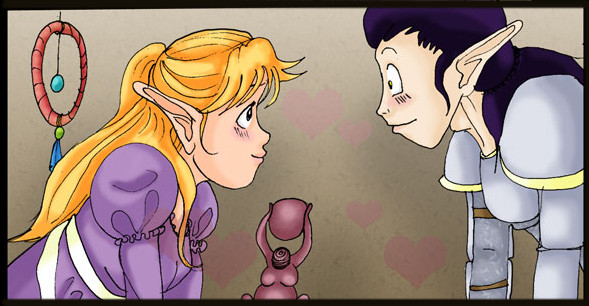
Elf Connection

Elf Connection

Evoke is the skill of friendship, inspiration, and seduction. While Contacts focuses on the friends you already have, Evoke judges your ability to make new connections and friends. Characters with a high Evoke are often skilled orators, knowing how to effectively move a crowd; but unlike Deceive, Evoke comes from honest emotion, as the orator talks about something that they believe in, or offers promises that they intend to keep. Alternatively, a skilled Evoker may be an artist, using a musical or dance performance to stir the emotions in an audience. It is the opposite of Provoke, which brings out the negative emotions in others.

Remember: Just because a character is filled with positive emotions doesn’t make them “good.” Many tyrants and zealots have killed out of love.

ACTIONS

OVERCOME:

Evoke may be used to overcome simple NPCs that stand in your way, by using your words and body language to befriend or convince them you are on their side. Evoke may also be used to remove negative emotional aspects placed on other characters, a group or a scene, such as aspects about fear, depression, or anger. They may not be used to remove aspects placed on yourself or heal consequences without additional stunts. The target opposes with Will.

CREATE AN ADVANTAGE:

Evoke may be used to place positive emotional aspects on characters and scenes, such as giving a teammate a Boost of Morale, or telling a joke to a crowd to Lighten the Mood. It generally cannot be used to discover hidden aspects on a character (this is better done with Empathy). The target opposes with Will.

ATTACK

In mental conflicts, Evoke may be used to “attack” other characters – rather than dealing physical or emotional harm to the defender, it signifies your efforts to seek a compromise and erode away the defender’s will to fight. Any consequences you deal would be themed around the opponent sympathizing with your ideal (ex. He’s Got a Point), feeling an attachment to you (ex. Crush on the Enemy), or trusting you implicitly (ex. I Can Trust This Guy!). Characters defend against Evoke with Will. Like Provoke, you may only use Evoke to attack if you have had a previous opportunity to discover a weakness or establish a short relationship with the target (ex. You have used Empathy to discover what positively motivates the defender).

DEFEND

Evoke does not grant any defense without stunts.
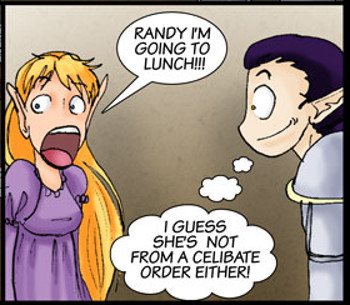
A rare day for Morf.

A rare day for Morf.

SPECIAL NOTES
Provoke – Just as Evoke lets you overcome negative emotional aspects from others, Provoke gains the ability to remove positive emotional aspects placed on other characters and on scenes.

Animals – If your setting includes a nature-themed skill (ex. Survival, Wilderness), Evoke cannot be used to deal mental stress to animals; instead, Survival/Wilderness gains the ability to deal mental stress to animals as if it were Evoke. Characters may still use Evoke to create aspects on animals as normal.

AN EXAMPLE

A great example of Evoke in popular media is the Sir Didymus scene in the Labyrinth. When attempting to cross a bridge, Sir Didymus stands in their way, refusing to let them pass. An attempt to fight him in hand-to-hand fails to remove him; however, it did succeed to winning his respect, and it did reveal more of his personality. He is not a bully hindering them out of spite, but an honor-bound knight.

This is where Evoke comes into play. Sarah politely asks him what the exact words of the oath he swore, to which he replies, “that none may pass without his permission.” Sarah then does what none have done before: ask for his permission. A confused Sir Didymus gladly grants it.

She overcame Sir Didymus because she appealed to what he cared about most: his honor. Fueled by her earnest love of her brother, she used a combination of logic and courtesy to weaken her opponent’s resistance. She used a positive interaction to remove an obstacle and, as a bonus, gain an ally.

EVOKE – STUNTS

I’m Good Enough, I’m Smart Enough, and Gosh-Darnit, People Like Me! – You may use Evoke to overcome negative emotional aspects placed on yourself. It may not be used to overcome consequences. Also, once per session, you may attempt to place a positive emotional aspect on yourself as you attempt to psych yourself up.

Laughter is the Best Medicine – You may use Evoke instead of Empathy when you are helping other characters to recover from mental consequences. You may not use it to heal yourself.

I’ll Play the Good Cop – If one of your teammates has successfully used Provoke or Intimidate this scene to deal mental stress to an enemy character, any of your successful Evoke attacks against that character deal an additional two mental stress.

Siren’s Call – Whenever one of your Evoke attacks takes an opponent out during a conflict, you have effectively hypnotized the target. After the conflict, you may make the character go to sleep, forget recent events, talk about anything, and/or carry out simple commands. However, the character will not do anything to harm themselves or others.

Love is Stronger – Whenever you use Evoke to create a positive aspect on a character or scene, and someone attempts to use Provoke to overcome it, you can use Evoke to actively oppose the roll.

Incurable Optimist – Your natural positivity is your best defense. When another character attacks you using Provoke or Intimidate, you may defend with Evoke instead of Will.

OTHER STUNTS

Remember that Place with the Thing? – Contacts – Whenever you use Contacts to create a character, you may use Contacts as if it were Evoke to deal positive mental stress to that character. This represents you weakening their resistance with stories about mutual friends and the good times you used to have.

Would I Lie to You? – Deceive – You may use Deceive as if it were Evoke to positive mental stress to a character. However, the target may defend with Will or with Empathy. Once they have successfully defended against one of your attacks (i.e. one of your attacks fails to either deal stress or to tie), that character gains the aspect “I See Through Your Lies.” While that aspect is on that character, you may not use Deceive to attack it.

Sympathetic Soul – Empathy – You listen more than talk, but when you do open your mouth, you know just what people want to hear. Once per scene, you may use Empathy as if it were Evoke for any action (ex. overcome a minor character, deal a positive mental attack, etc.)

Want for Nothing – Resources – You have everything that could make you happy. When an opponent uses Evoke to attack you, by attempting to bribe you with promises, you may defend with Resources instead of Will.

Iron Resolve – Will – Your ideals are unshakable. You gain +2 Will when defending against Evoke attacks.

Hate is Stronger – Provoke – Whenever you use Provoke to create a negative aspect on a character or scene, and someone attempts to use Evoke to overcome it, you can use Provoke to actively oppose the roll.

I’m Not a Pessimist, I’m a Realist – You don’t just induce negative emotions, you embody them. When another character attacks you using Evoke, you may defend with Provoke instead of Will.


That’s it for this week! Next week, I’ll be exploring Evoke some more, and possibly giving you more sneak-peeks of the Kickstarter launching month, Fate Accompli!
ASPECTS – CAN YOU PICTURE THAT?

Standard

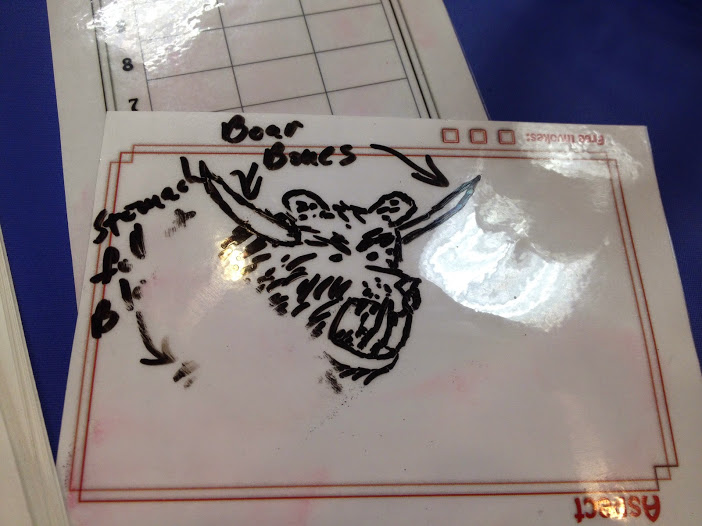
While thinking of a shameless way to write a blog about our company’s erasable notecards, which will soon be pre-sold on our kickstarter as “Fate Accompli” in July, I was reminded of one of my favorite playtests from GEN CON. We were playing our original FAE setting, “Dungeon Tours LTD,” which included the PCs creating a fake monster by stitching together random animals they had killed. The end result was a bear-boar-miscellaneous hybrid beast which they dubbed the Jeff. The name was all them, but I also asked them to draw the head of the dread Jeff.

the jeff

The Jeff. Fear it.

(Can’t remember the artist’s name, but if wants to come forth, I will be glad to credit him.)

In This Week’s Post: When I often introduce new players to FATE, I often tell them it’s a game of words. However, today we’re going to explore a new idea: using pictures! We’ll talk about the several ways you can use pictures along with or instead of words when creating your boosts and aspects, and in what ways they might enrich your game.

METHOD ONE – WORDS & PICTURES
One of the first ways you can use pictures alongside descriptive sentences; this is a redundancy, and thus has no immediate change on the game play, but it does have a few psychological benefits.

a. Sense of Play – Unless you are a professional artist, you’ve probably spent done more drawing and coloring in one year of elementary than you have in every post-elementary year since then combined. It’s no surprise then that drawing makes you feel young, and reminds you of idyllic art classes from days long ago. It’s a small thing, but it puts people in the right mind set- they’re ready to fire up their imagination and play games of make believe (which is really what RPGs are.)

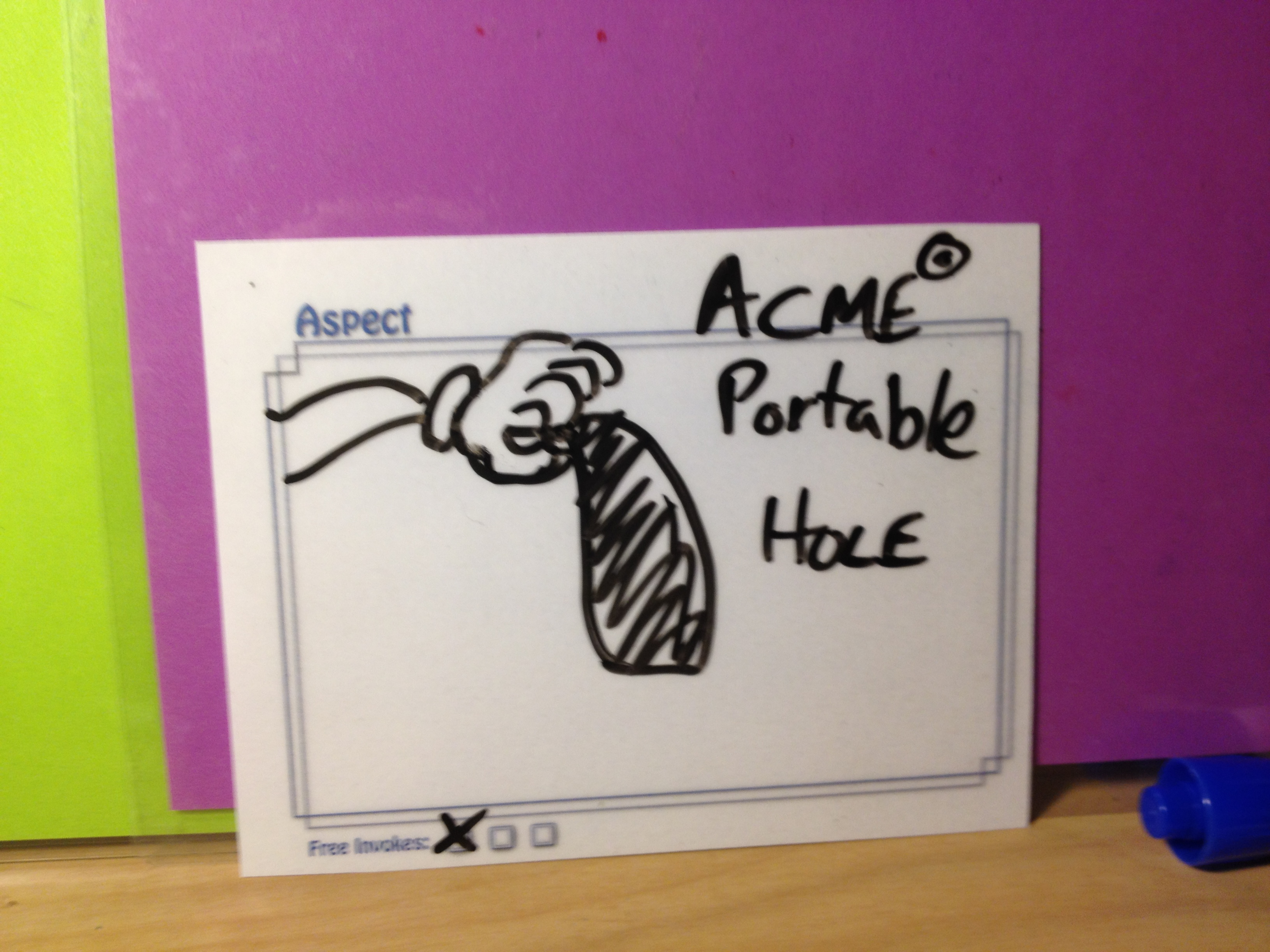
Toon Tested, Acme Approved

Toon Tested, Acme Approved

b. Genre Immersion – Depending on the setting, drawing also lets the players get in more in touch with the characters. “Dungeon Tours LTD,” as we mentioned above, is a game involving the PCs crafting objects. Likewise, any game which involves the PCs making something, like a cooking show contest or a creation god, the players are mirroring the creation of their characters, making the mental bond closure. Alternatively, drawing is also apt for any game setting typically associated with drawn visuals, such as a setting starring superheroes, anime characters, or loony cartoon characters.

METHOD TWO – PICTURES INSTEAD OF WORDS

As another option, you can have aspects represented by pictures, but with little or no words describing it. For example, you might have an aspect card with the written words “carving on wall,” but the only drawn indicators of what the glyph looks like.

I'm guessing Demon Cult, or Georgia O'Keeffe wannabes.

I’m guessing Demon Cult, or Georgia O’Keeffe wannabes.

Reason a. Mystery and Doubt – This is useful tool when a GM draws a clue for a group of players in a mystery setting. The image is intentionally vague, leaving players several hints, some of them contradictory. Like a Jackson Pollack painting, it might even be unclear which direction is up. Like a Rorschach test, the players might interpret it a hundred different ways. When asked to interpret an evil symbol, they might make wild theories about cults devoted to octopus gods, snakes, pasta monsters, or things you’d never have come up with. If one of their random ideas is better than the one you had, go ahead and change it! *

*Note: If a player is getting frustrated, don’t make the player depend solely on their own wits. Let them roll on their character’s skills (ex. Lore, Academics, Mythos); if successful, you can give the players hints about how the clue might resemble things the character has encountered before.

Reason B. Deliberate Misinterpretation – If a player is trying to create an aspect to reflect something that their character has made well, give them a chance to draw a picture to represent it in all of its glory (if they don’t fancy themselves an artist, imagination can take care of the rest.) However, if their character fails the roll, and creates something half-baked, you can use the player’s drawing to inspire how the malformed creation: this can be done by restricting them in some way, like forcing them to draw with their opposite hand or giving a only a few seconds to work. Thus, any mistakes they make might inspire the final aspect, like an illusionary double that’s basically a smiley face, or a summoned demon that has two arms but no legs.*

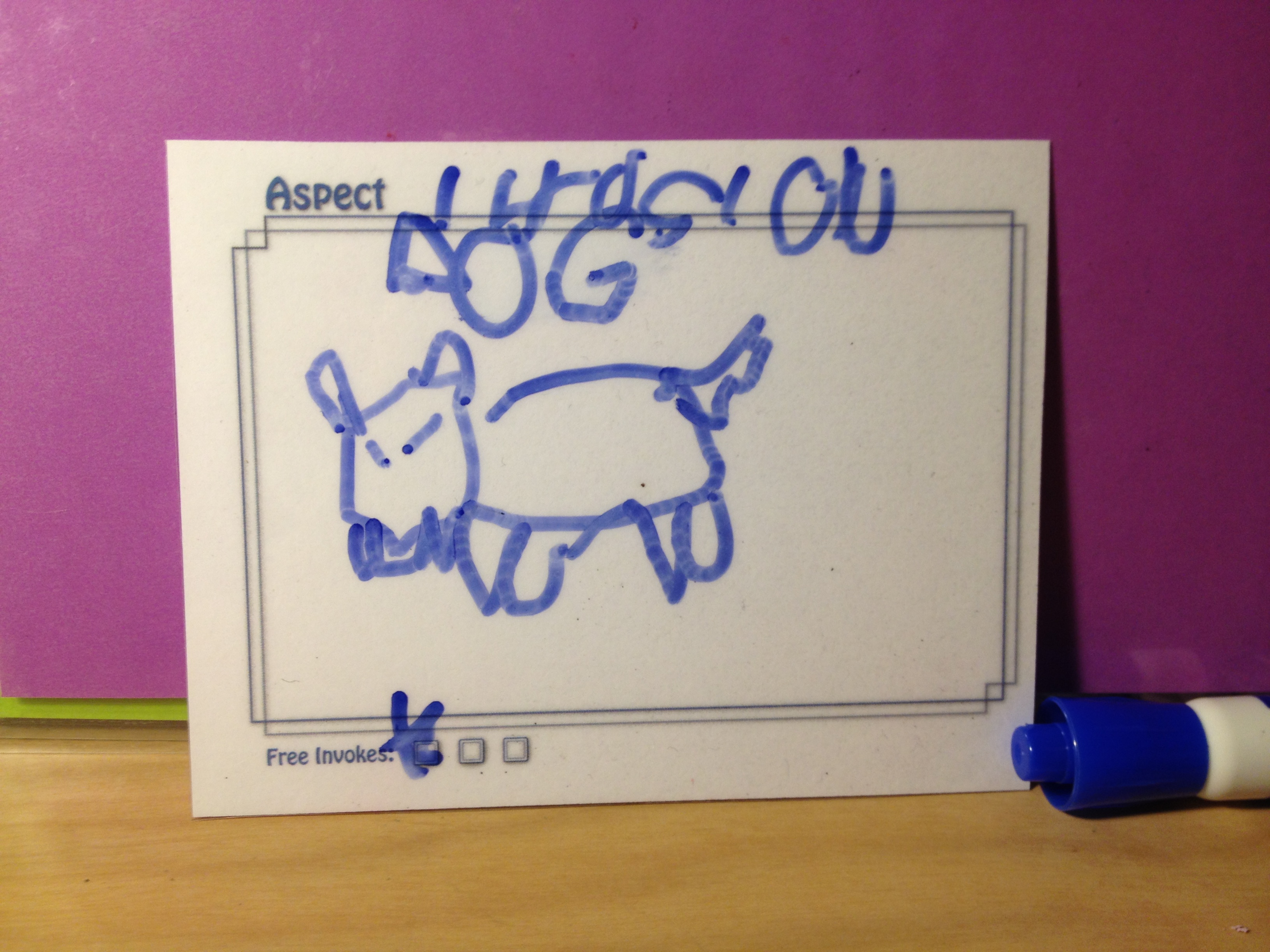
Of course that's a dog. Shut up.

Of course that’s a dog. Shut up.

*Laugh at vs. Laughing with- Adding art to aspects can also result in some comically bad drawings; however, you should always be careful about laughing at the art of others, especially people you don’t know very well. If in doubt, only laugh at art you made yourself.

METHOD THREE – MECHANICAL PICTURES

Lastly, it’s possible to have a picture that is not just pretty, but also functional- this normally gets into the pictographic territory, as there is something numeric that is also conveyed in the image. Here are a few things you might convey:

a. Invokes – An easy thing to keep track visually is invokes,

With all the talk of Rorschach, we had to slip in some pretty flowers.

With all the talk of Rorschach, we had to slip in some pretty flowers.

particularly in that they seldom do over a large number. I would recommend one image for the aspect, and a separate image to represent the invokes (ex. Drawing a gun, and using invokes as bullets), or representing an aspect as a white flower with the invokes as dark flowers.

b. Stress – You could have each player draw stress as images (ex. hearts) and erase them as they take stress. Alternatively, you can have it the other way around, with a healthy character drawing stress gaining pictures to represent stress they suffer. (For a variant, see the “Hangman Stress” below).

STRESS VARIANT – HANGMAN STRESS

Rules: All PCs get a single stress track of six points, each absorbing one stress. There are no mild consequences. Stress is measured not in tally marks, but in body parts: head, torso, right leg, left leg, right arm, and left arm, similar to the kid’s game, Hangman. Whenever a pc takes a stress point, they draw

Stayin' alive, stayin' alive.

Stayin’ alive, stayin’ alive.

a body part onto their tracker. You can pick which part arbitrarily, but it is best done through the fiction- if you take damage from a rock falling on your head, it makes sense to fill out the head. If an opponent attacks you and succeeds with style, instead of gaining a boost, draw an indicator on the wounded body (ex. An arrow sticking out of a body), which counts as an invoke. While there is an invoke on a body part, treat it as an aspect that can be invoked. Ex. Quince the barbarian has an arrow sticking out of his arm. The vicious orc attacking him in combat could invoke the arrow, removing it (and making the aspect disappear.) Instead, he decides to spend a fate point to invoke the hurt arm, saving the free invoke for a future exchange.

When a character has the fully drawn body and suffers stress, they are removed from the combat.

Lower / Higher Stress – If six is too high, consider making the head and torso one piece, or giving the character a “V” as a pair of legs. For higher stress, find a finite number of other body parts to add on (ex. A tough dwarf drawing on a beard.)


CON NEWS!

This Sat & Sun, Tangent Artists will be at Tidewater Comic Convention in Virginia Beach! Drop by to buy a one-sided die, playtest a game, or just say hello! Say that you’re a proud Tangerine, and get a gift prize!

SKELETON CREW – FRIGHT AT THE MUSEUM

Standard

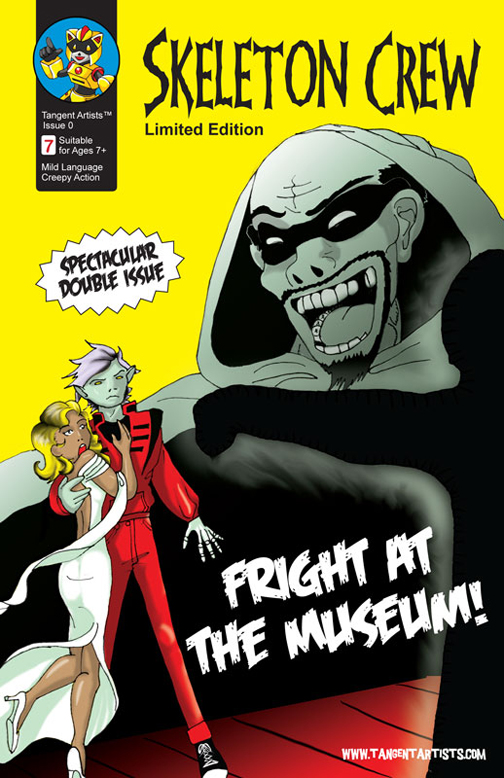
Last week, we gave out a slew of pre-made characters. This

You'll jump! You'll swoon!  You'll demand to see the manager!

You’ll jump! You’ll swoon! You’ll demand to see the manager!

week, we’re going to give you a full adventure to run. This one was inspired by the first Skeleton Crew comic we ever wrote (if you’re a player, no peeking, as there are spoilers!) I’ve used it at many conventions, it can generally be run in a little over 2 hours. Enjoy!


SKELETON CREW – FRIGHT AT THE MUSEUM

This is a Skeleton Crew RPG pickup game, designed for 2-6 players. The PCs start with 20 points of skill, with a cap of Great (+4). While some of the skills and aspects are provided for the players, Fate is a very much a “make it your own” kind of game, so we have left some parts blank. For filling in aspects, the GM will start the game by asking a few questions, to see about the character motivations and connections. Any open skills or aspects can be filled out before the game, after it starts, or even near the end. GMs are encouraged to let players switch out skills, even mid-game, and not to worry too much about the retroactive changes. Reminder: if they decide to gain more Physique or Will, it will give them extra Physical Stress or Mental Stress. Keep this in mind.

THE SET-UP

Read aloud: You’re New Manchester’s premier team of Monster Hunters and paranormal investigators. You have tangled with plenty of underworld criminals, and have made many enemies, but you’ve also recruited a handful of allies. One of them, known as the Nosy Shadow, just heard that the necromancer Deadringer is hitting the Schmitzonian Museum of Natural History tonight. You head there as fast as you can, hoping you can beat him there.

As you pull up to the Schmitzonian Mall, you recognize the building- it’s the one with the giant banners advertising their touring exhibit, “The Mummy of Amon-Khee-Sunkhel.”deadringer comical scared

As the crewmates pull in closer, they see the skinny Deadringer at a broken window, slipping himself through. He sees you coming up, curses to himself, “Oh, fudge me!” and climbs through awkwardly.

POTENTIAL PCS

For a list of pre-made PCs, see last week’s blog post. If you want to reverse the gender of any of them, go ahead- Shelley can easily become “Sheldon” or “Percy”. It’s your game!

PRE-GAME QUESTIONS

TEAM ASPECT – Your Team aspect is “Monster Hunters”

The GM should ask the players the following questions- these will help shape their aspects and relationships for the upcoming game. If the same player tries to answer more than one or two, make sure you allow other players a chance to answer some.

  • Best Mate – You (A) consider another character your best mate in the whole world- you have saved each other’s necks so often you’ve lost track. Character B – write an aspect describing your strong feelings towards A (love, trust, disgust, etc.)
  • Former Enemy – You (Character A) find yourself on a team with a former enemy (Character B.) Write your feelings towards this character. Do you trust ‘em? Character B: do you mistrust A back? Is there an ulterior motive behind your cooperation?
  • Superiority Complex – You (Character A) consider character B to be your biggest rival- according to you, B thinks he’s SOOO much better than you, and you’ll do anything to prove that you’re the best. Character B: Is A your rival too? Do you feel like A is better than you, and you likewise have to prove your worth? Do you actually feel superior, but don’t feel the need to prove it?
  • Love in the Air– You (Character A) are head over heels in love with character B. Character B: write an aspect showing your acceptance of this love, or your knowledge / lack of knowledge about it.
  • Ulterior Motive – You (Character A) secretly or overtly want something that only Character B can give. Does B know information about a secret treasure? Does B have an ancient artifact that you’re eager to pull from their dead fingers? Character B: Do you know of A’s objective, or do you only have vague hints?
  • Love Gone Sour – You (Character A) used to be in a romantic relationship with Character B, before it crumbled; OR, Character A had a relationship that was disrupted, thanks to Character B. Write your an aspect reflecting your interpretation of the events.
  • Like a Son / Daughter– Between you (Character A) and Character B, there is a paternal / maternal bond. Pick which is the father/mother figure, and which is the son/daughter figure (age might be a good indication.)

Team Chemistry -The Chemistry aspect describes how the group members view each other. If you want, this can explain hint at a mutually shared past. Here’s a few examples:

  • Trusted: Band of Brothers / Old War Buddies
  • Familial:  Childhood Friends / Test Tube Experiment Siblings
  • Awkward: Thrown Together / Distant Co-workers / Amateurs & Old Pros
  • Competitive:  Confederacy of Rivals / Enemy of My Enemy is My Friend
  • Hostile: Every Man for Himself / If We Get Chased, I’m Tripping You

Note: For 2 hour games, this section can be skipped. If so, here’s a recommended pre-made Team:

Team Name: Skeleton Crew

Team Concept: Monster Hunters

Team Chemistry: Second Family – Love & Brotherly Hate

The following section contains spoilers of what’s ahead, and should be viewed by the GM Only – players, back off!


“Fright” Story Structure:

  • Act 1 – The Foyer / Vampanzees Attack!
  • Act 2 – The Hall of Sharp Pointy Objects / The Orb of Kao!
  • Act 3 – The (Empty) Mummy Exhibit
  • Act 4 – The Dinosaur Exhibit / Rex Awakens!

ACT 1 The Foyer

End Goal:

  • Story: Players are to dispatch or placate the vampanzees
  • OOC: Players are to become accustomed to rpgs (turns, skills, declaring actions,) and Fate system (combat, aspects, stunt & invokes). If possible, also introduce compels and consequences.

Players should enter the building after Deadringer- common ways include climbing in through the window (athletics) or breaking down the solid door (physique).

The first room is the main hall of the museum.

Once you get in, you see Deadringer at the other end of the hall, about to slip into the first exhibit.

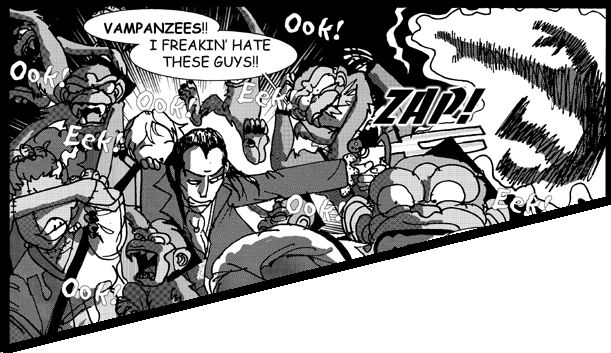
I’m going to get the mummy. If you have a problem with that, you can talk about it to- my army of vampanzees!”

Deadringer pulls back his cloak an reveals a cluster (hardly an army), of vampanzees- namely, vampire chimps, complete with tiny fangs and short black capes.

vampan hate

At this point, players should brainstorm what the main hall is like. I recommend a large Woolly Mammoth model in the center of the room. Other ideas could include a gift shop, an info kiosk, fire extinguishers, lighting fixtures, etc.

Vampanzees – Mob
High Concept – Vampire Chimps
Aspects: Overly Curious; Bouncy Little Bastiches; Fight or Flight
Skills : Fair (+1) rating in Athletics.
Stunt: Clamber – If a Vampanzee is in a mob of 2 or more Vampanzees, it can make Attacks with Athletics. (If NOT in a Mob, it will generally join another mob or run away!)
Stress: No shift boxes— one shift of harm is enough to take them out.
(Note: The number of vampanzees are handled like mobs- each one is weak as heck, but add up to a threat if not divided. There are is a mob of 3 per character.)

Alternatively: Have only 2 vampanzees (which will be weak,) but invoke their aspects a lot- this will demonstrate the players how invoking works. 

Initiate Combat – Roll for Notice (Reminder: Zomboy & Caomh have stunts that give them order bonuses).

Determine the objectives & stakes: Vampanzees, for their part, want to scratch you, drink your blood, and maybe eat a few fingers, until they’d grow bored with your bodies.

Phase 0: I recommend you institute Phase 0, especially with a new group. One the first exchange, characters are not allowed to make Attacks- instead, they can only Create Advantages or Overcome.

Possible Compels to consider: Vampanzees are very curious. Weston has trouble with Light. Amon-anda might has trouble is the Vamps act in a particularly nasty way.

Once the vampanzees are cleared, players can follow Deadringer down the hall.

ACT 2 – The Hall of Sharp Pointy Things

End Goals:

  • IC: Characters reach the end of the hall, which is best achieved by disabling the Orb of Kao.
  • OOC: Characters have experience with a non-combat obstacle, and test out a Challenge.

(Note: In a Short, 2 Hour session, this section is less necessary to the plot- the number of successes can be reduced as time dictates.)

As you leave the main hall, you get a closer look at the exhibit Deadringer escaped through: “The Hall of Sharp Pointy Objects.” It seems a poorly thought out exhibit, with display items ranging from historical, like ancestral knives and spears, to mundane and random, like bent pipes and jagged rocks. Really, someone should be fired for this.

At the end of the hall, you see Deadringer place a large black crystal ball on the floor. He rushes out the door, and the orb starts emitting a thick smoke. The smoke seems to coalesce into spectral hands, which start reaching out and feeling the objects around them. There is also a high-pitched melody emitting from the orb, like the lullaby from a music box.

Any attempts to approach the orb will result in the hands grabbing random sharp objects and throwing them in the character’s direction. I recommend one free “jump back” into the safety of the doorway, giving the characters time to plan their approach.

Orb of Kao – Challenge

High Concept: Crystal Music Box of Doom

Experts will recognize the sphere as the Orb of Kao, a soul catcher from Ancient Egypt (they’re pretty rare, which makes the fact that Deadringer found one a little surprising.) It protects itself with ghost hands, and plays a haunting melody that hypnotizes anyone close enough to hear it.
Aspects: Egyptian automated sentry; Souls trapped inside; Made of hard glass

Challenge parts:
1. Dodge the Attacks- Recommended Difficulty – 2. Recommended Skills: Athletics
2. Avoid the Siren’s Call – Recommended Difficulty – 4. Recommended Skills: Will
3. Crush the Sphere – Recommended Difficulty – 6. Recommended Skills: Physique.

Taking Turns: Each challenge should be tackled by one character at a time.

1-3 Characters: You may have one character attempt all three challenges (as they run the gauntlet), or may have characters tag in. You may also consider lowering the difficulty of the later challenges by one or two points.

4+ Characters: We encourage each challenge be tackled by a different character, as they divert one part of the orb’s defenses, letting the next character tag in. If having over 6+ characters, considering raising the difficulty of the lower level challenges by one or two points, or consider adding a fourth challenge.

Extra characters: Any character that is not tackling a challenge may do ONE following:

> Make one attempt to use create an advantage to create an aspect.

> May use the teamwork rule to add +1 to any skill rolls, provided they are at least Average (+1)in it.

Special Rules:
Black Smoke – Any attempts to attack the orb from the Hall entrance without first doing challenges 1 & 2 will be blocked by thick smoke, but a shooter may assist with other attacks (by adding +1 through teamwork or by creating aspects), or may shoot it if that character or other have already beaten challenges 1 & 2 (ex. a character getting close enough to shoot it at close range, or throw it out of the fog)

Outside the box: If players want to attempt to get the orb some other way, go for it- just write up a 2-4 part challenge for them to overcome. One group used a hypnotized Vampanzee to run the gauntlet, after using illusion powers to convince it that the orb was a banana.

Failure: If a character fails to overcome challenge one or two, don’t forget that they can succeed at a cost- this might mean they stumble through a challenge, but have some negative boosts, aspects or consequences to hinder them the next challenge or scene.

Victory: If the orb is destroyed or overcome, the characters can safely go to the next room. There is also a “broken orb” aspect which the players can exploit.

Act 3 – The (Empty) Mummy Exhibit

End Goals:

  • IC: Players realize that the mummy remains undisturbed, and that Deadringer is casting something in the next hall.
  • OOC: Nothing major. If players want to prep themselves, allow each player a chance to prep once.

You run into the exhibit of Amon-Khee-Sunkhel, and find it- strangely quiet. At first glance, it appears that nothing is disturbed.

When the players get tired of searching, lead them to the next room. Any magic users may wish to pilfer the exhibit for talismans of mild power. Characters can also steal prop weapons or search for ancient weapons.

Act 4 – The Dinosaur Exhibit / Rex Awakens!

End Goals:

  • IC: Defeat or subdue Deadringer and the Skelesaurus.
  • OOC: Players become familiar with Consequences, and fighting a character with multiple stress boxes. Against the T-Rex, players will hopefully see that stacking up Advantages is a good strategy for muscling through its tough hide.

You follow the (trail of magic / smell / maniacal giggling) to the next exhibit. It’s marked: “Mesozoic Marvels: In the Time of the Dinosaurs!” As soon as you come in, you can feel the crackle of ozone in the air. In the corners of the room are four mismatched candles, with hastily squiggled chalk circles. In the rear of the chamber, Deadringer has sprayed a chalk circle around the massive Stegosaurus skeleton.

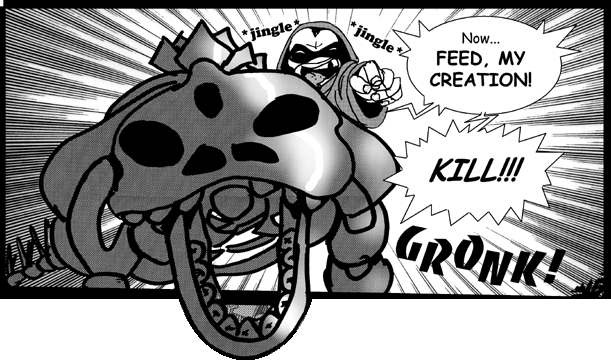
Aha! So, you know, I was going to resurrect the mummy, and then I saw the dinosaur exhibit, and then I thought, ‘That’d be a great idea,’ and then I was like, ‘I don’t know… it’s late, Deadringer, and you always make bad decisions when it’s late,’ and- well, to make a long story short, taste my Skelesaurus!”

dinosaur feast kill

Cue a Conflict.

Stakes: Deadringer- if he succeeds, he & the dinosaur break into the night to wreak havoc on New Manchester.

Once more, ask the players what’s in the room, and Roll for turn order.

Phase 0 –If you’re doing another phase 0 (no attacks), during Deadringer’s phase 0, he does the following:

Deadringer raises his Doom Bell and starts to cackle maniacally. “You think that stegi’s the only dinosaur I’ve prepared? Face the terror of my fleet-feeted- my fleet flooted –Oh, to heck with it. Arise Velociraptors!”

From the room arise half a dozen velociraptors, each a staggering… two feet tall.

Oh, Poo, they look bigger in the movie.”

The raptors run around the floor, nibbling on everything and getting underfoot. At the moment, they’re directed at you, but given time, they’ll likely get in EVERYONE’S way.

The raptors are an Aspect that cause an obstacle when moving from zone to zone (recommend Difficulty 2). Deadringer has a free invoke on the raptors, but any player can invoke it. Once a player has overcome the raptors, they won’t bother that player again for the rest of the scene. Players may also attempt to dispel or whoop the raptors completely (recommend Difficulty 4).

Skelesaurus Dinosaur – NPC
High Concept: Terrifying Undead Skeletal Stegasaurus
Aspects: Massive spiked tail; Don’t make it mad; Vegan at heart.

Skills:
+5 Physique & Fight (With 5+ players, make it +6)
+4 Intimidate, Wilderness
+3 Will, Notice

Stunts:
Stand & Take It – Skelesaurus can use Physique to defend against Shooting attacks
Monster – Skele gains +3 from Invokes instead of +2.

Deadringer – NPC
High Concept: Skinny little Necromancer
Aspects: Derives Power from the Doombell; Kind of a Weenie; Vengeful

Skills:
+5 Shooting (Death Magic)
+4 Athletics, Mythos
+3 Sixth Sense, Deceit, Notice, Intimidate, Will

Stunts:
Necromaniac: As long as he has his Doombell, Deadringer can create advantages themed on blood, spirits, bones, shadow, or anything else. These summoned forms can be invoked to help him as normal.
Slippery Devil – Deadringer gets +2 to Athletics when using Overcome to avoid being pinned down or held.

Fate Skill Hack: Zero Tolerance

Standard

Last week I introduced idea of the Zero Sum skills (nutshell version: having all skills paired up, with a set total sum.) Sadly, I didn’t really get a chance to analyze them, and discuss when to use them.

Before that, a shameless plug:


I'm the tin dog...

I’m the tin dog…

Tangent Artists is going to (Re)Generation Who this weekend, the brand new Doctor Who convention not far from Baltimore, Md. Come check it out!


First, let us take a look at the existing Fate Skills and Approaches.

FATE ACCELERATED
Number of Skills (Approaches) to pick from: 6
Skill Cap: 3
Pyramid Spread: one 3, two 2, two 1, one 0.
Total Skill points: 9
Average Skill Strength: 1.8
Number of skills at 1+: 5
Percentage of all possible skills with at least 1+: 83%
Percentage of all possible skills above average: 50%

FATE CORE
Number of Skills to pick from: 18
Skill Cap: 4
Pyramid Spread: one 4, two 3, three 2, four 1, eight 0.
Total Skill points: 20
Average Skill Strength: 2
Number of skills at 1+: 10
Percentage of all possible skills with at least 1+: 55%*
Percentage of all possible skills above average: 16%

*Note from the Editor: In the Fate Codex ezine by Magpie Games, Ryan Macklin wrote an article advocating that 55% was the perfect skill percentage. I recommend you look it up: Fate Codex, Volume 1, Issue 2, under “Changing Skills: A Matter of Survival.”

And thus, we see, how the Fate Zero Sum stacks up.

FATE ZERO SUM: DOCTOR WHO HACK (The one from last week)
Number of Skills to pick from: 8
Skill Cap: 4
Pyramid Spread: one 4, two 3, two 2, two 1, one 0.
Total Skill points: 16
Average Skill Strength: 2
Number of skills at 1+: 7
Percentage of all possible skills with at least 1+: 87.5%
Percentage of all possible skills above average: 37.5%

Comparison to Fate Accelerated: As you can see, Fate Zero has a wider range of skills to choose from, but a higher percentage of skills at +1. Fate Zero caps at 4 instead of 3, meaning that there’s a greater difference between your top skill and the average mook’s skill rating.

Comparison to Fate Core: Zero Sum has a much skinnier pyramid- as such, you feel less like a “jack of all trades” and more of an expert in a specific field; characters still skilled, but less versatile. This also means that there is more variation in your dice rolls- you have as many skills as +3 as you have at +1, making +2 a mathematical average, but not the actual number you’ll be consistently adding.


SLIDING THE RULER

Of course, that’s based entire on using the Doctor Who hack, with each skill pair equaling 4 and with 8 skills. Let’s play around and see what we get:

ZERO SUM: FOUR SKILLS
Prototype Skill names: Thought, Feeling, Intuition, Sensation
Number of Skills to pick from: 4
Skill Cap: 3
Pyramid Spread: one 3, one 2, one 1, one 0.
Total Skill points: 6
Average Skill Strength: 1.5
Number of skills at 1+: 3
Percentage of all possible skills with at least 1+: 75%
Percentage of all possible skills above average: 50%

ZERO SUM: SIXTEEN SKILLS
Prototype Skill names: Too Many!
Number of Skills to pick from: 16
Skill Cap: 4
Pyramid Spread: Several Options:
a. two 4, three 3, six 2, three 1, two 0.
b. two 4, four 3, four 2, four 1, two 0.
c. three 4, four 3, five 2, four 1, three 0.
Total Skill points: 32
Average Skill Strength: 2
Number of skills at 1+: For each Pyramid Option
A & B. 14
c. 13
Percentage of all possible skills with at least 1+:
A & B. 87.5%
c. 81.25%
Percentage of all possible skills above average:
a. 31.25%
b. 37.5%
c. 43.75%

In the effort of pushing something to the breaking point (or past it), let’s see what happens with a zero sum with 16 skills, only this time each Skill Pair is set at 5, with a skill cap of 5!

ZERO SUM: SIXTEEN SKILLS –FIVE POINTS, FIVE CAP
Prototype Skill names: Too Many! Aaaaaargh!
Number of Skills to pick from: 16
Skill Cap: 5
Pyramid Spread: One five, three 4, four 3, four 2, three 1, one 0.
Total Skill points: 40
Average Skill Strength: 2.5
Number of skills at 1+: 15
Percentage of all possible skills with at least 1+: 93%
Percentage of all possible skills above average: 50%
This might seem a bit power-mad at first glance; compared to Fate Core default characters, you have 4x the number of 4+ skills. However, it’s not far from Atomic Robo, which can result in characters with two or three skills at 5+, and four or five skills at 4+. This might be ideal if you plan on using a Fate Ladder with a base of 10 or 12.

Also, things get more interesting if you add the possibility of negative numbers into the mix. Let’s see that last one, but with the sum of every pair still equaling 4.

ZERO SUM: SIXTEEN SKILLS –FIVE POINTS, FIVE CAP + NEGATIVES
Prototype Skill names: Too Many! Aaaaaargh!
Number of Skills to pick from: 16
Skill Cap: 5
Pyramid Spread: One five, three 4, three 3, two 2, three 1, three 0, one -1.
Total Skill points: 32 (33-1).
Average Skill Strength: 2
Number of skills at 1+: 12
Percentage of all possible skills with at least 1+: 75%
Percentage of all possible skills above average: 43%

Thus, we see how a few negatives can potentially stem the range of skills that your heroes are good at. Imagine the original Doctor Who hack with each pair adding up to 3 instead of 4; you would have PCs that have less power and more breadth (although, if you wanted that, you could just use the default FAE or FATE list.)


So, I’ve thrown a bunch of numbers at you, but I still haven’t answered the BIG question:

WHY USE SKILL PAIRS / ZERO SUM SKILLS?

An excellent question. Here are a few ways in which it might be useful:

Fast character creation: Because two skills are linked together, picking one automatically picks the value of the other. This means you could have players pick 16 skills in the time it takes to pick 8. If you want to use a very lose skill pyramid (ex. Can only have one skill at 4), this makes the skill process even faster, as players don’t have to constantly consult a chart- they can just go to town adding points where they want. I’m tempted to try this at a convention some time, and let players build their characters. Likewise, it lets you create a NPCs with the same strength as the players in no time, in case you need to pull a new character out of your hat.

Separate but Equal Philosophies: Even if you are not using the Zero-Sum angle, I would recommend building your skills in pairs- that way, you are guaranteed that all characters have as equal chance of being effective in a scene, even if they have completely different philosophy; not every conflict should be won by the most aggressive PCs. In Fate Core, Fight and Shoot are perfect opposites- one involves directly getting into the fray, the other deals with indirect combat. In a social conflict, Provoke can be used to deal mental stress, however it doesn’t have a non-aggressive opposite; personally, I would alter Rapport into “Evoke”, and add the ability to add mental “stress.” If evoke/rapport is used to take an opponent out of a conflict, it represents the target being convinced to agree with you, while any consequences might represent any feelings they have for you that might linger into later scenes.

A World Divided: If your campaign focuses on two opposing worlds, you could have each pair have one skill attached to each “side.” For example, a Star Wars campaign with each pair having a Light side and a Dark side; a setting in Revolutionary France, with each skill having a “common” skill and a “noble” skill.


I had originally planned to cover the Impossible to beat threats and how to scheme against them, but looks like we ran out of room. Next week: To Scheme the Impossible Scheme!

FATE HACKS: ZERO SUM SKILLS and DOCTOR WHO

Standard

This week’s entry will cover roleplaying games in general, and end with a Doctor Who hack for Fate; but I want to start with a tangent:

doctor10a_water_original

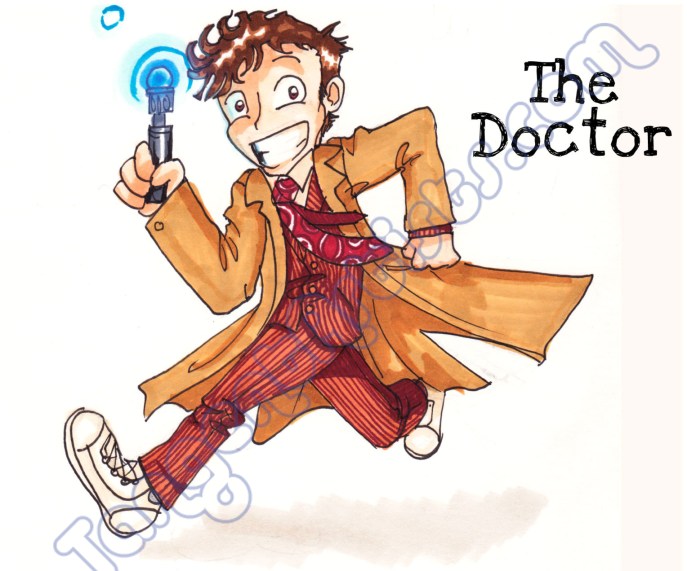
Art by Monica Marier, used with her permission. Tangent Artists claims no right to Doctor Who, or any of the other billion BBC owned characters.


I love Magic the Gathering.  I don’t play all that much (it’s hard to find opponents when you’re a goofy, casual player and all of your friends are busy,) but I love the symmetry of the color pie.

Each faction has their own place in the chart, but the placement is not arbitrary. With any color, the two neighboring colors compliment it, and have some overlapping strengths. What’s more, the opposite colors have diametrically opposed abilities, and even better still, opposed philosophies.

I thought of this when I started working on Masters of Umdaar: I noticed that the different approaches, by accident or design (I’m betting the latter), had natural opposites. For example, the “Flashy” approach, all about drawing attention to yourself, is the exact opposite of the “Sneaky” approach. I don’t want to take any of the steam out of Umdaar when ii publishes, so I’ll leave the rest a surprise.

Instead, let’s see if we can find any in Fate Core. Here’s a few that jump out at me:

  • Athletics – your ability to move – is the opposite of Physique – the ability to resist being moved by others
  • Contacts – your knowledge of living people and your connections to them vs. Lore – your ability to find information on your own, from the present or past.
  • Deceive – the ability to cheat people and mimic real feelings –  vs. Empathy – the ability to emotionally help people and detect the real feelings of others.
  • Fight – to deal damage up close and personally through direct contact vs. Shoot – to deal damage indirectly without close contact.

Of course, some of the Fate Core skills don’t have an opposite- for this reason, I think a few skills could be added or tweaked, but we’ll get into that during another post.

Today, I’m going to use the idea of opposite skills to experiment with something else: ZERO SUM SKILLS.

ZERO SUM SKILLS

Zero Sum Skills would work like this: imagine you all of your skills in your hacks are arranged into opposing skill pairs. For the first example, we’ll use Jung’s Four personality Types: Sensing vs. Intuition, and Feeling vs Thinking.

  • Sensing vs. Intuition – Jung defined these as two opposing ways to receive information and ideas.
  • Sensing individuals prefer using touch, taste, sight, smell, and the other concrete senses. They deal with outside stimuli, and live in the present.
  • Intuitive individuals gather stimuli from less tangible ways. This include through “sixth sense” premonitions about the future, or fanciful images of imagination and dream. Intuitive individuals respond mostly to internal stimuli, and often focus on the past or future.

Now, let’s turn those two into Skills, and build a character. This character has a limited number of points to spend between these two opposite skills; how about 4 points?

If the character is very intuitive, maybe a Psychic, you could add +4 points to Intuition, with Sense +0. Likewise, if the character is better at physical clues, such as a Detective, you could add +4 points to Sense, giving you an Intuition of 0.

4 3 2 1 0 1 2 3 4
Sense x x x x Intuition

However, you might not want a character that’s entirely one or the other: how about a Detective that’s deals with facts, but also knows that sometimes you have to trust your gut?

4 3 2 1 0 1 2 3 4
Sense X X X x Intuition


Thus, you get a Detective with Sense +3, and Intuition +1. Alternatively, you could have it be an even split, with +2 in each.

Now, to test this further, I needed a Fate skill list that wasn’t FAE, and was shorter than the Fate Core list. So, I decided to think of a new game setting that I could test it out with.

Now, I know what you’re thinking:

FINALLY, HE GOT TO THE “DOCTOR WHO!”

In honor of the debut (Re)Generation Who Convention in Rockville MD on March 27th, I’ve put together this hack:

HOW TO PLAY

You’ll use the following skills to create your character: you can make an original character, recreate your favorite companion, or even play as one of the incarnations of the Doctor (there’s lots of precedence for having several in one place.)

Look over the skills pairs below: you will pick one to be at 4, and the opposite skill at 0. You will pick two skills to be at +3, making those two opposite skills be +1. The last skill will be split evenly, giving you +2 in each.

Thus, the skill tree will look like this:

  • +4 – one
  • +3 – two
  • +2 – two
  • +1 – one
  • +0 – one

Here are our skill pairs, which we divided into Physical and Emotional (more details on the breakdown later.)

Physical:

  • Brains vs. Instinct
  • Scrap vs. Scamper

Emotional:

  • Evoke vs. Provoke
  • Purity vs. Deviousness

PHYSICAL SKILLS – Interaction with the physical world

Brains vs Instinct – Because you can’t have a Doctor Who setting without letting people show their braininess.

Brain – Includes: book-smarts; ability to research facts quickly; formulating plans; pulling from experience. Actions: overcome, create an advantage. Cannot be used to attack or defend (without stunts).
Pro-Brain Characters: The Doctor; Martha; The Great Intelligence; The Master
Stunts:
Time Lord 101
– The master gains to +2 Brain when creating an adventure related to knowing information about science or history.
Cyber-brain – Cybermen are beings of logic, not emotion. They can use Brains instead of Purity when defending against Mental attacks.

Instinct – Includes: reacting quickly to danger; acting without a plan; making knee jerk decisions; dumb luck. Actions: overcome, create an advantage. Cannot be used to attack or defend (without stunts).
Special Rules: Reflexes – Instinct can be used to defend against surprise attacks and traps. Generally, can only be used once per scene.
Special Rules: Initiative – When rolling for turn order in conflicts, add your Instinct to the roll.
Pro-Instinct Characters: Donna; Wilfred; Weeping Angels
Stunts:
Doctor Donna
– Once per session, Donna may use Instinct as Brain for all actions for the rest of the scene. However, after the scene, Donna immediately takes a Consequence.

Scrap vs. Scamper – Scrap vs. Scamper – With many settings, I wouldn’t put the opposite of “physical attacks” as “scamper,” but there are soooo many Doctor Who characters that aren’t fighters (sometimes not even MENTAL fighters) and who spend most of their episodes simply running away.

Scrap – ability to deal damage in a fight; the ability to defend against damage; the ability to destroy obstacles; the ability to bounce back when physically hurt. Actions: Overcome, Create an Advantage, Attack, Defend (physical).
Pro-Scrap Characters: Captain Jack; Soltari; Daleks
Stunts:
Ex-termi-nate – If a Dalek has one or more allied Daleks with it, it gains +2 Scrap when attacking, provided it loudly yells out “Ex-termi-nate” first.
Jack’s Dead Again – Captain Jack can never REALLY die. If Jack is killed, he is merely taken out of the scene. At the start of the next scene, roll 4dF and add his Scrap- if the result is 2 or more, he is returned from the dead, with all stress and physical consequences removed. If the roll is failed, he is still dead until the start of the next scene, when he can try again (don’t worry about dragging his body around, he’ll just magically show up.)

Scamper – athletic ability; dodging attacks and opponents; sneaking around; staying out of danger. Actions: Overcome, Create an Advantage, Defend (physical). Cannot be used to attack (without stunts).
Pro-Scamper Characters: Rose, Sarah Jane, Lady Christina de Souza
Stunts:
“Low” Priority – If Susan encounters an opponent and successfully uses Scamper to defend against a physical attack, she immediately gains an aspect with a free invoke regarding how the villains overlook her. She only receives this aspect once per scene, and only if she has allies in the same scene with her.

EMOTIONAL SKILLS– Interaction with the social and mental world

Evoke vs. Provoke – Evoke vs. Provoke – Fate Core includes the skill provoke, which allows characters to draw out the negative emotions of others. It only makes sense that there is an opposite skill (although, I think I’ll save that for a further discussion.)

Evoke – inspire positive feelings in others; make friends; seduce; draw attention to yourself; heal the mental consequences of others. Actions: overcome, create an advantage. In social conflicts, it may sometimes be used to “attack” (ex. when convincing someone to ally with you.) It cannot be used to defend.
Pro-Evoke Characters – Rory, Rose
Stunts:
I’m a Nurse – Rory can use Evoke to help heal the physical consequences of others as well as mental consequences.
Last Chance – Doctor – Once per scene, if lives are threatened, the Doctor can use Evoke as if it were Provoke to make a threat (mental attack) against hostile beings.

Provoke – bring out the negative emotions of others; conquering others through fear. Actions: overcome, create an advantage. It can also be used to attack, but this is often limited to social conflicts.
Pro-Provoke Characters – Amy, Daleks, Peri
Stunts:
Harbingers of Hate –
When Daleks successfully use Provoke and deal 2 or more stress, the first 2 stress must to taken by a Minor Consequence, if possible.

Purity vs. Deviousness –  I’m not 100% happy with the names on this one, but I think it works. (and again, stresses the importance of purity in Doctor Who.)

Purity – your resolve; your honesty, and ability to convince others in your sincerity; your ability to recognize when others are being honest with you others; your ability to keep your resolve and convictions when others try to influence you; your ability to collect yourself after being psychologically beaten. Actions: overcome, create an advantage, defend (against evoke, provoke, and deceive.) Cannot be used to attack.
Special Rules: anyone with Purity 4+ gains +1 stress box.
Pro-Purity Characters – Rose, Martha, Amy
I Believe in the the Doctor: If the Doctor is not present, Amy gains +2 Purity when defending against any mental attacks.
Pure Hearts Alike: When using Purity with create an advantage to when make new friends and forge bonds, add your Purity and also the Purity skill of the target to your roll.

Deviousness – your impurity; your ability to lie, cheat, and obfuscate; your ability to know how devious minds think; your ability to manipulate others without their knowing it. Actions: overcome, create an advantage. In social conflicts, it may sometimes be used to “attack” (ex. when manipulating others in a debate.) It cannot be used to defend against attacks, but may be used to resist attempts to discern your true motives.
Special rules: Chameleon – “Deviousness” is a skill with chameleon-like quality. Whenever a character uses it to overcome, create an advantage, or attack, the defender will be told that the character is using Evoke, Provoke, or Purity. Even when disguised as “purity,” it cannot be used to defend against attacks, although it can be used to resist attempts to discern the character’s true nature and intentions (in which case, it shows to others as “Purity.”) After a character has succeeded against a chameleon-Devious action three times (succeed with style counts as 2), the sneaky character can still use the skill, but it appears Deviousness instead of as another skill. Once a character has seen through the disguise, they can also tell any trusted allies, who will likewise see through the camouflage.
Pro-Deviousness Characters – River Song; the Silence; Autons; the Master; Zygons
Stunts:
Escaped Again! – River can use Deviousness as Scamper when physically breaking out of any type of confinement.
Doppleganger – When Zygons use Deviousness with the chameleon ability, they not only mask their skill, but also their true identity, appearing to be whatever person they want. If someone sees through their “chameleon” skill use, they see through the disguise as well.

SAMPLE PCS
Here are a few sample PCs.

THE DOCTOR (10)
High Concept: Frenetic Last of the Timelords
Trouble: Must help the defenseless
Aspects: We Only Kill as a Last Resort
Been There, Done That, Occasionally Remember

Brain +4 / Instinct +0
Scrap +3 / Scamper +1
Evoke +3 / Provoke +1
Purity +2 / Deviousness +2

Stunts:
Sonic Screwdriver – so long as you have the screwdriver, you gain +2 to Brain when overcoming inanimate or mechanical obstacles in your way. It doesn’t do wood.
Timelord Tenacity – You have an additional minor consequence.

RIVER SONG
High Concept: Mysterious Time Traveler Criminal
Trouble: Bad Reputation
Aspects: I Don’t Play Nice
One Step Ahead

Brain +3 / Instinct +1
Scrap +3 / Scamper +1
Evoke +2 / Provoke +2
Purity +0 / Deviousness +4

Stunts:
Escaped Again! – River can use Deviousness as Scamper when physically breaking out of any type of confinement.
That’s Doctor Song – Doctor gains +2 Brain when knowing information about the species or history of the universe.

CAPTAIN JACK HARKNESS
High Concept: Handsome Semi-Government Agent
Trouble: What’s YOUR Name?
Aspects: Very Experienced
Man on Top

Brain +2 / Instinct +2
Scrap +4 / Scamper +0
Evoke +3 / Provoke +1
Purity +1 / Deviousness +3

Stunts:
Jack’s Dead Again – Captain Jack can never REALLY die. If Jack is killed, he is merely taken out of the scene. At the start of the next scene, roll 4dF and add his Scrap- if the result is 2 or more, he is returned from the dead, with all stress and physical consequences removed. If the roll is failed, he is still dead until the start of the next scene, when he can try again (don’t worry about dragging his body around, he’ll just magically show up.)
Vortex Manipulator – once per session, you may use Deviousness instead of Scamper to avoid a threat. If successfully, are transported to a different location or/and a small jump in time, and may take one person with you.

DONNA NOBLE
High Concept: Sassy Temp
Trouble: Big Mouth
Aspects: Don’t Underestimate Me
Sucker for a Pretty Face

Brain +0 / Instinct +4
Scrap +2 / Scamper +2
Evoke +1 / Provoke +3
Purity +3 / Deviousness +1

Stunts:
Doctor Donna – Once per session, Donna may use Instinct as Brain for all actions for the rest of the scene. However, after the scene, Donna immediately takes a Consequence.
Bites Back – If Donna has been insulted or attacked with some type of Provoke, she gains +2 Provoke when attacking that opponent.

Clara Oswald
High Concept:  The Impossible Girl
Trouble: Controlling School teacher
Aspects: Actually Listens to the Plan

Brain +3 / Instinct +1
Scrap +1 / Scamper +3
Evoke +4 / Provoke +0
Purity +2 / Deviousness +2

Stunts:
Gift of Computers  – Gains +2 Brain when using create an advantage to hack or research through computers.
Parlay –During a physical conflict Clara can use Evoke with create an advantage to attempt to create a Parlay aspect.  If successful, the conflict temporarily becomes a mental conflict (ex. a debate), and no opponent may make any further physical attacks- they can only use Evoke, Provoke, or Deceive to deal mental attacks as they talk it out. This lasts until the conflict is won or conceded (by either side), until Clara is taken out of the conflict, or until one of Clara’s allies makes a physical attack, in which case, discard the Parlay aspect. Clara can only successfully create a Parlay once per session. (GM’s don’t forget you can compel a feisty PC into breaking the peace!)

NPCS

One of the things that sets Doctor Who villains apart is that, for the most part, they so tough. There are very few “mooks” that are defeated en masse; rather, most threats are severe enough that the heroes spend almost 40 minutes running away from it. There are two ways to handle this:

1. Competent Villains – most of the average villains the heroes encounter will be at the same level as the PCs – this means one Dalek is an obstacle for a group of four heroes, but not insurmountable. A ship filled with hundreds daleks, however, is a reason to concede!  If the number of threats is small, like a lone monster, it is likely at a much higher level than the heroes.

2. Impossible Villains – Some threats, whether it is a single beast, or a cadre of Cybermen, are just invincible as they stand. They have normal stats and PCs can use their Scrap to weaken them and to slow their advance, but they do not suffer stress. That would take a while to explain, so I think I’ll save that for next week’s post.

However, it’s not a bad idea to throw a few small threats in there.

SMALL NPCS

For these NPCS, either give them either +4 in only a two pairs, or give them a max of +2 points for each pair.

CYBERMAT
High concept – cyborg rodent
Aspect: small and slippery

Brain +1 / Instinct +3
Scrap +1 / Scamper +3
Evoke +0 / Provoke +0
Purity +0 / Deviousness +0

Stunts:
Basic – Cybermats are pretty basic, and cannot execute plans more complex than surveillance, attacks, or basic sabotage. They are, however, immune to all mental attacks, as they have no minds to sway.
Element of Surprise – If a cybermat has a stealth-related boost or aspect on itself, it may use Scamper instead of Scrap to deal attacks, which can only be defended against with Instincts. After the attack is done and any invokes have been used, the cybermat is exposed; destroy the “stealthy” aspect or boost.

Soltaran Scout
High concept – short bio-engineered warrior alien
Aspect: stronger than they look
Warrior code
Achilles’s heel (or neck)

Brain +2 / Instinct +0
Scrap +2 / Scamper +0
Evoke +0 / Provoke +2
Purity +1 / Deviousness +1

Stunts:
Weapons malfunction – Soltarans receive +2 Scrap when defending against conventional human gunfire.
Scout ahead – If Soltaran scouts successfully use Brains to create an advantage in regards to assessing their military opponents and surveying battlefields, they gain an extra free invoke.

BIG THREATS

DALEKS
High concept – machine-clad alien invaders
Aspect: Removed of so-called “weak” emotions
The Dalek race must prevail

Art by Monica Marier, used with her permission. Nope, still don't own this character.

Art by Monica Marier, used with her permission. Nope, still don’t own this character.

Brain +3 / Instinct +1
Scrap +4 / Scamper +0
Evoke +0 / Provoke +4
Purity +3 / Deviousness +1

Stunts:
Ex-termi-nate – If a Dalek has one or more allied Daleks with it, it gains +2 Scrap when attacking, provided it loudly yells out “Ex-termi-nate” first.
Messengers of Hate – The first time a Dalek successfully uses Provoke to mentally attack and deals 2 or more stress to the defender, the first 2 stress must be absorbed as a Minor consequence, if one is available. The consequence gains a free invoke as normal.


I think that’s enough for a start- next week, we’ll break down when to use Zero Sum skills, and more on the “Impossible Villain.”


Fate NPCs – Chimera Little Closer

Standard

After a month detailing Kickstarter set-ups, it’s time to get back to the fun stuff. This week: Chimera-mobs, a new format for Fate NPCS.

The Background

When creating NPCs for the Skeleton Crew Bestiary, I quickly ran into the following problem:

In order for an opponent to be a competent threat in a combat situation, it needed to have a few key skills. In my Skeleton Crew setting, these generally equaled:

  • Fight (to Defend against fight)
  • Agility (to Defend against shoot and fight)
  • Will (to defend against mental attacks)

Notice nearly makes the list- it’s not as essential, but too many NPCS without Notice basically means the players always go first. This becomes a problem in the following ways:

  • Relying just on the above is fine with a few NPC teams, but after a while, it becomes redundant.
  • Having NPCs with none of the above results in NPCs that are glass cannons at best and worthless at worst
  • Adding skills on to the above results in very complex NPCs with way too many skills at the same level (Jacks of all Trades), or tiered, mega-stunt enemies that are too much of a threat.

So, I started wondering: how do you create a villain that provides a variety of different flavors, but is not a super-strong “big boss?”

My proposal: Chimera-mobs!

How it Works

A chimera-mob is essentially an NPC character or mob that is stronger than the average mob, but weaker than a full NPC villain. It enters the scene like a lion, but once you get past the first layer, it becomes increasingly easy to defeat.

First off, decide how many “parts” are in your chimera-mob. For this first example, we’ll start with a three-sectioned beast (that just happens to be an actual Greek Chimera.)

Chimera-Whelp

High Concept Multi-headed Monster of Myth
Aspects: Wild Animal; Foul-temper, Fouler Breaths; Hates Pegasi, Alicorns, & My Little Ponies
Parts:

Lion Head – Fanged & Savage Snake Head – Quick & Alert Goat Head– Stubborn & Fire Breathing
Fight +5
Physique +4
Notice +5
Acrobatics +4
Shoot +5
Will +4
Stress: O O Stress: O O Stress: O O
Stunts: None
Consequences: Minor (2)

How the three parts work:

Skills: When the Chimera first appears, it counts as having all skills as max level (+5 or +4). Likewise, when any part of the Chimera is attacked or targeted by actions, it counts as having all available skills; for example, when Shooting at a healthy Lion Head, it still counts as having Acrobatics +4 (which it borrows from the Snake Head.)

Dealing Stress: If a PC deals stress to a chimera-mob, it is up to the GM to decide which part receives the stress. You can base on the narrative (ex. The PC goes directly for the lion head; A PC is attacking from behind, which would bring him closest to the Snake-Head-tail), or based on the defending skill (ex. A mental attack would blocked with Will, thus any stress would be dealt to the Goat Head.) Either way, if a part is dealt more stress than it has stress boxes, that Part is Knocked Out. If you deal enough stress to take out a Part and still have extra stress, it is NOT carried over onto the next part, unless your attack succeeded with style. (Note: we recommend each of the Stress boxes above equals 1 stress, just to make bookkeeping a little easier.)

Knocked Out: Once a part is Knocked Out, it has all of it’s Skills reduced to a mere +1. If it has any stunts, it cannot use them. Once all parts are knocked out, the chimera-mob is taken out.

Actions: By default, each chimera-mob can only take one Action each exchange. However, if a part has taken an action, a GM can pay a Fate Point to have a different part take an action this turn.

LET’S SEE THAT AGAIN!

We’re going to give you a second example. This time, let’s see it with a mob of different individuals forming a chimera-mob. This one will be split a little wider.

THE ZOMB SQUAD

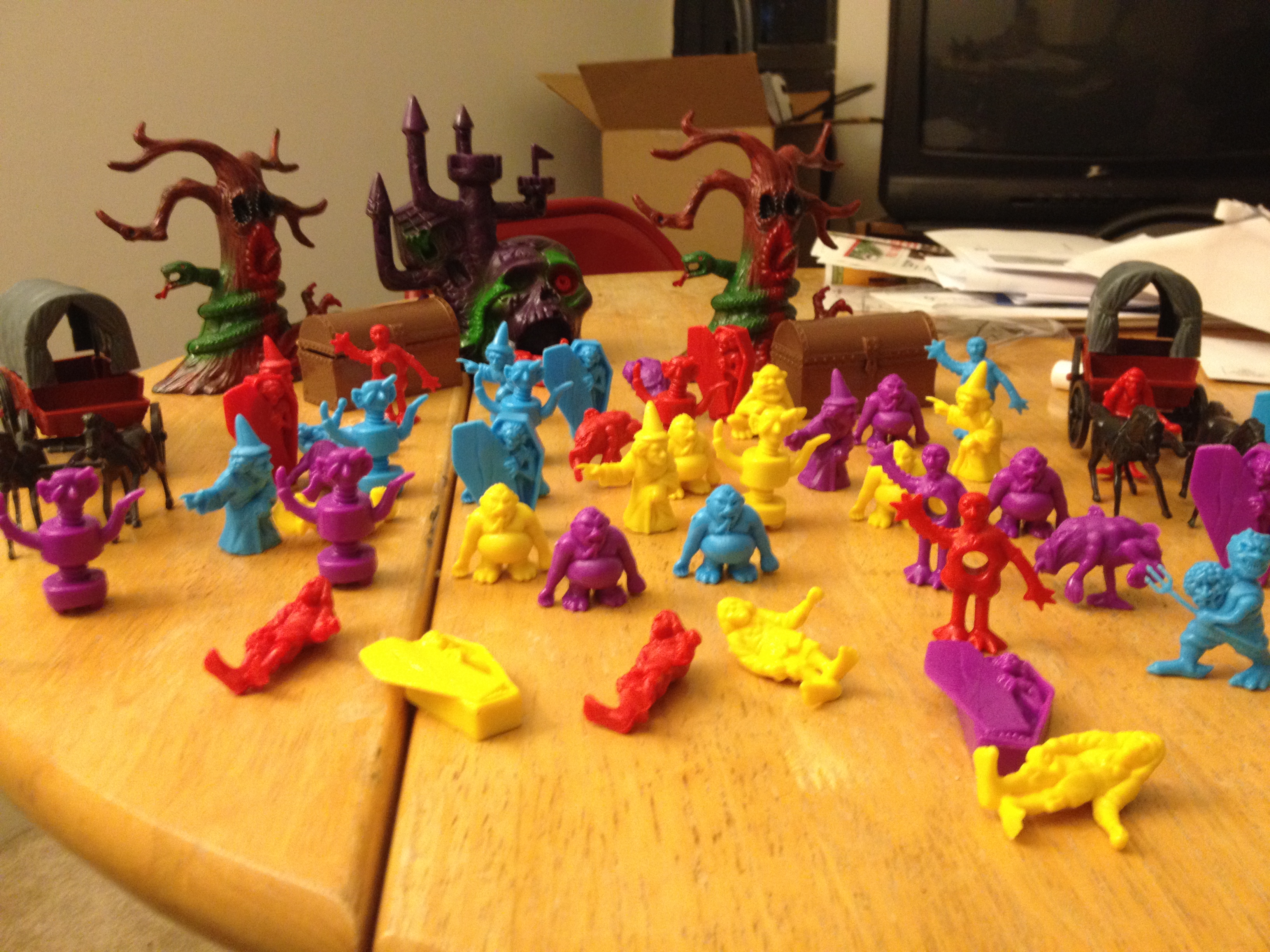
When the evil liche Sarcophoguy needs a small crack team of combatants for a task, he summons forth the Zomb Squad. These elite zombies have lost their personalities and memories in the haze of undeath, but parts of their inborn talent linger on, making them a versatile opponent.

Figures courtesy of Twilight Creation's awesome "Humans!!!" game.

Figures courtesy of Twilight Creation’s awesome “Humans!!!” game.

High Concept: Zombie Professional Team

Aspects: Mostly Mindless; On a Mission; Rotting Shells

Rocker Cheerleader Surgeon Miner Mid-Level Manager
+4 Fight

+3 Provoke

+4 Acrobatics

+3 Rapport

+4 Lore

+3 Stealth

+4 Physique

+3 Craft

+4 Will

+3 Notice

Stress: O Stress: O Stress: O Stress: O Stress: O
Stunts: Rock Never Dies! – If the Rocker is Knocked out, your Fight becomes +2 instead of +1. Stunts: Ra-Raaahh! If successful uses Rapport to create an advantage to distract an opponent, it is applied to all PCs in the zone. Stunts: Reanimate – Once per scene, at the end of his turn, the Surgeon may pay one Fate Point to wake up a Knocked Out part and remove all stress on that part. Stunts: Pickaxe – +2 when using Physique to overcome physical obstacles. Stunts: On Task – Once per scene, may use Will instead of any other skill if it relates to their objective (ex. Will as Burglary if they’re sent to steal an object.)
Consequences: Minor (2)

When do I use a Chimera-mob?

As you can tell, it’s a chimera-mob can be as very simple, or amazingly complex (the Zomb Squat, for example, has five stunts!) However, they can provide a single threat that is a threat to most every teammate without feeling like a beefed-up supervillain.

Zones & Spacing

When throwing a Chimera-mob at a group, it works best to set the fight in a small area. In a narrow corridor, it’s easy to see how you can aim at Surgeon zombie, only to have the acrobatic Cheerleader-zombie leapfrog off of your head, making you miss your shot. In a much wider area filled with many zones, it’s a little harder to justify in the narrative how the Rocker can simultaneously be attacking a player on one side of a football field and defending for the Miner against a punch 100 yards down the field. As you might surmise, chimera-mobs also work well for GMs that run map-less campaigns.

So, tell us what YOU think! Have some Chimeras of your own?

Paranormal Investigation Tool – Follow the Bread Crumbs

Standard

I’ve been working hard on a new aid for Paranormal Investigation games this week, and haven’t got a chance to make a new post. So, to kill two birds with one stone, I’m giving you a sneak peak of the work in the progress. Presenting:


THE BREAD CRUMBS GENERATOR!

researcher discovery

BREAD CRUMBS – A PARANORMAL INVESTIGATIONS CLUE GENERATOR

The goal of the “Bread Crumbs” system is not to create a full adventure for you- like any Fate Core game, it requires some creativity of your group’s part. Rather, it’s here to help generate clues and ideas. It’s really up to you, the gm and the players, to string together the relevant bits into a narrative.

Will this fashion a masterpiece of mystery, the likes of Agatha Christie? Nope. But it’s great for your average, “villain of the week” style one shot adventure.

HOW DOES IT WORK?

The Bread Crumbs system uses a principle called Apophenia, which Wikipedia defines as: “is the experience of seeing patterns or connections in random or meaningless data.” In essence, we start the group with a crime scene. At the scene is a murder victim, killed in a specific way, an item, and a few random sensations. Let’s say you get “a bullet to the chest,” “a banana,” and “a strange sense of well-being.” What’s the connection between them?

At the start, absolutely nothing. However, as you question witnesses, follow hot leads, and uncover more clues, (ex. More bananas, and a huge pile of cash), your group can now start putting it all together.

Maybe they discover a ring is smuggling street by magically transforming them into bananas. Maybe a Love God / Goddess from a Tropical nation is luring greedy banana-republic salesmen to their death. Maybe the banana’s a red herring, planted there to by the NecroCats to frame their worst enemies, the Were-Gorilla gang!

But how do I come up with the connections? Hopefully the players will provide connections on their own, but if not, we recommend some source books on the symbolism of various objects. It also helps to brush up on your mythological beasts: if the random chart generates feathers and talon-marks, you might decide to make the monster a cockatrice and drop a few cockatrice-themed clues along the way (ex. County fair with a rooster that lays eggs.) Most importantly, keep an open-minded. Don’t pick the weirdest theory for the villains, pick ALL of the weird theories!

This also combos well with the Brainstorm system introduced in “Atomic Robo RPG.” We will be releasing a similar, Investigation based system in the near future.

QUICK (AND THE DEAD) MISSION BUILDER

Before you start, make sure you create characters

Create Urban Legends – have each player and the GM create at least one each (although, if a player’s feeling creative, don’t put a maximum.) Some of these (or all of them) may not show in the story, but it’s nice to get ideas before you start.

Generate a Mystery (see below)

Go to the scene of the crime and Investigate. Generate a Location

As soon as you get there, start making supporting characters. Make sure you include a Face character or two for every organization and location. Don’t just have a random cop, have Carl the Chubby Meterman. If the murder’s in a back alley, have the owner of the restaurant Greasy Ginny, already answering questions to one of the detectives. These people seem incidental now, but could end up your suspects, eye witnesses, allies, enemies, and potentially future victims.

The team then gets to scan the scene for clues. Each character may attempt to use an appropriate skill to survey the scene. Investigate is the best skill, but Sixth Sense can be used to pick up Sensory Clues, and certain and situations allow characters to use other skills (ex. A stunt that lets a mad scientist investigate with Science!; a smooth talker using Rapports to question witnesses; Connections to dredge up rumors from your network.)

Successes: For each Success, the group gains one clue. You can only have a total of three Evidence or Corpse clues, so any further clues must be Sensory Clues.

Succeed with Style: If a character succeeds with style, you can gain a boost to aid another player with their search, or may take an additional aspect about the crime scene- this likely not a full clue, but rather a “hunch” about the nature of incident.

Fail / Succeed At Cost: No matter how many characters you fail, you always gain at least one Clue. Alternatively, don’t forget that, with Fate, you can always Succeed at a Cost.

Example “Success at Cost”: Finding a bit of evidence by tripping over it (giving you a Consequence to show your hurt leg or hurt pride); getting contradictory eye-witness testimonials; discovering an important bit of evidence and accidentally destroying it before it can be examined closer.

Clue chart:

If your group rolls on the same twice in a row, roll twice in a row, to assure a mix of the three.

Corpse Clue – Roll on the Corpse Clue Chart
0 Evidence Clue – Roll on the Evidence Clue Chart
+ Sensory Clue – Roll on the Evidence Clue Chart

Whenever they search, they always find SOMETHING, even if it doesn’t seem important. A bent fender. A phone message from Crystal. A bar napkin. Even if they lead no where now, some player might make a connection you never thought of.

Once the crime scene and all witnesses are exhausted, try to follow the clues. Maybe a forensic scientist can analyze the mud sample, or a guest lecturer can tell you more about an ancient symbol. Dig into the victim’s past, stake out similar locations in case it happens again. Reward player proactivity with more information.

When providing answers, draw connections threads between the events and aspects that are proposed (including the Urban Myths). If the trail grows cold, have the crime reoccur, or introduce someone who knows more than you (a hired assassin coming for you; a new witness; a rival to the enemy; the critically injured victim regains consciousness with vague memories.)

The Twist – Just when everything’s going smoothly, add in a plot twist. This can be something of your own devising, or roll on your adventure’s Twist table. When in doubt, remember the Urban Legends… maybe your Mexican Standoff with the Romanian Mafia gets interrupted by Elvis and his Alien abductors.

The Reveal – The mystery is exposed. Maybe it was a creature you still know very little about, or maybe it was really Carl the Chubby Cop the whole time.

[SKIPPING THE CORPSE & EVIDENCE CLUES FOR NOW- GOTTA SAVE SOME FOR LATER, RIGHT?]

GIVING OUT SENSORY CLUES

The _sense__ is __(category), a bit like __example.__

This means you roll for the sense chart, then on the matching description chart, and then your group picks one of the examples in it. This gives you a definite fact (ex. It IS sweet), and less concrete suggestion (ex. “it reminds you of jasmine”). This lets you alter it slightly later if need be! Make sure you let the group in on picking the description. Ex. You can read the full list and let them pick; you pick “fruit” and let them throw ideas of which fruit it is.

For example, a roll might include “The smell is sweet, a bit like almonds.”

Which Sense?: If a character has no particular focus, roll on the following chart. However, if a player has an aspect that suggests that one sense is stronger / more appropriate than the next, allow the character to pick which one. (Ex. A psychic picking up the Sixth Sense Clue; a werewolf with the aspect “Follow Your Nose!” getting a Smell Clue.)

Sensory Clue – Sub-Chart
0 +
Another player picks one! Smell Touch
0 Sight The GM picks one! Sixth Sense
+ Taste Hearing Pick one!

SIGHT

The location itself appears to you be ______, much like a _______

Sensory Clue – Sub-Chart
0 +
Disarray Neat Phony
0 Hidden / Blind spots In Full View Secrets Revealed
+ Snap Shot All in the Details Seen This Before

Disarray – The location is in shambles. You might mean: there was a great struggle; someone was looking frantically for something; the attack was made in hot blood; the attacker was a beastlike in its savagery.

Neat – The location is startlingly neat and tidy. You might mean: the victim was subdued without a fight; the murderer was someone the victim knew; the murderer is a master of stealth (vampire, ghost, ninja); attack was calculated and made in cold-blood; the attacker wasn’t looking for something / wasn’t a robbery.

Phony – You can’t prove it yet, but your gut tells you something about the placement of the body and articles feels fake, altered, or unnatural. This might be: a phony suicide letter or “dying message”; a half-hearted robbery; objects / evidence that looks planted; a “random” attack with perfect timing; an assailing “stranger” who knew too much.

Hidden / Blind spots – The murder occurred in a spot that is secluded, dark, or obscured from others. This might mean: the murderer is a creature of the night / has night vision; the murderer is hurt by sunlight; the murderer is an ambush hunter; the murderer lured the victim into the location; the victim agreed to go into the secluded place (trusted murderer, doing a shady activity.)

In Full View – The murder happened in spot that was well light, exposed to the elements, and where others could easily see it. They might mean: there are witnesses to the d

Secrets Revealed – upon investigation, you find a secret way in, possibly utilized by the murderer. This might be: a hidden door; a grate leading to the sewer; a passage behind a portrait.

Snap Shot – Something in the area let you catch a blurry picture of an unknown person at the scene, possibly the murderer. This might be from: the victim’s last selfie; traffic camera; ATM camera; satellite image.

All in the Details – You find a near microscopic piece of evidence that other eyes would miss. Roll on the Sensory table to see what you find (reroll any Sixth Sense or additional Sight results). It’s not much now beyond a simple smell or touch, but it’ll be more defined when the lab gets to analyze it.

Seen This Before – The sight seems strangely familiar to you. This might be: you have been to this spot before; you’ve seen an identical before (perhaps an unsolved case!); you recognize the victim from somewhere (maybe searching the mug shots will help).

SMELLS

The smell is ______, a bit like _________.

Sensory Clue – Sub-Chart
0 +
Floral Caustic Common Chemical
0 Metallic Foul Sweet
+ Smokey Earthy Spicy

Floral – perfume, cologne, lotion, flowers, green tea, violets (turpentine), fruit

Caustic – acidic (hydrochloric acid, sulfuric acid, vinegar, ammonia, lemon), basic (rubbing alcohol, methanol, quicklime, paint thinner, hydrogen peroxide), cleaning agents (bleach, detergent, soap, disinfectant, chlorine, “pine-fresh”), poisonous (bug spray, pesticide)

Common Chemical – Shoe polish, aerosol, hair spray, soap, new car, alcohol

Metallic – ozone, copper, burnt oil, melted plastic, ammonia (ex. Smokeless powder ammo)

Foul – rotten (flesh, wood, milk), bodily fluids, rotten eggs (sulfur, brimstone, gas), B.O., poo gas, fish (nickel tetracarbonate)

Sweet – fudge, vanilla, almond (cyanide, marzipan), cookies, rotting fruit

Smoky – candles, tobacco, gunpowder, fuel, wood, burnt meat / flesh, incense, burnt rope, gasoline, burnt hair, black tea, coffee

Earthy – damp leaves, mud, sea breeze, minerals, rust, grass

Spicy – pepper, garlicky (onions, phosphorous, arsenic), mustard (mustard gas), mint / menthol

TOUCH

The touch is ______, a bit like _________.

Sensory Clue – Sub-Chart
0 +
Gooey Slick Rough
0 Sharp Soft / Smooth Rubbery
+ Cool Hot Unearthly

Gooey – mucus, goo, adhesive, glue, tar, syrup (honey, maple, soda), plant sap, insect / spider silk, congealed blood

Slick – oil (gun oil, lighter fluid, cooking oil), grease, makeup, butter, snot, sweat, scales, ice, mold, lubricants

Rough – grit, sand, salt, dust, wool, sandpaper, sharkskin, bark, hair stubble, plaster

Sharp – fragments (glass, porcelain, metal shavings), splinters, shrapnel, shark skin, thorns / prickles

Soft / Smooth– moss / mold, wax, fabric (silk, cotton, satin), petals, natural (fur, suede, down), dirt / clay, marshmallow

Rubbery – rubber, skin (leather, skin), plastic, mummified / jerked flesh, leaves, latex (prosthetics / make-up, rubber gloves), dried goo (see Gooey)

Cool – Ice, Liquid (water, rain, alcohol), metal, long dead, from cold place (freezer, ground, teleport), balms / anesthetics

Hot – burnt (fire, electricity, steam, acid, magic), recently used machine (gun, engine, phone), living or recently dead human/animal, burned rubber, hot drinks (coffee, tea, cider), from hot place (indoors, oven, shower, teleport)

Unearthly – The substance of something at the scene seems unearthly, like it was made for unknown materials. Whenever you touch the surface with your bare skin, you get a strange feeling or impulse. Roll on the Sixth Sense chart for the sensation (if it doesn’t fit, reroll).

WILL SAVE THE REST FOR ANOTHER DAY… IF ANYTHING SEEMS A LITTLE UNCLEAR, OR YOU HAVE ANY SUGGESTIONS, ADD THEM IN THE COMMENTS SUGGESTION!

GMProv – Ask Me No Questions

Standard

This week, we’ll look at another rule of improv: Questions!  The improv rule is this:

Never Start a Scene with a Question.

Personally, I don’t think this rule is as steadfast in RPGS as it is in improv, but what is thatbefore I explore the exceptions, let me start with the rule itself.
In Improv:

As we mentioned last week, an improvised scene is all about set-up.  A 2 minute scene will succeed or fail based on the 20 seconds spent establishing the characters, conflicts, and locations. The setup is all about facts: what is true, what is concrete. Of course, a truth has two opposites: denial, and uncertainty. We covered denial/negation in a previous blog post, so today we cover questions & uncertainty. But what harm can asking a simple question do?

Let me start with a tangent: how many of you out there have ever seen the Improv Comedy tv show, “Whose Line is it Anyway?” If you’ve never seen it, (first off, I highly recommend it), it involves seasoned performers creating improvised sketches and songs before a studio audience.

75% of the show, and it’s resulting humor, is purely cooperative. The performers help each other out, deliver straight lines (giving the partner the perfect chance at a punchline), and generally have fun together. While it has a “winner” of sorts at the end, the beginning of the show even starts with the host saying, “the points don’t matter.” These are the types of scenes that I proudly showed my students (when I taught) as good examples of theatre sports.

25% of the humor, however, is derived from a different type of improv. It has gone by many names, but the one that captures the pure essence of it is “F@#$-Your-Buddy.”  F@#$-Your-Buddy is based on intentionally putting your scene partner in the most awkward and difficult situation you can. If a crisis needs solving, you put her on the spot to give the solution. If you’re playing a rhyming game, you force the partner to make a rhyme for “orange” or “silver.” It’s a theatrical demolition derby, in which the audience shivers with anticipation at the gaping chasm opened up before the performer. They delight in watching the unease and horror on the performer’s face. Don’t get me wrong, it’s just as harmless and hilarious to watch as the cooperative stuff, but it’s not the stuff I show young improvers as behavior to emulate. At the core, it is based on either competition (at best) or humiliation (at worst.) *

 * F@#$ Your Buddy – Colin & Ryan Style – The majority of F@#$-Your-Buddy on “Whose Line” is done between Colin Mochrie & Ryan Styles, who love throwing each other into tight spots. However, they have been doing improv together for over 20 years, and both know how talented the other is- I doubt they’d ever set-up an obstacle that the other player couldn’t honestly overcome. So, you could argue that they aren’t REALLY f*&^ing each other over most of the time, but rather putting on the appearance of F@#$-Your-Buddy-atude for the audience. Don’t try this at home, they’re professionals.

/End Rambling Tangent.

So, what does asking a question do?

Imagine two performers, Abel and Baker, who have to set up a scene. Depending on which universe you are in, Abel starts the scene one of two ways:

Variant 1-
Abel: Fan-frickin-tastic! I’m sick and tired of winding up in jail because of your shenanigans, Bob!

Using last week’s guide, let’s see who supplies the facts:

Who: Abel provides half- he gives us Baker’s name, “Bob.”

What’s the relationship: Abel provides implication that Bob & other person are partners or friends; the relationship is strained to the point of breaking.

Where are they: Abel provides that they are in jail.

When: Abel provides the past (there were previous arrests.)

Why are they having this conversation:  Abel provides that he wants to stop the arrests or stop the relationship with Bob.

NOW, let’s see an alternative opening:

Abel: What are you doing?

I could repost the “who, what, when, etc.” and fill in the information, but for the sake of time, I’ll go ahead and say that the answer for each is the same: Abel provides NOTHING.  Instead of verifying a fact or providing a new one (see the “Yes / And” blog post,) Abel foists all creative decisions on Baker’s unprepared shoulders. If Baker’s good, he’ll recover and make it work. If it’s not good or he suffers a mental block, Baker looks like an idiot in front of a leering audience, through no fault of his own. Whether you mean it or not, to suddenly ask a question is to play a game of “F@#$-Your-Buddy.”

HOW DOES THIS APPLY TO RPGS?

So, does this mean that you should never ever ask any of your players questions? No, that would be terrible. However, every question you ask should be a conscious decision on the GM’s part, because the type of questions you ask have a profound effect on shaping the game.

Questionless Adventure: In theory, you likely could run a game in which the player is not prompted to answer any questions or make any decisions. Just like last week, I’ll cite the Maltese Falcon. (Why? Because it’s an awesome movie!)

The Maltese  Falcon is a film noir mystery film. From the very beginning, there are many unknown factors: who killed Spade’s partner? Where is the missing girl, if she even exists? Who can Spade trust?  That being said, Spade doesn’t really have a chance to make many active decisions until halfway through the film. Until then, a revolving door of odd characters show up at his apartment and his office, pulling guns on him and tailing him wherever he goes.  This might seem strange that a detective does very little detecting, but remember: the story was originally a pulp story. I remember reading that one famous pulp author would count out his pages- if a certain number went by without any action, he would insert a pistol whip, a shot, an explosion, or a dead body into the story, just to liven things up. Why would there be a dead body or violent action? Doesn’t matter, the author would justify it later.  Pulps (and Dan Brown novels) depend on the hero being the subject of action- he could sit in his arm chair at home, and events would still find him, forcing him to react first, and to answer questions later.

Likewise, it is possible to have an RPG in which the characters spend most of the time reacting to events. This means you don’t have to ask them many questions, like, “where will you go next?” or “what’s your next step?” as the next step comes to them. This shows up a lot when running “on the rail” adventures, which is why “railed” adventures are commonly used with newbie groups. Gamers who are new to RPGs are likely overwhelmed enough by the rules and stats without throwing additional questions at them- all they have to do is react, until they feel comfortable.

The Question-full Game: Of course, you can also run a game based around entirely asking players questions. I know that Fate is a collaborative game, which requires the players to creating everything together; from the theme of the entire universe to the contents of a dirty linen closet.  At Gen Con, I remember asking for room ideas from my playgroups: I had some seasoned gamers blanch at the idea (as they were never been asked these things in D&D!) By the end, the players loved the idea, but there was definitely a learning curve. Once you get them going, I’ve seen a group take over the story completely, with the GM acting merely as the mediator. This gives players more chance to ACT, but less chance to react- as such, they spend more time building the world outside of their characters, and less time inside their character’s head, playing the character. Thus, a question is like breaking the fourth wall: on a subconscious level, the player is answering, not the character.

Easing Players In: To avoid shell-shock and not put players on the spot, here are a few tricks.

  • Start with little questions; instead of making them plan a giant caper from scratch, start with them brainstorming the items of a room.
  •  Give examples first. “The room is dank and foul. You see a slimy bucket containing something that’s definitely not water, and an algae covered drain is in the floor. What else do you see?”
  •  Ask the group, rather than the individuals. For example, during the scene set-up, don’t call out individuals to come up with ideas- propose it to everyone at the same time, and let those who are feeling comfortable speak up.
  •  Give people time to think. If each player has to think about what their character will do (ex. “What kind of action will you take this turn?”), propose the question to all players at once, and let them respond as they will- this means players who are more confident will talk first, while those who are less comfortable and like taking their time get to answer after. This might mean bending the normal turn-order, or just tossing it out completely.

 YOU SHOULD ASK FEWER QUESTIONS WITH:

  • Gamers new to rpgs
  • Gamers new to a system
  • On the Rail Adventures (see “The Golden Rule” below)
  • Horror rpgs / Dramatic / Tragic rpgs – fewer questions gives the player less feeling of control and more time in the character’s head, making the danger all the sweeter.
  • Cooperative Games- all of the players are collected together into a solid team
  • Groups/ games that focus on the players being “in-character”

YOU SHOULD ASK MORE QUESTIONS WITH

  • Fate Games
  • Campaigns with experienced players
  • Comedic Games – players get to spend more time setting up the joke, and feel less sensitive to having their characters be the butt of a joke.
  • World-Building Games– i.e. Games in which shaping the world is essential to the theme, such as games in which the characters are gods; my dungeon building game, Dungeon Tours.  Open-ended questions are jarring at first, but will remind them that they are in control.
  • Competitive / Cruel  Settings – If the setting involves characters regularly clashing with characters controlled by other players, then the more questions you can ask, the better. The more a player gets into the head of their character, the more likely they will take attacks against them personally.

THE GOLDEN RULE

So, whether you end up asking one question or one million, I suggest one golden rule; it harkens back to the “Never negate” rule I mentioned a few blogs back:

If you ask player a question, always be ready to go with their answer.

Asking a question means you are allowing the player to influence the game, and that you are interested in what they want to contribute. Imagine the following:

GM: What do you want to do?

Abel: I want to fly!

GM: You can’t fly, you don’t have the ability. What do you want to do?

Abel: I want to build a flying machine!

GM: There are no supplies. What do you want to do?

Abel: I go buy supplies!

Gm: The shops are closed. What do you want to do?

The GM’s saying “What do you want to do?” but he’s shutting down every answer Abel is giving. If he doesn’t want to Abel to do any of the things he wants to do, then why is he even asking? Don’t merely ask until you get the answer you’d give. This rule doesn’t mean you have to ALWAYS say yes, but if you’re going to ask, be prepared to throw away your carefully planned adventure.

NEXT WEEK: NO IDEA! What would YOU like to see?

GMprov – It’s a Set-Up

Standard

This week, I’m going to focus on another rules of improv: Establish the Scene.

Whenever you’re writing a play or a book, you have months to build up the proper setting and mood. You can take your sweet time to refine the language, and use flowery language to establish the mood. Ol’ Poe describes his chamber “the bleak December / and Each separate dying ember wrought its ghost upon the floor.” (Beautiful, ain’t it?)

When you’re running an improv scene, the average time you have door opento establish the scene is roughly 34 pictoseconds. When you’re GMing a rambunctious group, you might have about the same.

To set up the scene successfully, you need to establish with lightning speed, in order of priority:

  1. Who is everyone?
  2. What’s the conflict?
  3. Where are you?

You would think that the “where” would go first, but if you have to choose only one detail to give, the players are more likely going to need to know that the assassin darting through the crowd was the woman with the scar across her forehead, and will care less about the fresco on the temple ceiling.  When in doubt, people are fascinated by people, not things (which is why no talking cartoon animal ever looks 100% like the animal it was based off of.)  When you’re running Improv scenes, it is important that the player not only establish their own identity, but also the identity of the other person, and their connection.  This may seem like a lot to establish, but a skilled performer can set it up with a single sentence. Examples:

 “Young lady, you are not going to school dressed like THAT!”  Relationship: younger daughter (probably teen) and parent.

“Ladies and Gentleman of the board, as the CEO of Enerdine corporation…” Relationship: CEO, the board members.

“Excuse me officer, I’m sorry to bother you, but my wife and I are lost…” Relationship: Wife & Spouse (husband, her wife) and a stranger, who is a police officer.

Of course, the players have probably set up THEIR characters already, so you just need to set up the NPC characters. Young or old? Knowledgable or naive? In charge, or a mere pawn?

Also, remember that the player’s relationship with another person may vary drastically based on their reputation and goals. In their minds, they might be world-saving heroes, but others might see them as smelly, rampaging mercenaries. For a pop culture example, remember Indiana Jones: we see him as a gruff, heroic adventurer, but his students see him as a stuffy archeology professor, and the natives of the countries he’s see him as an infamous grave robber.

Next, mark sure you set up the conflict. Who wants what, and how badly? I talked about this a lot in the Chair/Bus Stop blog a few months back, but in a nutshell; every scene always ends with one of three possibilities:

  1. Both people get what they want.
  2. One side gets what they want; the other side can go no further to get what they want at this time.
  3. No one gets what they want, and no one can go any further to get what they want at this time.

Setting: This is the least priority, but not by much. It is vitally important that players get a few facts and a feeling about the world they inhabit. In Fate Core, these show up as situation aspects. If I have one flaw as a GM (note: I have WAY more than one), it’s that I have a habit of spamming a scene with way too many situation aspects. But how can I not? There are so many fun things to include: the space, the objects, the mood, the emotional tension.  Heck, I love situation aspects so much I built the Dungeon Tours game, which is built around players creating fun settings.

CHEAT SHEET

Character Creation Tip

Set-up Check list:
Who – are they talking to?
What – is the relationship?
When – Day or night? Is the clock ticking? Is the person rushed, and has no time for your foolishness? Alternatively, are you racing a ticking clock, and this person taking their sweet time?
Where – Location? Someone’s home turf? Tangible Factors? Intangible factors?
Why – Why are you two talking? What motivates each party? Why are you here?

Relationship – Quick Trick
Not sure what relationship to set up? When in doubt, a stranger is a mirror to viewer.

  • An honest person will see others as honest.
  • A lying crook who looks after themselves will assume others are crooks.

A great example is the movie The Maltese Falcon. Sam Spade is surrounded by lying murderers who use threats, bribes and seductions to get him to reveal what he knows about the statue, and to give it up. He insists he doesn’t have it and knows nothing, and they assume that he’s lying to drive up the price; because if they were in his place, that’s what THEY’D do. They don’t even consider that he might actually be telling the truth, and that he DOESN’T have it. He’s not as big of a crook as they are (though, not by much.)

NEXT WEEK:

QUESTIONS: Does and don’ts!

Toy Box Review- Haunted House Horror Bucket

Standard

Today launches a new segment on the site: the Toybox Review! But first, some context: I remember reading that Gary Gygax and the early D&D team used oddball, cheap-o plastic figures as inspiration for such creatures as the Rust Monster, the boullette, and even the signature Owlbear. If you’ve never heard the story, artist DiTerlizzi retells it quite beautifully on his blog.

Likewise, I learned during some of my Masters of Umdaar playtests that players respond surprisingly well to playing with brightly colored plastic toys. You’d think the poorly cast, un-detailed faces would turn people away, but I suspect it made new characters easier to step into- I chalk it up the psychological phenomenon called “Cognitive Closure.” Even if a shape is poorly defined, the human brain is capable of filling in any missing details. Observe the triangle on the below, borrowed from this website.

closure

Riddle me this, Batman- when is a triangle NOT a triangle?

When a player spends a long campaign fine-tuning a character, they end up with a very well defined picture in their head of what the character looks and feels like. Likewise, for experienced, long term characters, detailed figurines, (the kind Reaper and Games Workshop make from metal or resin), are perfect- the level of detail reinforcements the player’s image. However, if the character is brand new, giving them a well-defined miniature, I theorize, does the opposite. The miniature reminds them, “this is a well-defined character that you didn’t design.” There are no details for the player to contribute, because that’s all been done. Alternatively, if it’s low-detailed plastic toy, the player will consciously and subconsciously fill in the details with their own imagination, making the toy into something that closer resembles themselves.

Okay, enough with the amateur psychologist mumbo-jumbo. On with the fun stuff!

THIS ENTRY

Each “Toy Box Review,” I’m going to review of a toy product and it’s contents. This week: a toy collection I randomly found on Amazon. It is the:

Exclusive 62 Piece Haunted House Monster Bucket by PSE.

IMG_0698

Watch as the magical lid refuses to go back on…

Before I bought it, it looked: like your standard bucket of strange, monstrous creatures. The snapshot accurately captured the final product, although I’m a little sad that two of the designs feature in the photo didn’t end up in the kit. 4/5

That's $30 of ugly shoved into a $17 tub...

That’s $30 of ugly shoved into a $17 tub…

First impression: It’s definitely a large set. At $16.99, it wasn’t exactly a bargain, but I was definitely getting my money’s worth. The color scheme is quite fun, really; the red and purple are wonderfully dark and Halloweeny. The electric blue and yellow don’t match the mood quite as well, but they provide great contrast to the red & purple, so it all works out. 5/5

The Witch: One of the pieces I immediately fell in love with was the witch figure. For this reason, I included in several of the shots, to give a frame of reference for the scale.

IMG_0702

Two haunted trees, ready for a night on the town.

The Set Pieces:The playset came with 2 large haunted trees and a castle. The trees are wonderful, even if the paint job is a bit heavy handed. I love the color on the castle, but what takes away from it is the SCALE. It’s hard to tell, but on the bottom of the skull mouth are tiny steps- meaning, it’s supposed to match a figure that would only come up to the witch’s shin. There’s even a tiny door on the back that’s equally as small. This makes the castle less useful in a st, unless it’s a “far off castle on the hill.” 4/5

IMG_0701

Coffin Fit

The Props: The set came with 2 wagons and 2 treasure chests. The wagons are quite obviously ripped off of a Western line, but the fact that the canvas was printed in grey plastic instead of white really adds to the Transylvania feel of it all. The two treasure chests are way too large for “treasure,” but they actually work as really large coffins. The color is great, but before I even used them, I could tell that the hinges on the lid were broken the second I took them out of the tub- they come completely off when you open it. Still, the plastic “lock” on the front actually keeps it in place when shut, so it’s not a complete wash. 4/5

The Good: This shut covers some of my favorite pieces of the set, going left to right:

IMG_0703Pitchfork: Really like this guy. Can’t tell if he’s holding a monster head, or a mask- either way, there’s a story there! I only regret there’s only one in my tub.

Witch: As I said, fantastic. Lots of energy and character in her pose. I also got a ton of her, in all colors.

Fat Things 1 & 2: I also have a lot of these things (devils?) They’re just what I was hoping to get in the set; things that are not clearly defined, but fitting the mood. To me, they kind of look like Evil Buddhas. They also have an adundance of Plumber Crack from behind, which is an… interesting choice.

Nightmare Hound: Another “no clue what they were going for” toy, but they succeeded. The creature looks like a mutated humanoid or animal that’s balancing on one foot, mid-sprint.

The Ugly – These next few pieces aren’t terrible, but don’t quite blow me away (again, included the witch for scale.)

IMG_0704

Some inspired by hot-wing-induced nightmares, I suspect.

Coffin-Dude: This guy almost made it to the awesome side, if not for the scale of him. Take away the coffin, and he’s tinier than everyone else. It could work, “Suddenly, the coffin opens, and the Undead Mickey Rooney creeps out of the wooden box…”

Hole-Chicken-Man: I asked for weird, and weird I was given. The purple guy in the middle is beyond description- the best I can guess is that it’s a bald rooster-man hybrid who seems happy you shot him with a cannon. Or, he’s a crossbreed between a chicken and a donut. It’s hard to tell on the photo, but he also has two random details nea his chest- they may be attempts to mold feathers, but it kind of looks like he duct-taped two small t-bone steaks to his torso. Maybe that’s why you shot him.

Robot-Guy: In a different set, this guy might have made the “Good” category, but in a box filled with devils and witches, the robot is just out of place. His design is also odd in that, instead of eyes, he has two random spikes. They are likely attempts at alien antennae, but it instead looks like a lab accident shoved a spike through the poor robot’s eye. Which, also tells a story. Also, he loses points over the fact that his base is a bit less sturdy than the others, so he occasionally tips over.

IMG_0706

Unstable Monsters

THE BAD: The satyr and the Hunchback figure are both fantastic, except for the fact that they CAN’T STAND ON THEIR OWN. I could go to the dollar store and find 50 different toys, some of them devoid of detail, shape, or personality, and they’d at least stand up 9 out of 10 times. These guys? Not so much. I only received one of the satyrs, but a lot of the creepy butlers. He’s definitely good enough to fix, though.

Overall: I’d give it 4/5. It’s mistmatched and has a wide range of quality, but the box said “Haunted House,” I think they delivered a product that evokes a creepy, weird setting.

DESIGN CHALLENGE:

Now, here’s how I’ll close any given “Toy Box Review”- by pulling a “Gygax.” I will take the strangest, least defined thing in the review and attempt to make it into an actual monster. For this one, I’ll use the Skeleton Crew Fate Rules.

chicken closeup

Fowl Murder

HUNTED SPIRITS

In the wild, they are a countless number of nature spirits, taking the form of trees, rocks, and rivers. Some live their long lives in the form of animals, in the shape of the bear or the duck. However, while the spirits do not age, they can be hurt and killed. A spirit of an animal that is shot may die, but it may linger on in a half-life- all kindness and mercy drained away, leaving only a spirit of vengeance. A Hunted Spirit will seek out the hunters that killed it and it’s forest friends, but will often hurt innocent mortals in it’s rage. These vengeful beings can change shape to human or animal, but the original scars remains.

High Concept: Half-Dead Animal Spirits

Aspects: Must Have Vengeance!, Always Part Animal, Nature is my Home.

Aspects:

n  Undead—weaknesses to holy magic, silver, garlic and other magical purities

n  Blood Rush—For Vampanzees, blood is both an addition and an energy source

n  Overly Curious

n  Fight or Flight

n  Bouncy Little Buggers

Commonly Level: Average (+1)

Stunts:

Shapeshift— Hunted Spirits may change shape as a free action.

One with Nature—Once per scene, a Spirit may use Wilderness instead of any other skill. If there are several spirits in the scene, instead treat instead as “once per exchange, any ONE spirit may use Wilderness as another skill.”

AVERAGE (+1) FAIR (+2) GOOD (+3)
Athletics +1, Wilderness +1
Intimidate +1
Wilderness +2
Intimidate +2

Deceive +1
Athletics +1

Wilderness +3,
Intimidate +3

Deceive +2
Athletics +2

Notice +1
Stealth +1

Stress:
No stress boxes—a one shift hit is enough to take them out.
Stress:
One stress box—a two shift hit is enough to take them out.
Stress:
Two stress boxes—a three shift hit is enough to take them out.
Aspect: Monkey See, Monkey Do

Now, I challenge you, dear readers: use the Chicken-Donut Man, the fat devils, or any other toy and make a monster of your own (no rules necessary, if you prefer text.)