GMprov – It’s a Set-Up

Standard

This week, I’m going to focus on another rules of improv: Establish the Scene.

Whenever you’re writing a play or a book, you have months to build up the proper setting and mood. You can take your sweet time to refine the language, and use flowery language to establish the mood. Ol’ Poe describes his chamber “the bleak December / and Each separate dying ember wrought its ghost upon the floor.” (Beautiful, ain’t it?)

When you’re running an improv scene, the average time you have door opento establish the scene is roughly 34 pictoseconds. When you’re GMing a rambunctious group, you might have about the same.

To set up the scene successfully, you need to establish with lightning speed, in order of priority:

  1. Who is everyone?
  2. What’s the conflict?
  3. Where are you?

You would think that the “where” would go first, but if you have to choose only one detail to give, the players are more likely going to need to know that the assassin darting through the crowd was the woman with the scar across her forehead, and will care less about the fresco on the temple ceiling.  When in doubt, people are fascinated by people, not things (which is why no talking cartoon animal ever looks 100% like the animal it was based off of.)  When you’re running Improv scenes, it is important that the player not only establish their own identity, but also the identity of the other person, and their connection.  This may seem like a lot to establish, but a skilled performer can set it up with a single sentence. Examples:

 “Young lady, you are not going to school dressed like THAT!”  Relationship: younger daughter (probably teen) and parent.

“Ladies and Gentleman of the board, as the CEO of Enerdine corporation…” Relationship: CEO, the board members.

“Excuse me officer, I’m sorry to bother you, but my wife and I are lost…” Relationship: Wife & Spouse (husband, her wife) and a stranger, who is a police officer.

Of course, the players have probably set up THEIR characters already, so you just need to set up the NPC characters. Young or old? Knowledgable or naive? In charge, or a mere pawn?

Also, remember that the player’s relationship with another person may vary drastically based on their reputation and goals. In their minds, they might be world-saving heroes, but others might see them as smelly, rampaging mercenaries. For a pop culture example, remember Indiana Jones: we see him as a gruff, heroic adventurer, but his students see him as a stuffy archeology professor, and the natives of the countries he’s see him as an infamous grave robber.

Next, mark sure you set up the conflict. Who wants what, and how badly? I talked about this a lot in the Chair/Bus Stop blog a few months back, but in a nutshell; every scene always ends with one of three possibilities:

  1. Both people get what they want.
  2. One side gets what they want; the other side can go no further to get what they want at this time.
  3. No one gets what they want, and no one can go any further to get what they want at this time.

Setting: This is the least priority, but not by much. It is vitally important that players get a few facts and a feeling about the world they inhabit. In Fate Core, these show up as situation aspects. If I have one flaw as a GM (note: I have WAY more than one), it’s that I have a habit of spamming a scene with way too many situation aspects. But how can I not? There are so many fun things to include: the space, the objects, the mood, the emotional tension.  Heck, I love situation aspects so much I built the Dungeon Tours game, which is built around players creating fun settings.

CHEAT SHEET

Character Creation Tip

Set-up Check list:
Who – are they talking to?
What – is the relationship?
When – Day or night? Is the clock ticking? Is the person rushed, and has no time for your foolishness? Alternatively, are you racing a ticking clock, and this person taking their sweet time?
Where – Location? Someone’s home turf? Tangible Factors? Intangible factors?
Why – Why are you two talking? What motivates each party? Why are you here?

Relationship – Quick Trick
Not sure what relationship to set up? When in doubt, a stranger is a mirror to viewer.

  • An honest person will see others as honest.
  • A lying crook who looks after themselves will assume others are crooks.

A great example is the movie The Maltese Falcon. Sam Spade is surrounded by lying murderers who use threats, bribes and seductions to get him to reveal what he knows about the statue, and to give it up. He insists he doesn’t have it and knows nothing, and they assume that he’s lying to drive up the price; because if they were in his place, that’s what THEY’D do. They don’t even consider that he might actually be telling the truth, and that he DOESN’T have it. He’s not as big of a crook as they are (though, not by much.)

NEXT WEEK:

QUESTIONS: Does and don’ts!

Toy Box Review- Haunted House Horror Bucket

Standard

Today launches a new segment on the site: the Toybox Review! But first, some context: I remember reading that Gary Gygax and the early D&D team used oddball, cheap-o plastic figures as inspiration for such creatures as the Rust Monster, the boullette, and even the signature Owlbear. If you’ve never heard the story, artist DiTerlizzi retells it quite beautifully on his blog.

Likewise, I learned during some of my Masters of Umdaar playtests that players respond surprisingly well to playing with brightly colored plastic toys. You’d think the poorly cast, un-detailed faces would turn people away, but I suspect it made new characters easier to step into- I chalk it up the psychological phenomenon called “Cognitive Closure.” Even if a shape is poorly defined, the human brain is capable of filling in any missing details. Observe the triangle on the below, borrowed from this website.

closure

Riddle me this, Batman- when is a triangle NOT a triangle?

When a player spends a long campaign fine-tuning a character, they end up with a very well defined picture in their head of what the character looks and feels like. Likewise, for experienced, long term characters, detailed figurines, (the kind Reaper and Games Workshop make from metal or resin), are perfect- the level of detail reinforcements the player’s image. However, if the character is brand new, giving them a well-defined miniature, I theorize, does the opposite. The miniature reminds them, “this is a well-defined character that you didn’t design.” There are no details for the player to contribute, because that’s all been done. Alternatively, if it’s low-detailed plastic toy, the player will consciously and subconsciously fill in the details with their own imagination, making the toy into something that closer resembles themselves.

Okay, enough with the amateur psychologist mumbo-jumbo. On with the fun stuff!

THIS ENTRY

Each “Toy Box Review,” I’m going to review of a toy product and it’s contents. This week: a toy collection I randomly found on Amazon. It is the:

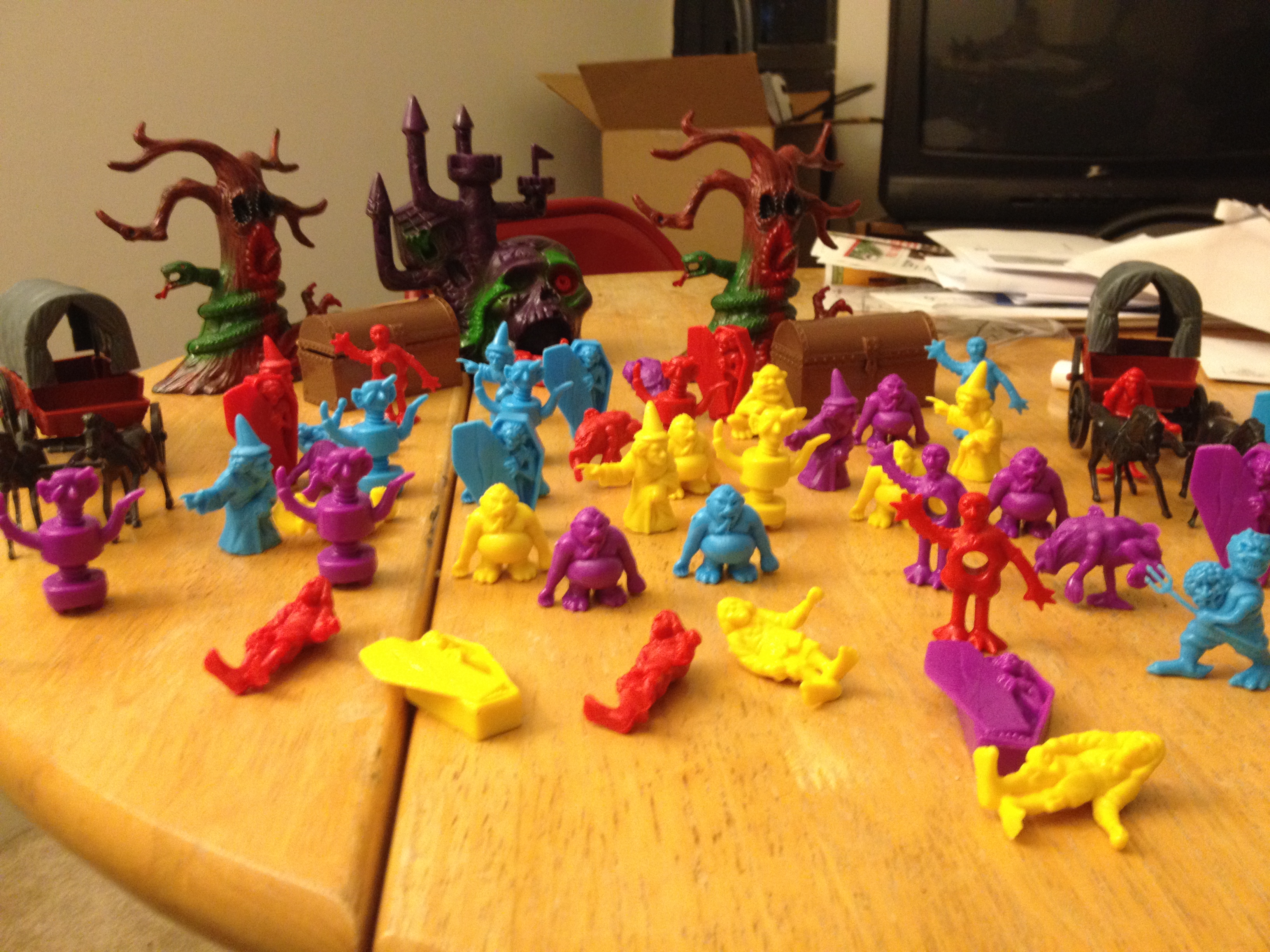
Exclusive 62 Piece Haunted House Monster Bucket by PSE.

IMG_0698

Watch as the magical lid refuses to go back on…

Before I bought it, it looked: like your standard bucket of strange, monstrous creatures. The snapshot accurately captured the final product, although I’m a little sad that two of the designs feature in the photo didn’t end up in the kit. 4/5

That's $30 of ugly shoved into a $17 tub...

That’s $30 of ugly shoved into a $17 tub…

First impression: It’s definitely a large set. At $16.99, it wasn’t exactly a bargain, but I was definitely getting my money’s worth. The color scheme is quite fun, really; the red and purple are wonderfully dark and Halloweeny. The electric blue and yellow don’t match the mood quite as well, but they provide great contrast to the red & purple, so it all works out. 5/5

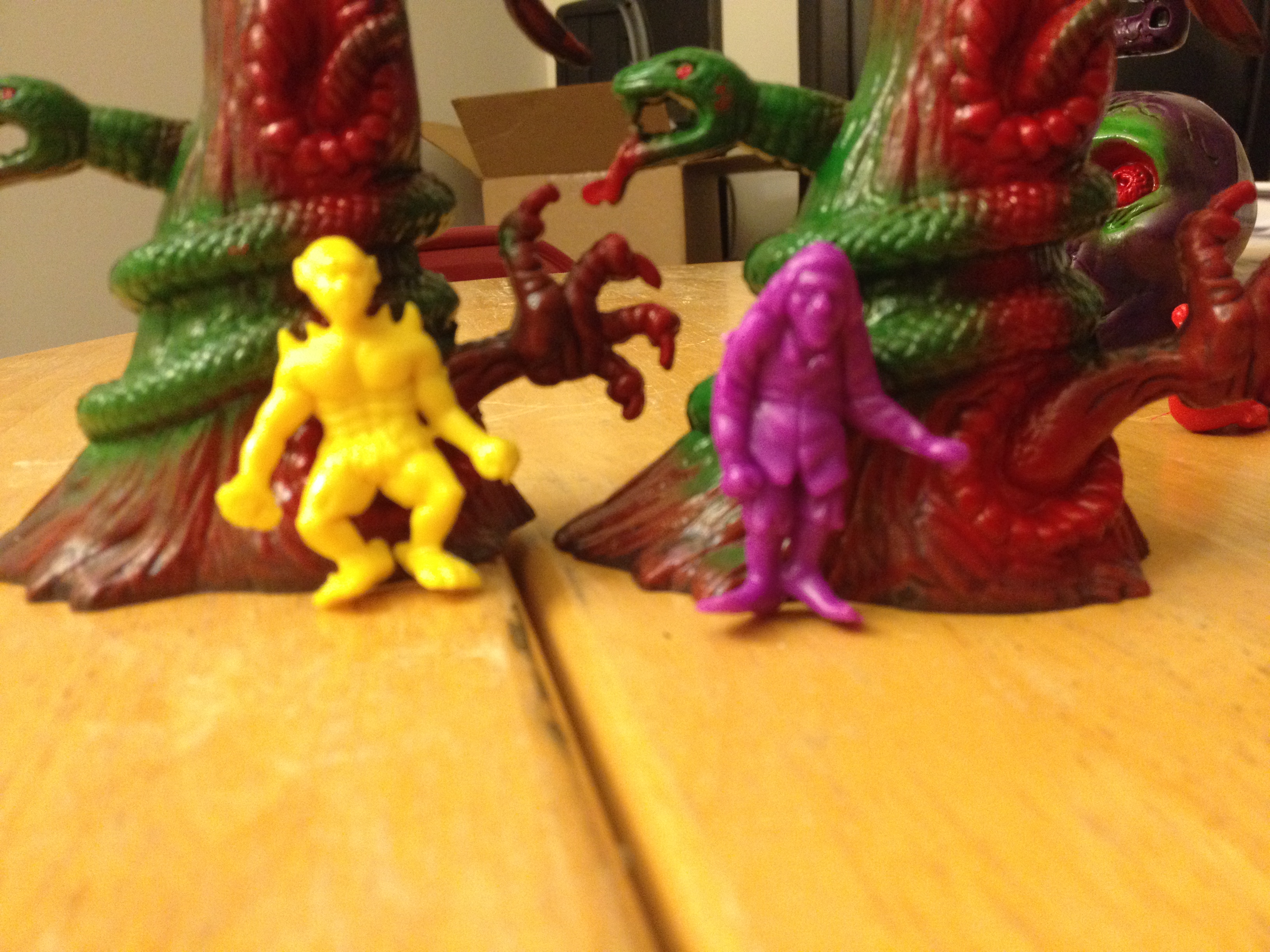
The Witch: One of the pieces I immediately fell in love with was the witch figure. For this reason, I included in several of the shots, to give a frame of reference for the scale.

IMG_0702

Two haunted trees, ready for a night on the town.

The Set Pieces:The playset came with 2 large haunted trees and a castle. The trees are wonderful, even if the paint job is a bit heavy handed. I love the color on the castle, but what takes away from it is the SCALE. It’s hard to tell, but on the bottom of the skull mouth are tiny steps- meaning, it’s supposed to match a figure that would only come up to the witch’s shin. There’s even a tiny door on the back that’s equally as small. This makes the castle less useful in a st, unless it’s a “far off castle on the hill.” 4/5

IMG_0701

Coffin Fit

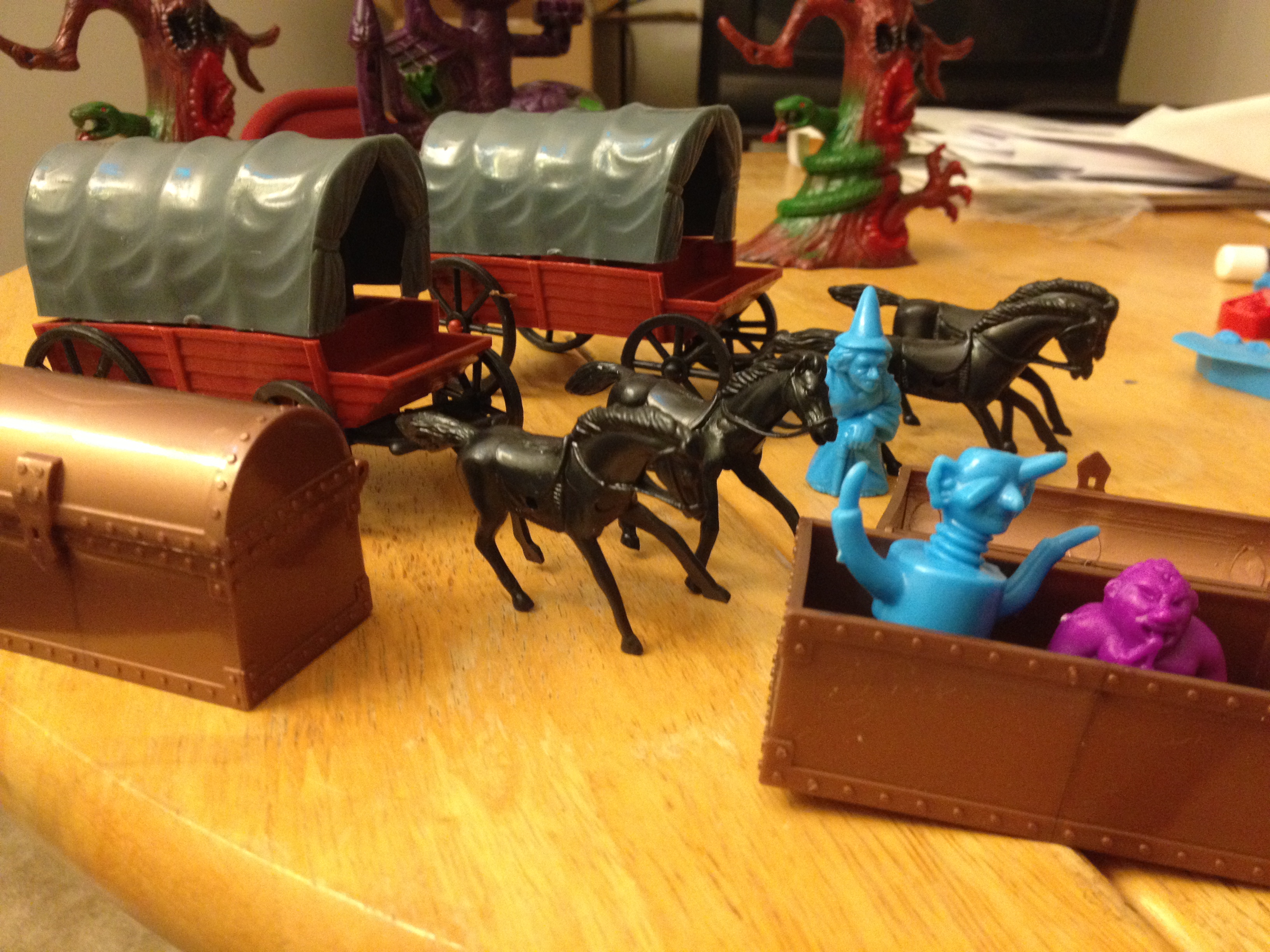
The Props: The set came with 2 wagons and 2 treasure chests. The wagons are quite obviously ripped off of a Western line, but the fact that the canvas was printed in grey plastic instead of white really adds to the Transylvania feel of it all. The two treasure chests are way too large for “treasure,” but they actually work as really large coffins. The color is great, but before I even used them, I could tell that the hinges on the lid were broken the second I took them out of the tub- they come completely off when you open it. Still, the plastic “lock” on the front actually keeps it in place when shut, so it’s not a complete wash. 4/5

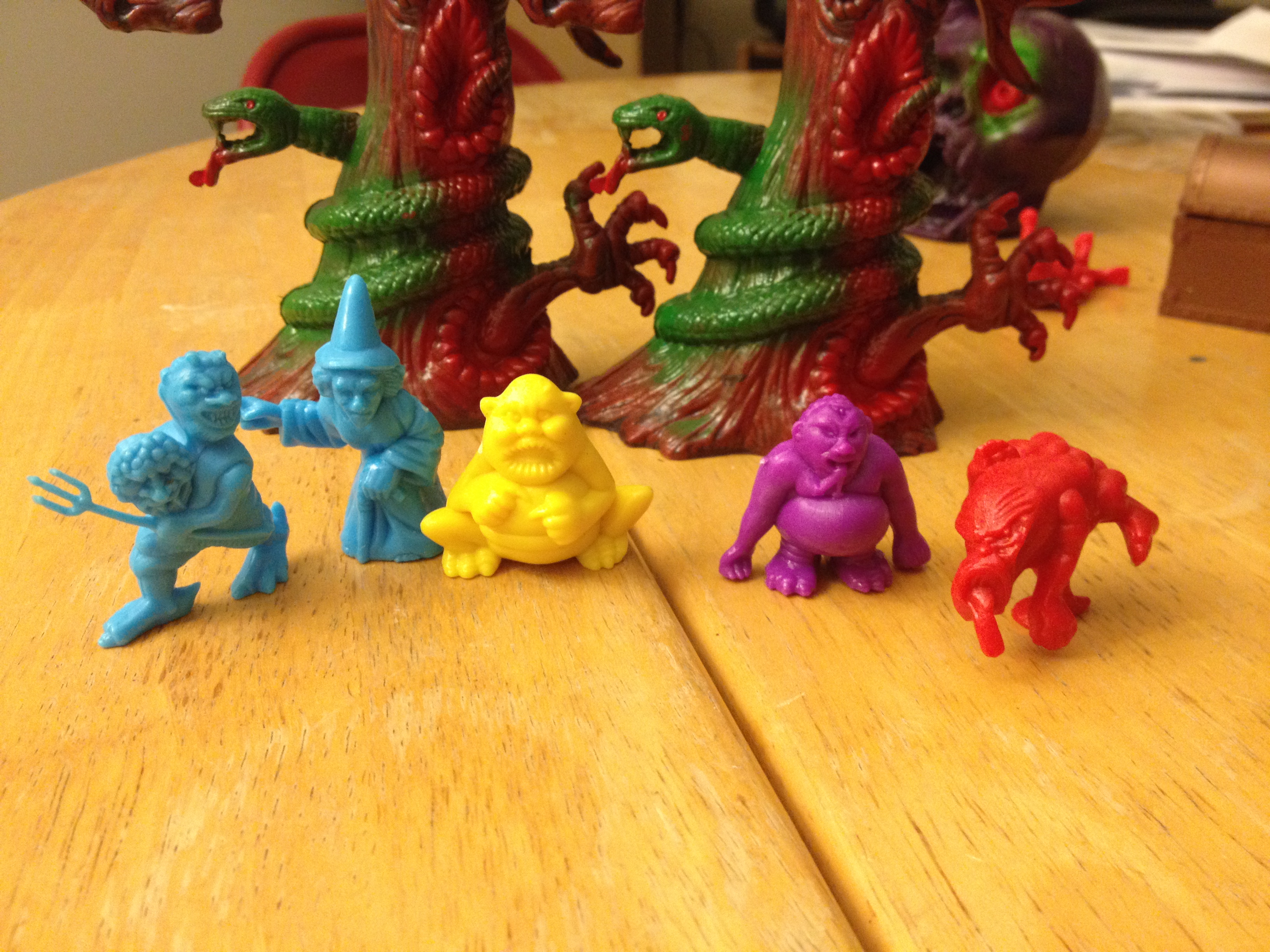
The Good: This shut covers some of my favorite pieces of the set, going left to right:

IMG_0703Pitchfork: Really like this guy. Can’t tell if he’s holding a monster head, or a mask- either way, there’s a story there! I only regret there’s only one in my tub.

Witch: As I said, fantastic. Lots of energy and character in her pose. I also got a ton of her, in all colors.

Fat Things 1 & 2: I also have a lot of these things (devils?) They’re just what I was hoping to get in the set; things that are not clearly defined, but fitting the mood. To me, they kind of look like Evil Buddhas. They also have an adundance of Plumber Crack from behind, which is an… interesting choice.

Nightmare Hound: Another “no clue what they were going for” toy, but they succeeded. The creature looks like a mutated humanoid or animal that’s balancing on one foot, mid-sprint.

The Ugly – These next few pieces aren’t terrible, but don’t quite blow me away (again, included the witch for scale.)

IMG_0704

Some inspired by hot-wing-induced nightmares, I suspect.

Coffin-Dude: This guy almost made it to the awesome side, if not for the scale of him. Take away the coffin, and he’s tinier than everyone else. It could work, “Suddenly, the coffin opens, and the Undead Mickey Rooney creeps out of the wooden box…”

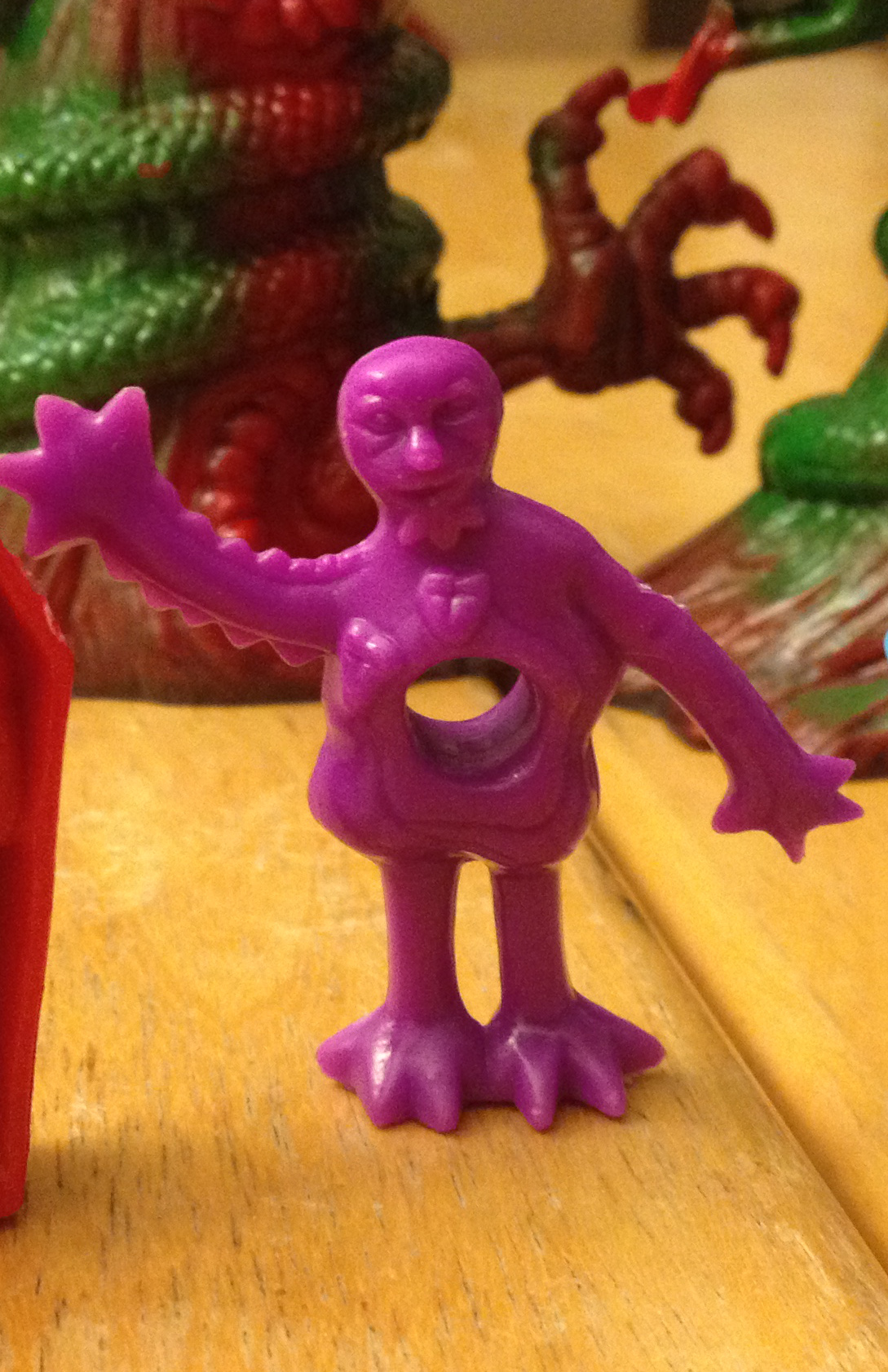
Hole-Chicken-Man: I asked for weird, and weird I was given. The purple guy in the middle is beyond description- the best I can guess is that it’s a bald rooster-man hybrid who seems happy you shot him with a cannon. Or, he’s a crossbreed between a chicken and a donut. It’s hard to tell on the photo, but he also has two random details nea his chest- they may be attempts to mold feathers, but it kind of looks like he duct-taped two small t-bone steaks to his torso. Maybe that’s why you shot him.

Robot-Guy: In a different set, this guy might have made the “Good” category, but in a box filled with devils and witches, the robot is just out of place. His design is also odd in that, instead of eyes, he has two random spikes. They are likely attempts at alien antennae, but it instead looks like a lab accident shoved a spike through the poor robot’s eye. Which, also tells a story. Also, he loses points over the fact that his base is a bit less sturdy than the others, so he occasionally tips over.

IMG_0706

Unstable Monsters

THE BAD: The satyr and the Hunchback figure are both fantastic, except for the fact that they CAN’T STAND ON THEIR OWN. I could go to the dollar store and find 50 different toys, some of them devoid of detail, shape, or personality, and they’d at least stand up 9 out of 10 times. These guys? Not so much. I only received one of the satyrs, but a lot of the creepy butlers. He’s definitely good enough to fix, though.

Overall: I’d give it 4/5. It’s mistmatched and has a wide range of quality, but the box said “Haunted House,” I think they delivered a product that evokes a creepy, weird setting.

DESIGN CHALLENGE:

Now, here’s how I’ll close any given “Toy Box Review”- by pulling a “Gygax.” I will take the strangest, least defined thing in the review and attempt to make it into an actual monster. For this one, I’ll use the Skeleton Crew Fate Rules.

chicken closeup

Fowl Murder

HUNTED SPIRITS

In the wild, they are a countless number of nature spirits, taking the form of trees, rocks, and rivers. Some live their long lives in the form of animals, in the shape of the bear or the duck. However, while the spirits do not age, they can be hurt and killed. A spirit of an animal that is shot may die, but it may linger on in a half-life- all kindness and mercy drained away, leaving only a spirit of vengeance. A Hunted Spirit will seek out the hunters that killed it and it’s forest friends, but will often hurt innocent mortals in it’s rage. These vengeful beings can change shape to human or animal, but the original scars remains.

High Concept: Half-Dead Animal Spirits

Aspects: Must Have Vengeance!, Always Part Animal, Nature is my Home.

Aspects:

n  Undead—weaknesses to holy magic, silver, garlic and other magical purities

n  Blood Rush—For Vampanzees, blood is both an addition and an energy source

n  Overly Curious

n  Fight or Flight

n  Bouncy Little Buggers

Commonly Level: Average (+1)

Stunts:

Shapeshift— Hunted Spirits may change shape as a free action.

One with Nature—Once per scene, a Spirit may use Wilderness instead of any other skill. If there are several spirits in the scene, instead treat instead as “once per exchange, any ONE spirit may use Wilderness as another skill.”

AVERAGE (+1) FAIR (+2) GOOD (+3)
Athletics +1, Wilderness +1
Intimidate +1
Wilderness +2
Intimidate +2

Deceive +1
Athletics +1

Wilderness +3,
Intimidate +3

Deceive +2
Athletics +2

Notice +1
Stealth +1

Stress:
No stress boxes—a one shift hit is enough to take them out.
Stress:
One stress box—a two shift hit is enough to take them out.
Stress:
Two stress boxes—a three shift hit is enough to take them out.
Aspect: Monkey See, Monkey Do

Now, I challenge you, dear readers: use the Chicken-Donut Man, the fat devils, or any other toy and make a monster of your own (no rules necessary, if you prefer text.)

GMProv Part 3 – Verily, And More (Or “Yes And”)

Standard

For this installment of “Improv for GMs,” I wanted to tackle something that is less of a trick and more of a philosophy. When I first learned about improv in middle magic zip it scaryschool, one of the golden rules was “No Negation.” Negation is not just the act of responding to a question with no, it’s an entire frame of mind. However, it was a decade before I learned of that rule’s opposite: “Always say ‘Yes And.’” (If this sounds familiar to you, they made fun of it on “Arrested Development.”) First, a small shameless plug:


As a part of BrigadeCon, I’m hosting a game of Skeleton Crew RPG live online at 6pm EST, Sat Nov 15th. Spots still available!

Also, the Skeleton Crew RPG is finished, and is now open for playtesting! Sign up here to get your free copy! [/ Shameless plug]


“Yes And” is a rule, but to demonstrate it, I’m going to walk you through an exercise I stole from a Second City book, appropriately named “Yes And.” This is how the game works:

> All the players sit in a circle and pretend they are a part of a company developing a new product.

>Each player takes a turn adding a new idea about the product.  They can focus on any angle of the product’s development and promotion (ex. features, construction, packaging, advertising, etc.)

> Every statement must start with “Yes, And…”

>No statement can repeat what anyone else said.

>NO Statement can contradict any statement made by another player.
Unacceptable: Player A says “Yes, and the t-shirts are red.” Player B says “Yes, and the t-shirts are blue instead.”
Acceptable: Player A says “Yes, and the t-shirts are red.” Player B says “Yes, and they ALSO COME in blue.”
>Play ends when everyone has had at least one turn. (If it’s a small group, wait until each player has contributed 2-3 times, or until everyone’s bored).

I encourage students that the ideas can be as simple as “Yes, and the t-shirt’s made of cotton,” or as far-fetched as, “yes, and the t-shirt lets you travel back in time and kill your enemies before they were born.” Nothing is wrong, so long as it doesn’t repeat or negate a previous statement.

In this game, we see what the “Yes And” mindset accomplishes:

Yes – It affirms the creative elements of others. The statement does not try to edit or undo anything already established.

And – It doesn’t just affirm what others do, it requires you to add something that others can build on, creating a mutual created world.

Now that you got the jist, let me clarify Negation a little further. Here’s a hypothetical scene I love to propose in improv classes:

Imagine two improvers starting a scene. They are not assigned characters or a situation, and are supposed to create the scene from scratch. Person A turns to person B, grabs them by the hand, and says, “C’mon, Grandma, let’s go to the zoo?”

The question: What’s the WORST possible thing Person B can answer?

Inevitably someone will answer, “No, I don’t want to go to the zoo.”  I tell them that’s the second worst answer they can give. The number one worst answer would be: “I’m not your grandma.”

The second worst answer negates the action- this results in a boring scene that goes nowhere, and establishes a competitive relationship between the players- subconsciously, if their idea isn’t taken, they lose.

The worst answer negates not just the action, but the universe- if a player makes a statement (i.e. “you’re my grandma,”) that is establishing a FACT. To negate a fact is the same as saying “I don’t exist in the same universe as you,” or, alternatively, “your universe isn’t good enough for me.” This creates a disconnect between players, and an adversarial relationship- on a subconscious level, you’re not just competing, you’re playing two separate games.

Practical Applications: When Would I Ever Use This?

Brainstorm! – The most direct version of this is when brainstorming a new concept. When doing panels on collaborative fiction, I always advise people, write down EVERY idea, and don’t shoot anyone else down. It might seem like a bad idea to you, but everyone else might love it; or, what seems like a weak on idea on its own might be fantastic when coupled with an idea that comes later. If you start a brainstorm by saying “no, that’s stupid” to everyone else, the “storm” will fizzle in no time, with only the most aggressive and swaggering people contributing. Here are further examples:

Brainstorm: Campaign – Use this when setting up a campaign setting with the players. This is especially true of Fate games, which encourage collaborative world and character building. If you have a playful group, you might even play a round of the “Yes And” game, just to warm everyone up.

Brainstorm: Establishing Facts – Even after the campaign is started, don’t be afraid to have the players held shape the world. If a player wants to try a magical ritual that is only loosely defined in a rulebook, before you tell them what’s required for the ritual, ask them; they might come up with something that’s not just fun, but sets a precedent for how magic works in the universe. Once again, Fate has a great precedence for letting players establish scene aspects whenever you come to a new setting- this is a great way to ease players into making small facts, without giving them the reins or throwing them in the deep end.

Brainstorm: Atomic Robo – I have yet to have the pleasure of trying it out in the flesh, but the Fate Core game Atomic Robo actually has a mechanic built around Brainstorming, as the various scientists deduct the origins of a threat and concoct a plan to defeat it. As written, the Brainstorming system is a little competitive, but for a twist, why not make it that the final solution has to be built on the ideas of ALL members present?

Adventures – The Yes And is also really important to keep in mind when running adventures. Whenever a player asks for permission to attempt something off of the beaten path, ask yourself: is my response negating the idea or Building on it? That’s not say that everything a player wants falls into their laps without a catch (some would reclassify this as “Yes, But,”); however, remember that the perfect story in your head isn’t a game, it’s a novel. A game requires collaborators, who are writing the story with you.

Lost in Translation – Muddling Messages

Standard

LOST IN TRANSLATION

This week, I’m going to focus on translation. Certain rpgs, like Skeleton Crew (open playtesting starting soon!), require characters to translate a message from one language to another. If the researcher was perfect, you could just hand over the “translated” message in English exactly as you wrote it. However, perfection is boring, and PCs are seldom as skilled as they think they are.  So, what are some ways you can mangle the message, but still make it feel like a translation?research barron

Answer: Google Translate! Of course this requires an internet connection, and copy/paste is lot easier on a keyboard. However, with a little bit of goofing around, you can get great results.

The Message: As a test, I wanted something that had a few complex words; more important, if the words are put in the wrong order, it could mean the difference between life and death for a character. So, I borrowed a line from the classic movie, The Court Jester (which stars Danny Kaye, the mom from Mary Poppins, and a hot Angela Lansbury… yeah, you read that sentence right.) Here it is:

The pellet with the poison’s in the flagon with the dragon, but the vessel with the pestle has the brew that is true.

MANGLING METHOD #1

The first way to mangle the phrase is to post the phrase in English, translate it into another language, and then retranslate the translated phrase back into English. For example:

In Spanish, that translates as:

El pellet con el veneno está en la jarra con el dragón, pero la vasija con la mano del mortero tiene el brebaje que es cierto.

If you paste the Spanish into the first box and translate it back into English, you get:

The pellet with the poison is in the jar with the dragon, but the vessel with the pestle has the brew that is true.

Now that you got the idea, I’ll just skip to the end result for different languages. I was really amazed how many translations came back perfectly (some even having the “Brew that is True” rhyme.) However, here are few more of the interesting results:

Urdu: Poison in the flagon with the dragon, the vessel with the pestle has the brew that is true with the tablet.

Catalan – The pellet with the poison is in the jar with the dragon, but go with the pestle has the brew that is true .. (Not that different, but I found the fact that it added advice interesting)

Georgian – Precipitation venom in a flagon dragon, but the vessel with the pestle has the brew, that’s true .. (Interesting punctuation swap there).

Gujarati – Flagon with the dragon’s venom, but with the pestle has the brew that is true pellet with the ship .. (Where’d the ship come from?)

Haitian Creole – Lead is poisonous and in the flagon with the dragon, but the vessel with the pestle has the brew that is true ..

Hungarian – The poison pellets in the pitcher of the dragon, but the ship breaks the brew that is true .. (Fluid sounding, but not quite right)

Igbo – The pellet with the poison from the flagon dragon, and utensils and pestle to make a beer that is true .. (Utensils and beer?)

Irish – The brew is truly the pellet with the poison in the flagon with the dragon but the vessel with the pestle .. (Right words, wrong order!)

Persian – The pellet with the poison is in the vessel with the pestle is the missing dragon tail that is true .. (This is flipped too! Bwah ha ha!)

Japanese – Poison of dragons, pellets of container and flagon with a pestle is have the brewing is true .. (The rhythm is almost a haiku.)

Korean – The pellet with the dragon the neck of the bottle of poison in a narrow; the pestle has the brew that corresponds to the vessel. (To contrast with Japanese, this feels like it came from a text book.)

Latvian – TheGranulu with poison years in the bottle with the dragon; thekuģis with the pestle has the brew that is true .. (The second part’s perfect, but the first part leaves you unsure what IS poisoned.)

Maori – Knead with the poison in the bottle against the dragon; the vessel to crush the silica is a true ..

Marathi – Flagon with the dragon of the poison in the paper; The vessel has a beam that is true drink ..

Slovenian – ThePeleta sthe otrov u carafe with a dragon, or the cup with a pestle to cook the Truth ..

Finnish – ThePelletti kanssathe poison nthe bottle of wine kanssathe dragon, muttathe alusthe pestle onthe drink that is true ..

Mongolian -Poisonous dragon, but the pestle in a pot Flagon Rolling distillation is that true ..

Somali – Size is toxic in raisins demonic But container with tuntid brew has to be true .. (Almost Post-Modern sounding.)

Tamil – The pellet with the poison dragon, but the truth is that God’s brew flagon is shipping ..

Turkish – the dragon Amath Zehirth rammer ileth ship in unity ileth Vials The pellet doğrudurth to brew ..


Which to use? That depends on how mean you are and what you want to achieve:

German, French, Russian – I didn’t put these on the list above, because the result was near perfect. You might lose some of the poetry, but keeps all of the meaning. If you want to make it less fluid but equally clear, try Japanese or Korean.
(Above paragraph in Korean, retranslated): German, French, Russian – because the result was near perfect, I did not put the following in the list above. You lose some of the city, but you can keep all the implications. If you want to make less fluid, however, equally clear, consider Japanese or Korean.

Finnish, Slovenian & Turkish- These one resulted in a few properly translated words and a lot of nonsense ones. This gives the translator a lot of doubt, but they know where the doubt lies. It feels like you were given half of the puzzle. Finnish seems to go extremely wonky when you have a lot of “the”s in the sentence.
(Above paragraph in Finnish, retranslated): Finnish, Slovenian and Turkish, which together resulted in very few translated words share a lot of nonsense about them. This antaathe the translator a lot of doubts, but they know missäthe doubt lies. It seems as if you had puoletthe puzzle.

Marathi, Mongolian & Maori – These resulted in real words, but a nonsense sentence. The narrator is unsure about what to trust, and what to dismiss. It hints at a story, but the true meaning eludes you.
(Above paragraph in Marathi, retranslated): Marathi, Mongolian and Maori – the real untranslated results, but only a foolish statement. Feature dismiss faith CEO, Chief Executive Officer and is unsure about. It hints at a story, but only one true meaning eludes.

Irish & Persian – These are deceptive, in that they sound like they are fully formed (and poetically beautiful), but the information might come out skewed. This feels like the perfect result to give a researcher who is overconfident- it sounds right, until they make their fatal error.
(Above paragraph in Persian, retranslated): Irish and Persian – this is deceptive, in that they sound like they are fully formed (and beautiful poetic), but may come out skewed data. It feels so good to be a researcher’s right, it sounds overconfident-, either to his fatal error.

MANGLING METHOD #2

So, what can we do to mix it up even more? What if we went through a few other languages before we return back to English?

SO, Let’s try English – > Chinese, Chinese – > Russian, Russian -> English

End result: Poison in a bottle with a dragon, but with pestle container particles with BREW’s true.

Good, let’s add in Norwegian & Arabic too into the chain:

Poison in a bottle with a dragon, but the container stump particles with the right mixture.

MANGLING METHOD #3

Now, what happens if you mess with the translation itself? For example, what if you add a random letter to every forth word in the translation?

Norwegian translation (normal) Pelleten med giften sin i flagon med dragen, men fartøyet med stampe har brygg som er sant.

Norwegian (with added letters in bold): Pelleten med giftren sin i flargon med dragen, mein fartøyet med stamper har brygg sqom er sant.

Result: The pellet with giftren her in flargon with the dragon, mein vessel with tubs have brew sqom is true.

You end up with a most of it being genuine, some of it sounding like it could mean something (“mein vessel,”) and some that is clearly messed up (mmm… sqom.)

Adding random letters helps with language that use the same alphabet, but you can also use mess with languages with different alphabets.  For example, in the following Russian, I copy/pasted the “д” symbol in every few words.

Russian (with added д s): Осаддок сthe ядом-х в бутылди с драконом, но содсуд с пестиком имеет варевдо, что истинно.

You get: Osaddok sthe poison’s in butyldi with the dragon, but sodsud pestle has varevdo that is true.

Or, instead of messing with letters, why not mess with the spacing? In Traditional Chinese, hit the Enter button after every character, putting each character on its own line.

So: 与毒在

Becomes:


This turns a clear translation into:

Chinese Traditional (with spaces): Versus Poison In Versus Dragon Of Liqueur Pot, But Versus Pestle Allow Device In Of Stars Grain Tool There is BREW This Are Really A.

To me, this sounds like a great way of faking hieroglyphs or translations other pictographic languages; each word has its own strong, individual meaning, but fails to connect to the others in a coherent sentence.

MANGLING METHOD #4

  1. Translate from English into One language. Copy it.
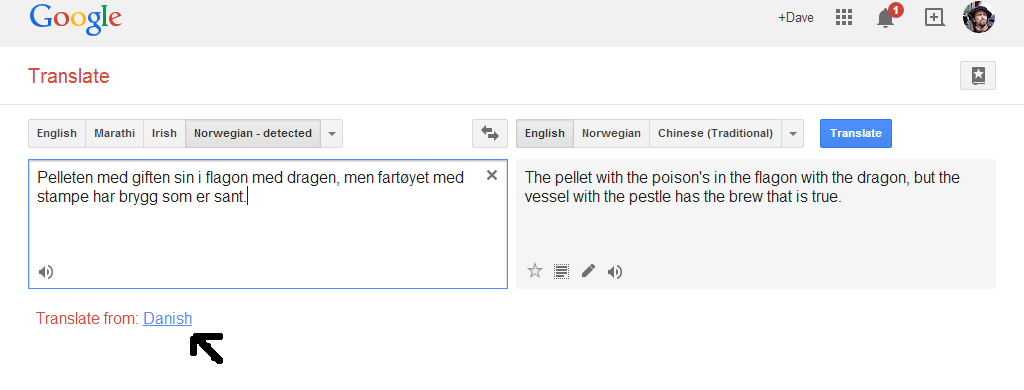
  2. Next, Paste it into the first box. Instead of using Detect Language but tell it that it’s a language SIMILAR to real one, and translate it to English.

screen capture

Chinese text translated as if it were Japanese gives you: Azukadoku Jae given 龙的 Sake壶, however Azukakine container medium basis granulocytes androgynous BREW 这是 true basis.

Japanese translated as Chinese: There ド poison fu ra ra Oligo Oligo nn nn To で na ku pestle で container To Paint Ritz ッ Suites ga really で thou ru Niang who made wo ~ te I ma si.

Spanish translated as Italian: El pellet está en el veneno the jarra with el dragón, but the vasija with the hand holding the mortero brebaje el que es cierto.

Latin as Italian – Cum lagena in blood cell veneni cum dracone, Has Ceruisam stack vas verum.

Norweigan as Danish- The pellet with the poison’s in the flagon with the dragon; fartøyet with tamping has brygg which is interesting.

Croatian as Slovenian – ThePeleta sthe otrov u carafe with a dragon, or the cup with a pestle to cook the Truth ..

Marathi as Hindi – Cya in to Batli poison dragon co Daruchi official documents; The drink contains Musla Naukela This is true ..

Nepali as Hindi – The vessel with the pestle with Dskko Ajidagar saturate with poison pill Sacho flagon that the solution g ma ..

Have some methods of your own? Share them below!