ALL’S WELL THAT ENDS WELL: COMEDY AND TRAGEDY IN GAMING

Standard

The other night, I had a chance to watch a live performance; it was a group of actors and impersonators that specialize in political satire. I did care not for it, but I will not mention the name, as the performers themselves were very talented and hard working, and I don’t want my bad review to reflect on the actors in any way.

My girlfriend (scratch that- as of this week, my fiancee) asked me why I did not enjoy all of it.*  “You like Colbert Report and Daily Show,” she said, “why not this?” It took a bit of analyzing, but I finally put my finger on why this particular show didn’t appeal to me:

*It didn’t really matter what answers I gave her; she still accused me of being an old fart.

1. Most of the jokes avoided the issues of philosophies of the characters. They went into Huckabee being religious, and the fact that politicians lie, but didn’t seem to go any further than skin deep; Trump has funny hair, Obama has big ears, Hilary has a vacant stare; the democrats distract, the republicans are crazy, etc. At best, this is light frivolousness; at worst, this is superficial muckracking.

2. It was bi-partisan in nature, doing its best to rib on both the left and the right; given the fact that they are in DC, this can be seen as a savvy move, as they are less likely to alienate half of their audience. However, I couldn’t help but feel like one almost canceled out the other. It didn’t feel like a cry from the moderate middle against the extremes, or a call for compromise; it just seemed to devoid of any legs, drifting aimlessly from one borrowed viewpoint to another without committing to anything.

In contrast, the Daily Show often takes intense issues and philosophies and boils them to their core; more often than not, you’re not laughing at the people being lampooned as much as the ideals. It some instances, the Daily Show follows the old movie adage, “show, don’t tell” – you don’t say that someone’s a hypocrite, you show a story about WHY they’re a hypocrite. The audience learns about an issue they never knew, or an important figure they were ignorant of.

On the Colbert Report, the opposite was the case; Colbert’s cold-hearted host character would often be forced to change his rigid views to match a forever progressive world; his struggle to learn and adapt, filled with tears and revelation, made the new events fresh and humanistic.

In the aforementioned live comedy show, most of the characters just walked onto the stage, did a few jokes, and left, like a bad stand-up routine; nothing changed, no one made any real human connection. However, there were a few exceptions; one of my favorite pieces involved President Barack Obama lamenting about getting pulled into war with Syria, and finding solace from a commiserating George W Bush, who was also pulled into the Middle East. They were transformed from thin caricatures to real people that shared a bond.


With this in mind, I would like to propose a tweaked definition of
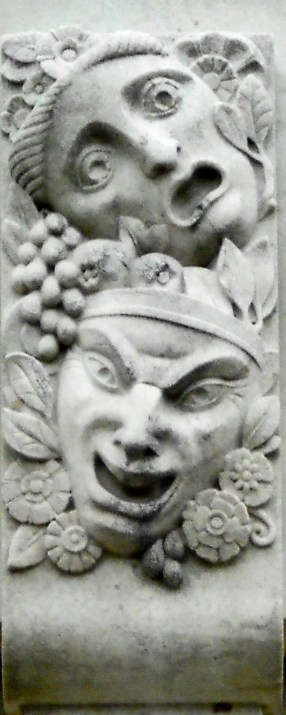
Cret_Comedy_and_Tragedy

Why so serious?

comedy and tragedy, based around this concept:

1. Comedy – in which the characters learn to be better people.

2. Tragedy – in which the characters are given the opportunity to learn to become better people, but do not.


COMEDY BREAKDOWN

By this definition, a comedy is about flawed individuals who fib, fumble and fail to get what they want, and generally learn the life lessons necessary to become better human beings. The liar turns honest. The overly righteous person learns to relax. The stuttering lover learns courage.

An old benchmark for “is it a Shakespearean comedy?” is, “did someone get married at the end?” With this model, that still works; isn’t marriage about two individuals learning to be a functional union?

Bad Comedy

Bad comedy, we can surmise, is the opposite:

A badly written comedy is one in which none of the characters learn to be better people.

If a comedy is 100% custard pies and meaningless car crashes, you don’t have a story (at least, not one worth telling). If the heroes don’t improve and/or the villains aren’t taught a lesson, the experience was a frilly waste of time.

That’s not to say that EVERY character needs to learn. There are plenty of Jack Sparrows and supporting characters that stumble around, making sure others get their better future; and like Jack Sparrow, many of them do have their own brief moments of improvement and enlightenment (even if they are conveniently forgotten when the sequel roles around.) In the cases of the Marx Brothers’ films, the clowns make up 70% of the movie, but even they help the lovers get together and rattle the villain’s brains. For a classic example, in Moliere’s The Misanthrope, the title character and his on-again/off-again betrothed come close to amending their ways, but don’t; their best friends, however, learn, grow and get married.

TRAGEDY BREAKDOWN

Just like a comedy is about people learning, a strong tragedy is about about people failing to learn. Othello fails to learn that he should trust his wife more than his old war buddy; Hamlet fails to learn that bloodshed only leads to further bloodshed; Juliet fails to learn that the cute bad boy really won’t change, etc.

A good tragedy is all about the little brass ring of hope and enlightenment, and watching the characters reach for it; but it is just out of reach, or more painful still, they pull their hand back at the last moment.

Bad Tragedy

Thus, here is my take on a poorly written tragedy:

A badly written tragedy is one in which the characters are never given the opportunity to learn.

Just as a bad comedy contains a lot of whimsy with no change, a bad tragedy doesn’t give the character a chance to change; if there is no brass ring or lesson to learn, then there’s no missed opportunity for redemption; rather, the characters are being railroaded towards disaster without any real choice or control.* They aren’t characters making tragic decisions, they’re just cardboard stand-ins that the author couldn’t bother to give any life; alternatively, they are decent human beings who are have bad things happen to them for seemingly no reason (I haven’t seen it, but I’ve been told the Michael Keaton film “Birdman” was guilty of this).

*I suppose the lesson the characters could learn is, “life is like being railroaded towards disaster without any real choice or control,” but that’s a pretty ham-handed way of showing it. Macbeth, for example, toys with the themes of fate and destiny, but still gives the characters the ability to affect their fates (or at the very least, the illusion of choice).

I’m not a fan of many modern tragedies, in that many of them don’t seem offer any chance of redemption. It’s like watching a bunch of kids hanging on to a playground roundabout that’s going faster and faster; there’s no mystery about what will happen next, the kids will all fly off. In a good comedy, the audience is curious about what clever tricks will be employed to bring the plot line to a satisfactory conclusion; in a bad tragedy, the only unknown factors are when and in which order the characters will fly off to their doom, and that’s not quite enough to engage me as an audience member.

WAIT, WHAT ABOUT SATIRE?

Satire is slightly different, in that it is a comedy in which the main characters MAY learn, but are not required to; in this way, the plot line may more closely parallel a tragedy*. Rather, it the audience that learns the lesson. However, like the Daily Show, some of the best satires have an ordinary, Everyman character (like John Stewart) who can react to the craziness and arrogance around him, and who can learn (or pretend to learn) alongside us.

*For example, Chekhov considered many of his tragic plays, like the Cherry Orchard or Uncle Vanya, “comedies,” despite the fact that they are, well, NOT FUNNY**. They really are about foolish people who bring about doom; in this sense, they are satires about a dying way of life, with a clear message for the audience to pick up upon.

**Maybe they’re funny by Russian standards.


GET ON WITH THE GAMING THING!

What is this literary rant doing on a gaming blog? A few things:

1. When crafting any story or campaign, it’s a good idea to know how to craft a story.

2. Several games have popped up in the last year that focus upon storytelling, particularly about tragedies. Such examples include in Fiasco by Jason Morningstar, A Tragedy in Five Acts by Michelle Lyons-McFarland, and The Play’s the Thing by Mark Truman. I haven’t had the pleasure of playing any of the three, but I hope to before this time next year.

3. For your one shot games, I propose a simple thing you can tack on at the end. I give you:


THE EPILOGUE!

I’ve run several one-shot games before at gaming conventions, and at the end of the long drawn out fight with the baddie, I always felt bad whenever I dropped the suspension of disbelief like a fire-curtain and said, “That was it! Thanks for playing! Bye!”

I now propose the following: after any one-shot game, hand each player a blank post-card. The players will take a minute or two to write down what happens to their character after the story is done. Their fate might be as dramatic as “turning a new leaf,” or “to walk the earth like Caine”; it might be as simple as “taking a nap” or “getting shawarma.” After the players have written them, have them share if they like. If you want, the GM can even write one for a villain or major NPC.

Why do this?: It eases the players back to the outside world (in that they are thinking of their character from the outside), but ends on a powerful note; they have full control over the character’s fate. Did they learn? Did they fail to learn? Did they gain what they sought, or are they saving that nugget for another day?

More importantly, it turns the random rolls of the dice into a full story, with a solid end.


On that note, readers, I want to wish you a Happy New Year. Until next year, GAME ON!

Fate Accelerated: I Don’t Like Spam!

Standard

I like Fate Accelerated. I really do. Hell, I’ve made two Fate World settings using it, and will likely make my third setting FAE too. That being said, it’s not perfect.

Sidenote: If it’s not perfect, why do I play it? To paraphrase Winston Churchill, “[Fate] is the worst form of [RPG], except for all the others.”

The best part of FAE is that there is always another way to skin a cat; if a party’s sorcerer has to leave the game early because they have work in the morning, you’re not suddenly stuck with a group incapable of overcoming the magic door down the hall; through cleverness, careful study, or barbaric vandalism, they will find a way.

Deep-fried_spam_(2041662434)

Yum. I think. Conflicted.

The evil flip-side to this is that whenever you want to encourage a player to approach a problem from one of their lesser approaches, someone will insist that they can use their strongest approach; this frequently called “spamming.”  While they mean well, these sophisters will turn every turn into a drawn out negotiation, which can kill the mood and drag the evening out. Of course, the GM could always say “No, you have to use this approach,” but that’s against the spirit of FAE, and saying “No” leads to an unfriendly atmosphere (one of my very first entries discussed how much a GM should say “yes.”)

Evil Hat’s Zen Master of Fate Rob Donogue has proposed some ways to get around this on his blog, The Walking Mind, but I thought I’d try one or two ideas of my own:

Option 1: the Permission Aspect

If a player wants to use an approach that doesn’t seem obvious Require a “Permission aspect” first. This will likely be a situation aspect. If they already have a character aspect, require that they invoke it (which gives them the ability to use the approach AND the invoke bonus).

Ex. Chartok, Marna, and Phil all want to attack the a vicious ingredient in Kitchen Arena, the Monstercheese. Chartok’s player wants to charge straight in using Forceful, while Marna’s player wants to use Clever, and Phil’s player wants to use Sneaky. The GM sees no trouble with Chartok using the Forceful approach to make a raw attack, but feels that using Clever or Sneaky is less justified in this instance. The GM requests they get permission aspects first: a rational person like Marna wouldn’t charge in blindly, but if zhe spends an exchange looking for a weapon first (create an advantage for a Giant Cheese Machete), zhe could attack with Clever during any later exchanges. Similarly, a sneaky attack from Phil out of nowhere seems forced, but if Phil’s player spends a fate point to invoke his aspect “Born in Shadows,” the GM will let him use Sneaky to attack (and also gets the +2 invoke bonus). The GM is feeling generous, and decides these invokes are enough to let them use those approaches for the rest of the scene, or until it no longer makes sense (ex. Marna loses the Cheese Machete; Phil uses Flashy to draw attention to himself.)

If the player has a weapon that’s also a stunt, which is tied to a specific approach (ex. The Bow in in Masters of Umdaar using Quick), then the character can always use that weapon to attack; however, they can only use it whenever it seems right for the weapon (ex. Can’t use the bow in close combat), and only if they possess the weapon (ex. They haven’t been disarmed).

Option 2: Critical Hit

If players don’t like the stick, give them the carrot! Whenever a character makes an attempt with an Approach that is Fair +1 or lower and succeeds, automatically treat the result as success with style. Thus, they have a lower chance of success, but a higher gain should they pull it off. A GM might offer this all the time, but it seems better to me as a bargaining chip.

Player: I don’t want to use Forceful to attack, I want to use Quick, it’s higher!
GM: Okay, but if you hit with Forceful, I’ll give you a Critical Hit bonus…


Which option sounds better to you? Tell us what you think!

Until next week, GAME ON!


Image Citation:

Spam image courtesy of Father.Jack from Coventry, UK, Transferred from Flickr by User:Fæ. Used with permission through Creative Commons Attribution 2.0 Generic license. Neither licensor nor the Spam corporation endorses this blog or its use.


Skeleton Crew Necromnibus – Closet Full of Skeletons

Standard

Welcome, readers! So, Halloween ’15 has come and gone, and I know what you’re thinking: not a single supernatural-horror themed entry?! This is particularly egregious, considering one of Tangent Artists’ works-in-progress is Skeleton Crew, an RPG based off of our original comic series. Why didn’t we post something with that?

The honest reason: a few months ago, we decided to take the rulebook back to the drawing board. Don’t get me wrong, it was a good RPG, but we feel we can make it even BETTER. If the Fate System is all about telling a story, then that’s what we’re going to help players do; instead of giving fans a fat splat book filled with stats and figures, we’re going to create a book that helps you tell your story!

Speaking of stories, we’re proud to have a new product at our Tangent Artists booth: the first Skeleton Crew Necronomnibus! This massive tome collects issues one to five of Skeleton Crew into a single book.

necronom_cover_print_original

In honor of this milestone, I thought I’d come up with a TA Tabletop entry with FIVE little extras that you can use in your next Fate game, one for each issue.

SKELETON CREW ISSUE ONE: DEATH AND TAXES, BUT MOSTLY DEATH

Kingship Manor – Extra

Kingship Manor is a decrepit mansion located in the Jacobian Heights sc1page012suburbs. It would likely be condemned by the Board of Health, if any of them had enough of a spine to go inside it. In 1884, the manor was been built by the Kingship family, a well-renowned circle of occultists; all but one of the Kingship family members are dead, but their spirits and shadows of many others linger on inside the walls.
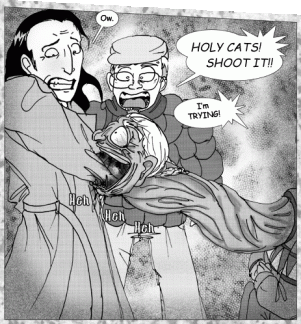
Special Rules – Kingship Manor is a location with several situation aspects, including:

Rotting Boards & Creaky Doors – This counts as an obstacle whenever anyone attempts to move between zones.

Perpetually Dark

Bleeding Walls & Ghosts Over Your Shoulder

Big House – Let’s Split Up, Gang – Can be compelled to split the party

Stunt – Gives You the Creeps – The house has the ability to make you shiver in your boots and see things that shouldn’t be there. Once per session, the GM may use the Manor against the occupants; treat this as a create an advantage or attack roll with Provoke or Intimidate +5,which is defended with Will; roll to attack each person separately. Timing: the GM may choose to attack all of the group members in a single turn (ex. when they first enter the manor), or may chose decide to toy with them one by one (ex. If used to attack, the house deals mental stress. If used to place an aspect, the aspect may be invoked by the GM to cause the PC to see something horrific, or to be drawn in by a hallucination.

Old & Busted – The house is not likely to come crashing down around your head, but it is definitely in a fragile state. Any of the interior doors or walls may be broken through with a Physique roll of 5 or higher. This does not apply to walls leading outside and the basement walls (which are made of thicker material).

ISSUE TWO: HOW WELL DID YOU KNOW YOUR FATHER?

Revenants – NPC 

[From the notes of Avi Bashevis]

“During our research expeditions, we have encountered numerous beings that have seemingly “returned from the grave” (although I still theorize this to be a death-like coma state – see Appendix B). Some of these beings sustain physical and mental characteristics from their previous life, but many of these beings suffer radical alterations; it is almost as if they suffer severe mutation. For lack of a better term, I call these altered beings bite arm“revenants.” Unlike humans I have classified as “vampires” or “werebeasts,” which share common symptoms and modifications, no two revenants are exactly alike. Most are in a frozen state of composition, still maintaining their flesh- some even look completely alive if not examined closely. However, this is the only common trend I could find; Sample 1A had limbs that stretched like rubber, while 1C had detachable body parts that float on their own. Sample 4A grew eyes in random parts of his body, while sample 5B had skin grew over her entire force, blocking her eyes completely. I am in the process of conducting research to discern whether these variations are caused by the conditions of their death, their burial, or by some factor they were exposed to in life.”

In the Skeleton Crew universe, “revenant” is a catch-all term for any undead monster that doesn’t fit well into any of the traditional monster rolls.

Here are some rules for creating revenant NPCs

High Concept: Supernatural Fleshy Undead Mutants

Aspects: Driving Hunger (for food, revenge, etc.)

Always Get Weird

Mutated Skills: When creating a Nameless Revenant NPCs, do not plan out their skills ahead of time. Instead, the first time that a revenant uses a skill (to either do an action or defend against one), roll 2dF and add +2 – this is the Revenant’s value for that skill; (for the sack of the action, do not roll the fate dice a second time, but treat it as revenant rolled a +0). Record the value on the revenant’s character sheet.

Example: Weston pulls back his fist and swings hard at a revenant; he rolls 1, plus his fight value of +2. The revenant defends with Fight (which it has not used yet), rolls 2dF and adds +2; it rolls a +2 on the 2dF, for a total of +4. This means the revenant has a Fight of +4 from now on. For this exchange, it’s treated as if Weston rolled Fight +2 plus +1, and the revenant has Fight +4 plus +0.

To keep things simple, once a revenant has recorded five or six skills with a value of +1 or higher, you may treat all other skills as +0.

Tougher Revenants: For tougher and named NPCs, you might include a higher bonus (2dF +3), a wider swing (3dF + 3), or allow the GM to pay Fate Points to reroll the value.

ISSUE 3: MIND YOUR MANORS

Sandworms – NPC 

harvey.gifSpirits tend to haunt areas where the veil between our world and the next are thinnest; likewise, there are other beings that slip through other dimensional cracks, including sandworms. Sandworms are alien serpents that start off small, but can grow hundreds of feet long. They are carrion eaters by nature, but will eat decaying veggie matter or hunt fresh meat if desperate enough. They are expert burrowers, using dimensional portals to hide in solid rock or in impossibly small spaces.
High Concept: Extradimensional Striped Serpents

Aspects: Drawn to Warm Dry Places

Sneaky, not Smart

Small Medium Large
Stealth +2

Fight, Athletics +1

Stealth +3

Fight, Athletics +2

Notice, Will +1

Stealth +4

Fight, Athletics +3

Notice, Will +2

Stress: 1 2 Stress: 1 2 + Mild Stress: 1 2 3 + Mild + Moderate

Stunts:

Ambush Hunter: If a Sandworm is making a surprise attack (ex. From a hiding spot, has a hiding aspect placed on it), it may add it’s Stealth skill to its Fight skill for that turn.

ISSUE 4: MIND YOUR MANORS -pt. 2

The Love Triangle – Scene

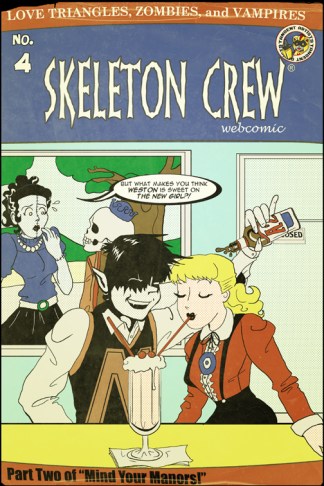
scissue4_cover archieA love triangle is a unique type of social contest. It can be adapted for any number of characters, but for this demonstration, we’ll start with three.
In this example, we’ll start with three characters: Maria, Shelley, and Weston. In the comic, there were two characters (Maria and Shelley) who were attracted to the third (Weston), but do not feel bound to this this; there’s nothing to say that you can’t have all three be attracted to each other.

In a love triangle scene, each character will attempt to use their skills to draw in a potential romantic partner, or sabotage another relationship. In the tracker below, every two characters are connected by three boxes. During each exchange a player may attempt to Lure or Sabotage; treat these as an overcome rule against active opposition. To lure, use an appropriate social skill, such as Rapport, Deceit or Evoke*; the target defends with Will. If you succeed, tick off one of the boxes in between your character and theirs.

Weston o o o Shelley
o o
o o
o o
Maria

*To see more on Evoke, see entry “Killing with Kindness.” The finished SC RPG will likely involve a version of evoke (working title: Incite).

If your character fails, then no boxes are ticked off (alternatively, if you have no boxes ticked off, you may “succeed with style,” which ticks off a box on the tracker of every characters connected to you- obviously, you’re charming but your aim needs work!) If you succeed with style, gain one box and a boost as normal.

To sabotage, you use different social skills, such as Provoke, Intimidate, or Deceit; pick a filled-in relationship boxes, and target one of the two characters on that track (that character defends with Will). If your sabotage attempt is successful, than uncheck that filled box- it becomes empty again. Also, if you succeed with style, you may also fill in a box connecting one of those two characters to you (your lies are drawing one of them in). However, if you fail by more than two points (i.e. the defender rolls +2 higher than your roll), you uncheck one of the boxes connecting you to the defender (or, if there are none, fill in an empty boxes connecting those two characters together); obviously, your underhanded tactics are not impressing them.

ISSUE 5: FRIGHT AT THE MUSEUM

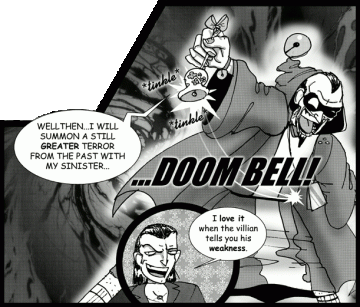
The Doombell! – The Artifact Extra

gear doombellThe doombell is a small bell once belonging to the dread necromancer Frida Feiertag, who was as brilliant as she was lazy. Instead of having undead servants lazing about the house and trying to summon them with a bell, she found it simpler to just create an artifact that raised servants right on the spot. Most of the undead zombies and skeletons it raises are too dumb to carry out complex tasks, but have a very low chance of turning on their master (always a plus). It can also serve as an alarm clock to long powerful-but-sleeping undead creatures, like mummies and liches, but these figures feel no sense of loyalty.
Special Rules: Any enemy* armed with the doombell may use it to summon forth one or more minions as an action; once per scene, the user may roll their Will plus 4dF- this are Summon Points. With this result, they can either summon a mob of NPCs or a single nameless NPC. A mob will include one mob member for each Summon Point, each with two skills (Fair +1 each) and one stress box. An NPC will have one skill equal to the number of summon points, two skills at Summon Points -1, a mild consequence, and stress boxes equal to the Summon Points -2. Create a high concept and an extra aspect describing the nature of the summoned minion. If the summoner is defeated or concedes, any remaining minions fade away; if not, they will linger around.

Ex. Deadringer has Willpower +3 and rolls +2, for a total of 5 Summon Points. He can create a mob of five NPCs (ex. +5 Fight, +5 Will, 5 Stress), or a single NPC (+5 Fight, +4 Physique, +4 Will, 3 Stress Boxes [a 1, a 2, and a 3] + Mild Consequence).

*By default, this item can only be used by enemy NPCs; however, if a PC manages to steal it, they can learn to use it as a stunt. If so, they can only use it once per session, and the Summon Points are equal to HALF of the PC’s Will + 4dF, rounded up. (Ex. If you roll a total of 5, you gain 3 Summon Points.) Any minions created will return to the aether after any long scene in which they participated.


That’s it for this entry. Until next time, folks, game on!

Gods and Masters – A Fate World Mash-up

Standard

Welcome to this week’s TA Tabletop! But first, an anecdote:

In 1994, the band Blur wrote the very catchy song, “Girls & Boys.” According to Wikipedia, the front-man of Radiohead, Thom Yorke, once said he had wished he had written the song, and called Blur “bastards” for writing it first.

In 2014, Evil Hat Productions gave me the amazing opportunity to write a Fate World for them. I am very pleased with how “Masters of Umdaar” came out, but that doesn’t mean I don’t hold an overwhelming sense of awe and fist-shaking frustration towards fellow author Chris Longhurst. Mr. Longhurst, who I’ve never had the pleasure of meeting, is guilty of writing “Gods and Monsters,” a setting so brilliant and original that I kick myself for not coming up with it. Worse still, I must acknowledge the fact that any attempt of mine to create a creation-god setting would have been far inferior than his… curse the scallywag!

Thus, in a vain attempt to cash in on some of his genius, this week I’m proposing rules for merging “Gods & Monsters” and “Masters of Umdaar” together.

Speaking of other people’s ideas, the idea of mashing-up “Gods and Monsters” and “Masters of Umdaar” was proposed by someone else on G+ several months ago. Sadly, I did not record the person’s name… if he or she remembers, please let me know, and I’ll be glad to give credit where it is due.


GODS AND MASTERS

Image avaible through Creative Commons 4.0, courtesy of Wellcome Trust http://www.wellcome.ac.uk/

Image avaible through Creative Commons 4.0, courtesy of Wellcome Trust http://www.wellcome.ac.uk/

Gods and Masters” is a two-part campaign set on the planet Umdaar. The gods in question are the Demiurge, the deities / demons / super-advanced aliens that made the planet as diverse and bizarre place it is today.

Gods & Monsters– Recommending Changes

In Thy Own Image – While some of the bioforms of Umdaar were created by accident or out of scientific curiosity, many were created or molded into the image of a certain god. Thus, I recommend looking (or rolling) on the Umdaar Bioform chart for inspiration. A centaur god of the wilderness makes sense, and the mind boggles at what a cyborg god would be like!

Regions – When creating regions, use the areas and rules listed in Gods & Monsters, but do not be afraid to add a sci-fi twist (for Umdaar-themed biomes, see this post from a few months back). Pick a distinct otherworldly name for each region, like the Crystal Forests or the Phantom Mountains. These regions will show up in both parts of the campaign, so make ‘em good!

Communities – Don’t forget that the communities on Umdaar don’t have to be human; likewise, any humans you encounter might not stay human for long! For the Demiurge, altering genetics is child’s play; you can raise dumb animals into sentience and shape worshipers into your image. If your power starts to bleed or a station is too close to a village, it might accidentally warp the mortal creatures nearby into strange new bioforms.

Artifacts – The Demiurge love their artifacts; its practically a compulsion. When they are working, they create tools to aid them. When they are courting, they give baubles and toys. Even if you’re not a god of Smithing or Tech, your Demiurge will have the ability to make artifacts that are metal, crystal, or even biomechanical in nature. Similarly, we recommend making artifacts part of the god’s identity, like Thor’s hammer or Hades’s Cap of Invisibility. This item might show up in a stunt. Alternatively, you can tie it into the God’s Boons, as follows:

Tier 1 – Innate – Your god may use this ability without an artifact.

Tier 2 – Requires the god to have their minor artifact (ex. a cloak, a piece of jewelry) at hand*

Tier 3 – Requires the god to have their signature artifact at hand*

The only exception to the “at-hand” rule is that a god can still use a boon if their artifact is in the care of a loyal community that worships them; this allows the god to use the boon “hands free,” but also opens your artifact up to theft or desecration.

If your artifact is lost, destroyed, or desecrated, your Demiurge will have to go on an epic journey to retrieve it, or to find the rare materials needed to rebuild it.

Sci-Fantasy: If you see the Demiurge as aliens, artifacts are easy to picture. However, for fantasy players, think of the artifacts as the god’s mantra-turned-object. Like Voldemort’s horcruxes or Sauron’s ring, they bear a part of the god’s soul.)

The Fall – When players start their campaign, it is in the early part of the Demiurge’s rule- there might not be races on Umdaar, or even a planet at all. However, at some point, eons in their future, the Demiurge will be gone. Did this take them by surprise, or do they have only have a limited window to be in our plane of existence? Do they learn of a prophecy, detailing how each will fall, like the Norse gods knew of Ragnarok? (Normally, I find “prophecies” lead for boring stories, but I make the exception with gods!)

Masters of Umdaar – Recommended Changes

Use the G&M approaches instead of the Fate: Bold, Subtle, Clever, Mighty, Wise, Swift.


PUTTING THEM TOGETHER

I see two easy ways to put the two games together:

NOW & LATER – The simplest way is to move from G&M to MoU is to play a short Gods & Monster campaign, end it, and then start a Masters of Umdaar campaign. If so, the G&M campaign is really about setting the stage; fill the world with wonders, bioforms, and artifacts. Demiurge should be encouraged to bleed power and leave loose threads- a small monster that the Demiurge let go because it is no threat to them might be a scourge that the archaeonauts have to deal with thousands of years later.

In this format, any godly Stations will likely become prominent regions in Umdaar. Of course, it’s possible that some of them will be inverted or corrupted: the Sky City becomes the Sky Ruins, the Shimmering Sea could become the Sludge Sea, or the forest god’s Screaming Forest can become the bustling industrial city known as the Screaming Furnace. The archaeonauts might even encounter a fallen god that has devolved into a monster (or even into a mad Master!)

FLASH BACK / FAST FORWARD – The second way to run a “Gods and Masters” game is to run both campaigns simultaneously; the group might play a G&M game one night, and a MoU game the next. This can lead to some messy bookkeeping, but it means that the actions of a G&M game might set up the problem for the next game; likewise, the archaeonauts might uncover a glorious artifact, only to flashback to its origins. This can be done with two sets of character sheets, but it is not necessary; we recommend the Reincarnation set-up detailing below:

ReincarnationA seasoned group of archaeonauts, who have been together for years, encounter a half-mad sage. The sage tells the baffled archaeonauts that they are the demiurge reborn*, reincarnations of the godly warriors and creators. The party members laugh it off… but as they keep hearing more myths of the old gods, and stumble upon the relics of their “former incarnations,” they start to wonder if it’s true…

*It’s possible that you’re a reborn god, even if you’re playing a robotic archaeonaut that was never technically “born.” After all, as the Umdaar proverb says, “Even Ozell [the Bronze Goddess] was once a toy.”

Reincarnation Set-up – Players will create one character sheet for both Demiurge god and mortal archaeonaut. The approaches will be identical. The player should aim to create aspects that overlap as much as possible, but some aspects will be split in half, like the high concept (ex. Barbaraic God of the Beasts / Mortal Beastman Barbarian) or be intentionally inverted for different back-stories (ex. Crown Prince of the Gods / Orphaned Street Rat).

The only major difference will be the stunts and boons. A god will have one set of godly stunts, and access to boons. The archaeonaut will have a different set of stunts to represent their more modest abilities (and will likely be more action/adventure oriented). Of course, there might be potential for overlap; at the end of a long adventure, an archaenaut might recover an artifact of their former incarnation (granting them the stunt / boon in BOTH incarnations!)

Intention & Approaches: Whenever a god’s power fluctuates or an archaeonaut hits milestones, any Approach changes in one incarnation will be also changed for the other incarnation; this can represent an avatar embracing their older incarnation, a mere mortal being inspired by the tales of a god, or pure coincidence. However, the invokes and actions of an archaeonaut will not alter the intention tracker (at least, not at first… who knows what will happen when they start to embrace their destiny!)

Refresh: As the refresh of the character changes at milestones, it changes for both incarnations.

Stunt Changes: If a character gains a stunt at a milestone or buys a stunt with refresh, both characters gain a different stunt which only that specific incarnation can use (or, in rare cases, a stunt that they both can use).


Have any suggestions of mash-ups of your own? Let me know! Until next time, readers, game on!

Masters of Umdaar: Monster Showcase – The Elektrokhan!

Standard

This week, I’m presenting a new monster to use in “Masters of Umdaar”: the infamous scourge of the Silicon Steppes known only as the Elektrokhan!

This week showcases an amazing creation by Gennifer Bone; by donating to Patreon, you can support her creating monsters on a weekly basis. But your generosity won’t go unrewarded: Gennifer is granting publishing rights to anyone who pledges her work. Support her, and you can use her work in your own game books! Find her page here!


THE ELEKTROKHAN!

Art by Gennifer Bone, used with permission. See more at https://www.patreon.com/ladyredfingers?ty=c

All travelers in the Silicon Sands are cautious of the copper cobras, and with good cause, but there is one beast that is most feared of all; the Elektrokhan. It is ten times larger than any other specimen of it’s species, and hundreds of years old. It is the destroys caravans, devourers who herds of batgoats, and barks lightning into the summer skies. And every year, it grows stronger, and bolder…

High Concept: Legendary Electric Sand Worm

Aspects: Ambush Hunter; Don’t Walk with Rhythm; Shock and Awe

Skills:

+5 Flashy

+4 Sneaky, Forceful

+3 Careful, Quick

+0 Clever

Stunts:

Tunneler: Whenever Elektrokhan successfully uses Sneaky to leave a zone, it gains the aspect “Burrowed.” It may still be attacked, but may invoke the aspect for defense. At the start of any of it’s turns, it may discard the aspect to appear in any zone and use Sneaky to attack.

Lightning Strike: The Elektrokhan can spit lightning. It may use flashy to attack characters up to 2 zones away, and gains +2 if they are wearing or made of metal. It may not use the Lightning Strike if it started the turn Burrowed.

Stress: 1 2 3 4

Consequences: Mild & Moderate

Copper Cobras

High Concept: Electric Sand Worm

Aspects: Shock and Awe; Fight or Flight

Skills:

+2 Flashy

+1 Sneaky, Forceful

Stunt:

Ambush! – Unless the plot says otherwise, Copper Cobras always go first in any conflict.

Stress: 1


That’s it for this week! Until next time, game on!

MANOR OF FACT – Supernatural Roleplaying with “Betrayal at House on the Hill.”

Standard

In a previous blog, I looked a GM can take the Kill Doctor Lucky board game and adapt it for an RPG game map. This week, we’re looking at one of my favorite new games, “Betrayal at House on the Hill.”

Betrayal at House on the Hill is a horror-themed board game designed by Bruce Glassco and published by Avalon Hill Games (now a subsidiary of of Wizards of the Coast, which is owned by Hasbro). The 1st edition debuted in 2004 and is out of print, while the 2nd edition debuted in 2010. The premise is simple, the execution complex; 3-6 explorers are locked in an old haunted house, encountering the many twisted and dangerous rooms. At some random point in the game, the Haunt begins, turning one of the “heroes” into a traitor; no one knows who it will be until it happens, even the traitor himself! To say that “every game is different” is a bit of an exaggeration, but with 50 random end games to stumble across, it means that there’s ton of variety and replay. If you’ve never played it, I highly recommend you go to your local store or con and buy it.

Official Box Art from the Game, used without permission. Find it at http://www.wizards.com/default.asp?x=ah/prod/houseonthehill

How Does it Rate as a Game Mat?

Given that I’m looking for a spacious haunted mansion that the players are exploring for the first time, I’ll be ranking the game on the following scales:

Structured vs. Random

Creepiness & Surprise

Space

Extras

Structured vs. Random?: This first criteria is more of a spectrum, as Structure and Randomness are polar opposites. By default, the map you create is definitely random. If that’s what you want, wonderful. However, some of the rooms are designed to show up in more specific locations: you will only find the Bedroom in the Upper Floor, only find the Furnace Room in the basement, etc.
Can it be Structured?: If you want to go through the time of mapping each room by each room, recording it, and having the characters run through it, you can, but it is a bit of a hassle. The best way to handle this would be to build the entire house and then flip the tiles over- those, the players know where the next room is located, but not what’s in it. (Although, you’d still have to keep records yourself so you know without having to peek every few minutes).

I would recommend allowing a little bit of randomness; for example, have some important events in your adventure occur in specific rooms, and trim down the deck so players will stumble upon those rooms faster. Likewise, you can craft three “decks,” one for the ground floor, one for the upper, and one for the basement; this means you have strict control of which rooms will appear close to other rooms, even if their exact placement will shift about.

Random: 7, Structured:3

Monica Marier and a rulebook that's very clear (mostly)

Monica Marier and a rulebook that’s very clear (mostly)

Mood: This game is dripping with mood. Drip. ping. Be careful how you stack it on your shelf, as it will drip on to games underneath it, turning your edition of Candyland dark and spooky. Dripping ceilings? Check. Great art? Check. Even the font keeps me up at night. I give it a 9/10- about a 7 by itself, but the bonus cards pick it up to near perfection (more of those later). Mood: 9

Suspense: Whether you’re going with a randomly generated map or one that the GM has created and flipped over, it is very easy to keep the players in the dark over what is coming next. The only people who are likely to see what’s coming are the players who own the game and have memorized all of the room names. (On a side note, if you want to study game craft, the default game has great ways of building suspense on its own.) Suspense: 9

Space: This is the one place where Betrayal is poorly suited for RPGs: the space. Each tile is roughly 2.5” by 2.5” long, which is barely big enough to fit the six 20mm figures that come in the box, let alone any monster or larger size figures you might supply yourself. If you’re playing Fate Core, it’s hard to imagine any room being bigger than a single zone, making the conflict in one room nearly identical to a conflict in another. The exception is the entrance hall, which is three long rooms connected together, making it the most interesting location to have a conflict. With this is mind, it might be a good idea to have a “Betrayal” RPG adventure involve the characters exploring in and retreating back to the entrance; alternatively, you can have them wake up in the strange place and have them explore until they find the way out.

The only other option I see setting up complex multi-zone areas involves a partially pre-built the map: a GM could link together three separate room tiles and declare them as one space that’s split into three zones (ex. The characters start in on the Balcony, with slender Tower bridge which leads to the open air Chapel.)

The last issue comes from Movement. Fate Core is very loose with moving out side of a conflict (no limit) and very strict during a scene (one zone for free, nothing else). I recommend that outside of a conflict, a character can explore one new room a turn. Once explored, they may move one room OR one room for each Athletics point unless they’re in a conflict. If a fight breaks out, they can move one for free, or use their action to move several (must use Athletics, to an overcome a difficultly equal to the number of extra rooms you’re moving). For, tiles have special rules regarding movement (ex. The Tower, the Collapsed Room) treat those rooms having situation aspects, which make movement in the zone difficult and will block someone from running through several rooms that exchange. Space: 2

The game we played... as lightning crashed outside. Brrrr.

The game we played… as lightning crashed outside. Brrrr.

Extras: Almighty Jeebus, the extras in this game are fantastic. If you ever need inspiration for random events to occur in your game, look no further than the 13 omen cards and 45 event cards, which range from mildly creepy to Grade-A Nightmare Fuel. The game includes decent plastic figures, close to 145 tokens, and some decent mechanics. Some of the room tiles themselves have suggestions for obstacles and situation aspects. If you don’t mind spoilers, you can even read the scenarios themselves for ideas for adventures (but at that point, you might as well just play the game as is). I almost wonder, though, if the Omens and random tiles are enough to create a random adventure on the fly as it is (although, Fate Core might not be the system for that… I’m wondering if that would work better with an Apocalypse World game, like “Monster of the Week”). Space: 10

Total Score: 40 / 50

Comparison: Kill Doctor Lucky: 38/50

Even if the game was terrible (which it’s not), the tiles and extras make this game a great buy for any GM that loves running horror games. Snatch it up and break it out for a Halloween.

Fate GM Aid: Screen a Little Screen for Me….

Standard

It’s been busy at Tangent Artists, preparing the Fate Accompli material for the printers.

To double-dip a little bit, I thought I’d show off the rough draft for the Fate GM Screen that we plan to use as a bonus to our backers.  Thus, this week we ask you to Screen a Little Screen for Me….

(Yeah, I know the old song was “Dream a little dream OF me,” but whatever…)

Fate Accompli Kickstarter Preview. Click Me!

Fate Accompli Kickstarter Preview. Click Me!

Credit where credit is due: most of this rough draft is pulled from the amazing Fate Core GM Screen created by Jordan Dennis. Find it here at the Evil Hat Wiki page. Likewise, we’ve pulled a little from Richard Bellingham’s Action and Outcome Grid. The final screen will be put into our own words, but they are due a thanks in the final product none the less.

So, tell us: is there anything important we’re missing? Is there something you always wanted to see on a Fate GM screen that isn’t included in the following?


FATE GM SCREEN

The Ladder (p.9)

 +10

+9

+8 Legendary

+7 Epic

+6 Fantastic

+5 Superb

+4 Great

+3 Good

+2 Fair

+1 Average

+0 Mediocre

-1 Poor

-2 Terrible

-3

-4


For results above 8 and below -2, create your own names!


Dice Results (FAE, Page 18)

Result = Roll of 4 Fate Dice + Skill / Approach bonus + Bonuses from stunts + Bonuses from Invoked Aspects

You can wait until after seeing the opposition’s result to add Invoke Bonuses – it’s not too late!


Game Time (p. 194)

• Exchange: time for everyone to get a turn

• Scene: Time to resolve a situation

• Session: a single sitting

• Scenario: An Episode

• Arc: A Season

• Campaign: The entire game in a particular setting


Skill Roll (p. 130)

Roll four Fate dice and add to skill rating. Compare to opposition. For each step on the ladder greater than your opposition, you earn a shift.


Opposition types (p.131)

• Active: another character rolls against you.

• Passive: A static rating on the ladder.


Four Actions (p. 134)

Overcome: attempt get past an obstacle – also used to ignore or remove situation aspect.

Create an Advantage: Attempt to create a story detail (aspect) or add invokes to an aspect for free.

Attack: Harm another character.

Defend: prevent attacks or advantages on you.


During Conflicts & Contests, characters may only make ONE action per exchange. (The Exception is defend: you may always defend against attacks and create an advantage rolls for free.)


Four Outcomes (p. 132, FAE p. 13):

Fail: Your Result is lower

Tie: Your Result is equal

Success: Your Result is higher (1 – 2)

Success with Style: Your Result is higher (3+)

Overcome

Fail*

Attain Goal (May be at minor cost)

Attain Goal

Goal + Free Boost

Create an Advantage (New Aspect)

Fail or Enemy creates aspect w/ +1 free invoke

Free Boost

Create Aspect (+1 free invoke)

Create Aspect (+2 free invoke)

Create an Advantage (Existing Aspect)

Enemy gets +1 free invoke

Add +1 Free invoke

Add +1 Free invoke

Add +2 Free invokes

Attack

No stress; opponent gets boost (if defender rolls higher by 3+, they gain free boost)

Free Boost

Deal hit equal to number of shifts

Deal hit equal to number of shifts + 1 free boost

Defend^

Suffer aspect or stress; (if opponent rolls higher by 3+, they gain free boost or invoke)

No stress / aspect, opponent gets boost

Suffer no stress /aspect

Suffer no stress / aspect, +1 free boost

*Overcome & Create an Advantage may choose to Succeed at a Cost. With Create an advantage, the Enemy creates the aspect and gains +1 free invoke.


^Boosts given with Defense don’t stack with attack; i.e. if an attacker ties, he gains only one boost, not one from the attack result and one from the defend result.


Actions -Movement (p. 139)

Movement – Unopposed – During an exchange, if there are no aspects or opponents hindering your movement, you can move one zone for free in addition to your action.

Movement – Sprinting – you may move use overcome to move any number of zones; this counts as your action for the exchange.

Movement – Obstacles – if your movement is blocked, use overcome against passive resistance (if barrier or situation aspect) or active resistance (characters); this counts as your action.

Actions – Miscellaneous

Free Actions  – Small things like drawing weapons and yelling are free and don’t count as actions. (p. 172)

Interpose – Take an attack meant for another character. Attacker rolls against Mediocre (+0) opposition.  (p. 160)

Full Defense – Instead of taking an action, gain +2 to Defense until your next turn. (p. 159)

Helping: Instead of taking an action, you may add +1 to a character’s skill (if you have Average +1 or higher in that skill). GM may place limits on how many characters may help (ex. a character with +3 cannot receive more than +3 from helpers). (FAE, p. 17):


Mitigating Damage (p.160)

Stress BoxAbsorbs stress equal to box number (ex. 2 box absorbs 2).

When you suffer stress, do one of the following:

> Fill in one stress box greater than or equal to the value of an attack

> Take one or more consequences

>Fill in one stress box and take consequences

If you can’t do one of these three things, you’re taken out (does not automatically equal dead).

• Giving In: Give in before your opponent’s roll and you can control how you exit the scene. You earn one or more fate points for giving in (page 24).


Consequences (p. 162)

• Mild: -2 to attack value

• Moderate: -4 to attack value

• Severe: -6 to attack value

• Extreme: -8 to attack and permanent character aspect

When created, a Consequence has one free invoke which the opposition may use.

Recovery (p. 164)

• Mild: overcome Fair (+2), one whole scene

• Moderate: overcome Great (+4), one whole session.

• Severe: overcome Fantastic (+6), one whole scenario.

Aspect Types (p. 57)

• Game aspects: permanent, made during game creation

• Character aspects: permanent, made during character creation

• Situation aspects: last for a scene, until overcome, or until irrelevant

• Boosts: last until invoked one time, or (often) until end of scene

• Consequences: last until recovered

Invoking Aspects (p. 68) (FAE, p. 27):

Spend a fate point or free invoke.

Choose one:

• +2 to your skill roll.*

• Reroll all our dice

• Teamwork: +2 to another character’s roll versus relevant passive opposition

• Obstacle: +2 to the passive opposition

Warning: You can only spend one Fate Point per aspect per roll (i.e. cannot pay two fate points to invoke same aspect twice for +4).

Free invokes stack with a paid one and each other.


Compelling Aspects (p. 71) (FAE, p. 28):

Accept a complication for a fate point.

• Event-based: You have _____ aspect and are in _____ situation, so it makes sense that, unfortunately, _____ would happen to you. Damn your luck.

• Decision-based: You have _____ aspect in _____ situation, so it makes sense that you’d decide to _____. This goes wrong when _____ happens.

Refresh (p. 80)

At the start of a new session, you reset your fate points to your refresh rate. If you ended the last session with more points, you keep the extra. At the end of a scenario, you reset to your refresh rate no matter what.

Spending Fate Points (p. 80):

Spend fate points to:

• Invoke an aspect

• Power a stunt

• Refuse a compel

• Declare a story detail (new aspect, no free invokes) (FAE, p. 29):

Challenges (p.147)

• Each obstacle or goal that requires a different skill gets an overcome roll.

• Interpret failure, costs, and success of each roll to determine final outcome.

Contests (p. 150)

• Contesting characters roll appropriate skills.

• If you got the highest result, you score a victory.

• If you succeed with style and no one else does, then you get two victories.

• If there’s a tie for the highest result, no one gets a victory, and an unexpected twist occurs.

• The first participant to achieve three victories wins the contest.

Conflicts (p. 154)

Pre-Conflict
– Establish Scenic Aspects / Zones
– Roll for Turn Order – Notice / Quick for Physical Conflicts; Empathy / Careful for Mental or Social Conflicts
Conflict
Start the first exchange:
• On your turn, take an action and then resolve it.
• On other people’s turns, defend or respond to their actions as necessary.
• At the end of everyone’s turn, start again with a new exchange.
Conflict is over when everyone on one side has conceded or been taken out.
Post Conflict
> Concessions and Consequences – Agree on the terms of the concession, or the consequences for those taken out
>Remove any boosts or irrelevant situation aspects
>Recovery – Roll to recover appropriate consequences

Earning Fate Points (p. 81)

• Earn fate points when you:

• Accept a compel (get immediately)

• Have your aspects invoked against you (get at the end of the scene)

• Concede a conflict.


Setting Target numbers (FAE, p. 37)

• Easy Task: Mediocre (+0) – or success without a roll

• Moderately Difficult: Fair (+2)

• Extremely Difficult: Great (+4)

• Impossibly Difficult: Go as high as you think makes sense. The PC will need to drop some fate points and get lots of help to succeed, but that’s fine.

Turn Order (FAE, p. 21)

• Physical Conflict: Compare Quick approaches—the one with the fastest reflexes goes first.

• Mental Conflict: Compare Careful approaches—the one with the most attention to detail senses danger.

• Everyone else goes in descending order. Break ties in whatever manner makes sense, with the GM having the last word.

• The GM may choose to have all NPCs go on the turn of the most advantageous NPC.

Approaches (FAE, p. 18)

Careful: When you pay close attention to detail and take your time to do the job right. Thinking before you act.

Clever: When you act indirectly, solve problems,or account for complex variables.

Flashy: When you act with style and panache.

Forceful: When you use act directly, or use brute strength.

Quick: When you move quickly and with dexterity. Act before you think.

Sneaky: When you use misdirection, stealth, or deceit.

Skills -Default –

Overcome

Create an Advantage

Attack

Defend

Athletics

x

x

x

Burglary

x

x

Contacts

x

x

x

Crafts

x

x

Deceive

x

x

x

Drive

x

x

x

Empathy

x

x

x

Fight

x

x

x

x

Investigate

x

x

Lore

x

x

Notice

x

x

x

Physique

x

x

x

Provoke

x

x

x

Rapport

x

x

x

Resources

x

x

Shoot

x

x

x

Stealth

x

x

x

Will x x X

Time

Time taken to complete a given action outside of a conflict is measured in the following abstract quantities:

Half <-> One <-> A Few <-> Several

These  are then applied to a timescale, for example: Seconds, Minutes, Hours, Days, Weeks, Months, Years, Decades, Generations, Centuries, Millennia.

Shifts can be spent on speeding up the action, with each shift spent bumping you down the scale. If time is an important factor,  the amount of shifts you fail by can bump you UP the scale!


Going past the scale on either side jumps you up or down or up a timescale – for example one shift would jump you from Several Months to Half A Year or from Half A Day to Several Hours.

Milestones

Minor

Frequency: Every Session.

Options: Swap two skills, rename an aspect, buy a stunt or power OR exchange a stunt.

Significant

Frequency: Every Scenario or Plotline (every 2-3 sessions).

Options: Additonal Skill Point & Benefits of a Minor Milestone & spellcasters may reconfigure foci.

Fate Points are reset to your Refresh rating even if you have more than this.

Major

Frequency: When the plot is shaken up a lot, multiple scenarios or a large-scale plotline.

Options: Significant Milestone & Refresh +1 & buy stunts or powers & rename Extreme consequence.

Shiver Me Timbers – Fate Naval Battles

Standard

Ahoy, gamers! Someone of G+ posted a question about how to use Fate Core to have a naval battle, and it got me thinking; the key to a naval battle in Fate is not maps and tactics, but about the narrative. Just like in a Horatio Hornblower story, you might not understand which ship is how far away from that ship, but you know at any given time who is playing it safe and who is reckless, and who is winning.

(And to any fans who were hoping for my Umdaar stuff, none of that this week… unless you want to have a flying-air skiff battle!)


An ancient shot of me, during the infamous Pirate Ninja wars.

An ancient shot of me, during the infamous Pirate Ninja wars.

NAVAL BATTLE RULES

BASICS

Naval Battles use a variation on the Swashbuckler Duel, found in the Fate System Toolkit. Any player that succeeds with style on of their actions gains the “The Upper Hand”; if they do, this replaces the boost or extra invoke they would normally receive. They keep the upperhand until an opposing character gains it.

SKILLS

Most naval combat actions will use the following three skills: Shoot for disabling and attacking, Pilot (which is based on Drive) to maneuver close and dodge attacks, and Physique to withstand attacks.

Here are some sample ships:

Small – Sloop – Pilot +3, Shoot +2, Physique +1 – 2 Stress Boxes, 1 Consequence

Middling – Frigate – Shoot +4, Pilot +2, Physique +2 – 3 Stress Boxes, 2 Consequences

Great Ship – Galleon – Physique +5, Shoot +4, Pilot +1 – 4 Stress Boxes, 3 Consequences

ZONES / MOVEMENT

There are two ranges (which are similar to zones): close and long range. All ships start at long range.

Long Range: While at long range, your cannons are too far away to deal large amounts of damage- as such, you can’t make an attack action at long range. You may, however, still use Shoot to pepper the enemy with light fire in the hopes that you hinder them in some way (ex. tear a sail, or knock out a few spar, demoralize the crew). It is also too far to use any personal skills, like Deceive, Provoke, Empathy or Rapport.*

*Optional Rules – You may use attempt to personal skills with Flags, such as pretending to have a friendly ensign or provoking them with a black flag.

Maneuvering into Close Range: A player may attempt to move their ship into close range with the enemy ship; this uses the overcome action. The defender rolls to defend against the action: this represents them either maneuvering to stay at long range or to force the encroaching party into a bad position. Use the following outcomes:

Attacker Succeeds with Style: you move into close range; also, you ,may either take a boost to gain the upper hand.

Attacker Succeeds: you move into close range.

Attacker Ties: the defender chooses: to have the attacker stay at long range (but the attacker gets a boost), OR let the attacker pull into close range (and the defender gets a boost.)

Attacker Fails / Defender Wins: the defender gets a boost. In addition, the defender chooses when the attacker stays at long range, or moves to close range.

Maneuvering – Succeed at a Cost: If you fail to move in close, you may choose to Succeed at a Cost; if you do, you are automaticlaly pulled in close, but the defender choose whether to gains a boost or the upper hand- this is definitely a risky move!

Maneuvering out of Close Range: As an action, you may attempt to move your ship from close range into long range. If you are unopposed, it happens automatically. Any enemy ships that are in close range may attempt to oppose you; both ships use their Pilot skill.

ATTACKING

Attacks: If two ships are in close range, they can exchange one of two types of attacks: a Broadside Attack or Raking Attacking. A Broadside attack is easy to do, but very dangerous; a Raking attack is safer, but may only be done if you have the upper hand.

Broadside Fire: If you are in close range, you may deal a Broadside attack. Roll your Shoot plus 4dF as normal; however, the resulting shifts of damage are dealt to both the enemy ship AND your ship* (to represent their return fire); a player can add invokes to deal more shifts, but this will also deal more shifts to you. After you determine the number shifts dealt, both your and the defending ship rolls to defend- the attacked ship may use Physique or Pilot to defend, but you may only use Physique to defend against broadsides that you initiated.

*The exception is merchant / cargo ships: during a broadside attack against a merchant ship , the maximum number of shifts you can deal to yourself is equal to the merchant ship’s Shoot ability. This makes merchants easy prey!

Example: Delilah controls a Middling ship (Shoot +4, Pilot +2, Physique +2) and makes a broadside attack against a small ship (Pilot +3, Shoot +2, Physique +1); her middling ship has a Shoot of +4, rolls +1, invokes an aspect for a total of 7 shifts of stress. The defender can defend with Physique or Pilot, and chooses Pilot, as it is higher (+3); one the defense roll adds +2, thus, the small ship suffers 2 stress. Delilah’s broadside also deals 5 shifts to her own ship, which she can only defend with Physique (+2); she also rolls a +0, which means she deals 5 stress to herself. (A very dangerous turn of events!)

Strategy Tip: You’ll notice, of course, that a smaller boat that has lots of fire power but little defense has little incentive to initiate a broadside (unless the target is outnumbered). However, a more robust ship with high defense and lots of stress boxes can initiate several broadsides and survive.

Raking Fire: Raking attacks represents you pulling up perpendicular to the enemy, a maneuver called “crossing the T”; this means all of your guns are facing their ship, while their relatively unarmed aft or stern is facing you. Raking fire can only be done if you are in close range and have the Upper Hand. However, a raking fire attack deals shifts of damage without dealing any damage to you. (This makes it ideal for smaller crafts that have low defenses.)

MULTI-SHIP COMBAT

Here are a few extra rules about having several ships fighting at once:

Formations: Allied ships are organized into formations. If a side has 3 or fewer ships, they will always be in the same formation. If a side has 4 of more ships, they can split into formations (these can’t start smaller than 2, but can break into smaller groups mid-battle). When a moving the group, they all move as a single group, which takes up the action for all of those ships for this exchange.

Close Range & Formations: Whenever you move into close range with a ship, you count as close range with all of the ships in that formation. Also, if a ship approaches you want to defend against it, you must defend with the lowest Pilot skill in the formation; you’re only as fast as your slowest ship! Likewise, when trying to escape from close range, you either escape as a formation (using the lowest Pilot), or have a ship break formation and leave on it’s own.

UPPER HAND – 3+ Combat – If there are more than 3 characters in conflict, use these following additional rules for the upper hand:

  • Gaining the upper hand for your ship does not automatically grant it to your allies; however, you may have several characters on your side that have each earned the upper hand independently.
  • Whenever you gain the upperhand, and one or more of your opponents have the upperhand as well, choose which opponent you steal the upperhand from.
  • Each ship may only have one “upperhand” bonus- however, if you if you already have the upperhand, and an opposing ship has the upperhand, you may remove their upperhand bonus.
  • If you gained the upperhand during a previous turn, you may pass it to any of your allies; however, this be done at the start of your turn, before taking your action, and passing it does not allow your ally to steal an upperhand bonus from any enemy (i.e. you only steal it when you first succeed with style).

That’s it, folks! Until next time, GAME ON!

Masters of Umdaar Bonus Content – MISSION MOTHERLOAD

Standard

In the last few weeks, I’ve shared some of the bonus material that couldn’t fit into the “Masters of Umdaar” book (available for “Pay-what-you-want” on DriveThruRPG.)

Artist by Tazio Bettin, Enrica Eren Angiolini. Copyright artists & Evil Hat LLC. Used without permission.

Two weeks ago, I shared some ways to create a Master, a Wildland, and an Evil Lair.

Last week, I gave you the basic set-up for Rescue Missions.

This week, we’re giving you the motherload: not one, not nine, but 54 more missions for you to generate!

MISSION TABLE

Roll two off-color fate dice and see what mission you are charged with:

0 +
Pick: Get! or mission table of your choice Discover! Thwart!
0 Rescue! Pick: Get! or mission table of your choice Escape!
+ Defend / Escort! Slay! Pick: Get! or mission table of your choice

[As we mentioned in weeks past, most of these adventures focus less on the Archaeonauts actually, y’know, doing archaeonaut-themed things. For this reason, we’ve adjusted the Mission chart to give you a higher chance to rolling a “Get!” artifact-themed adventure.]

SLAY

A threat has been threatening the peaceful peasants, and the perpetrator must be stopped. It follows this format:

The _Victim___ informs you of a threat so vile, that you might be forced to journey through the _____Wildland_____ to the __Evil Lair___, so your warriors might SLAY…

0 +
A New Warlord – Create a new Master, who excels at using physical force to get his way—Forceful, Quick— You can make him a member of an existing race, or create a new one. A Monster – A fantastic beast is razing villages and killing any who get in its way. Roll twice on the Monster Chart, and pick the one that sounds more terrifying! Your Old Worst Enemy – The villain is an established Master, or the nemesis of one of the party members.—Of course, old foes are notorious for cheating death.
0 A Warlock Master– A hermetic old warlock or witch has been pilfering poor peasants for centuries- but no more! The Evil Lair building has been the Warlock’s home base for centuries, and is full of clever traps! Master is skilled at Clever and/or Careful. A Demon! – A secretive figure is has summoned and bound a monster from another plane, and is using it to terrorize the land! Unmask the summoner, or face the much harder task of slaying the demon itself! An Ancient Evil – Long ago, the Demiurge captured an ancient evil- now it is free! Worse still, it cannot die, only be trapped. Generate a Wildland- this is the evil’s haunt. You must lure it back to the Evil Lair, or an equally powerful site, if you are to stop it. 
+ A Double Threat – Create a new Master or Beast—see Monster above, but the brute is not so mindless after all- it’s skilled at brain and brawn. The monster can speak eloquently, the warlord can quote philosophy. A Teetering Enemy – Whoever slays the Master will gain power over his domain- which means you have plenty of rivals trying to kill him/her first! The Crime Lord! Your quarry is a sneaky Bandit Lord—High Sneaky or Quick—Instead of having the Wildland and Evil Lair based around remote spots, build them around urban spots, like Bazaars, Slums, and Palaces.

DISCOVER!

Something is out there, lurking at the edge of knowledge, in the undiscovered county. It’s time to discover what it is.

The_Victim_asks you to travel through the _Wildland_____, in the hopes that you might uncover…

0 +
A New Religion – Missionaries from a foreign land have asked you to visit their temple, and their High Priest. Roll for the Evil Lair, which doubles as the holy temple- go and see what the religion is all about, and if the High Priest is an ally to win over or a new Master to subdue. A New Race– An undiscovered tribe dwells in the nearby Wildlands, attacking anyone who ventures through it. Rather than role a complete race all at once, add an additional Animal, Adaptation, Power, or Weapon with each new scene. Roll an Evil Lair for their base. A Hidden Treasure – In the Wildlands, you find hints of an Evil Lair, which holds an ancient Artifact. When you reach there, roll to see what the treasure is.
0 A Hidden World – Underneath a Land of Light, a crevice has opened up, revealing a hidden world beneath your feet. Search the underground Wildland underneath, and the Evil Lair it holds. Or, have a portal open to an entirely different universe. A Lost Tribe –A local tribe in the Wildlands could swing the balance of power in the region.

Treat it as above result “Lost in the Mists,” but add a rival Master who is also trying to recruit the locals through guile and force.

A Hidden Base – A Master has established a new base camp, hidden somewhere in the Wildland. Roll for several Evil Lairs- only one contains the Master, but they all have their shares of danger!
+ A Hidden Purpose – In the Wildland is an Evil Lair structure- except, the entire structure is a leftover Demiurge machine. What is the function? Will the rival Master claim the structure first? A Hidden Menace – A new master is threatening the kingdom and is sending agents to assassinate the monarch. Stop the assassins, follow them to their Evil Lair, and discover their master’s identity.—Great for a 2-part story. An Aberration – An unknown factor is causing the denizens of the Wildland to warp and mutate. Is this a blessing or a curse, and how will rival Masters use it to their advantage?—Roll a Power or Adaptation for each group you meet, and an Evil Lair.</table>


THWART

An evil plan is in motion. Only you can prevent it from coming to fruition. It follows this format:

The _Victim___ beseeches you journey through the _____Wildland_____ to the __Evil Lair, where the vile _Master_ is carrying out his/hwe plot. You must stop…

0 +
An Evil Alliance! – Several Masters, who are normally fierce rivals, are meeting to plan an alliance. Stealthily sabotage them before they can ally against you! A Doomsday Machine – A villain has found a diabolical device from the age of the Demiurge, and is nearly finished repairing it.—Alternatively, it could be an original invention. An Evil Cult’s Ritual – A cult, possibly hidden in an ally’s kingdom, past the dangerous Wildland. Reach the kingdom, route out their temple, and stop from casting a dangerous spell.
0 A Treacherous Plot – You learn of a nefarious plot- and the chief suspect is a very trusted member of the royal family. This is not a matter to be solved by smashing- you have to find solid evidence incriminating the noble, or catch him in the act. For this adventure, the climactic final scene will be in the Land of Light. A Plague War – An unseen threat is intentionally spreading plague throughout a local settlement. Journey through the dangerous Wildland reach to the neighboring Land of Light, find the threat, and end it before it can spread. An Assembly of Power– The master is attempting to reconstruct a dangerous Demiurge weapon, which was split into several parts. They already have one piece, and will racing you to the Evil Lair for the second. This is a great Multipart story, with room for 1-2 more parts.
+ A Traitor in your Midst! A traitor has stolen a vital code from your allies. Find the culprit, and follow them wherever they go- the code must be intercepted! But are they the only traitor? An Invasion – While a team of crack infiltrators are breaking into the Master’s stronghold to stop his invasion plans, your team must act as the decoys. Can you draw out his forces, distract them long enough, and survive? The Launch – The Master is prepping an ancient Demiurge weapon for launch- if the StarSpear takes off, it will mean the destruction of the capital!

GET

A key item holds the balance of power in the Wildland. It follows this format:

The Victim_ tells you of the essential item- to reach it, you must brave the _____Wildland_____ to the __Evil Lair. Be quick, as the greedy _Master_ will try to stop you from getting…

0 +
The Lost Scroll – You have been asked to pick up an important manuscript- only to find the scroll’s keeper dead, and the scroll missing. What was it, a weapon, a treasure map, an ancient spell? Find out fast, before the killer gets away. The Secret Plans – This can go two different ways- someone has stolen the defense plans to your local city, OR you’re trying to steal the defense plans to your arch nemesis. Either way, cities will fall over a few lines on a parchment. Trust no one. Your Memories – You are trying to recover your memories! You’ve woken up with no recollection of who you are. Find out the cause, and get them back.—<em>Note- this can be a literal object, like a snow globe holding your memories.</em>
0 The Target- Roll for an Artifact—but you and the Master aren’t the only ones seeking it- other forces hunt it as well, and will hamper you at every turn. The Lost Artifact – People have uncovered a powerful artifact from the Demiurge, which is able to shift the balance of power in the region. Roll for a random artifact. The Scattered Being—A powerful god, demon or spirit of energy has been split into several smaller beings, which have scattered to the winds. Collect them all, so they can be reunited—or before they can recombine into something worse!
+ The Blackmail – The enemy master is coercing you to—i.e. blackmail, threatening a loved one—into finding an Artifact in the Wildland, and bringing it to the Evil Lair. Will giving the artifact to the Master make things better or worse? Leverage – The Evil Lair holds an unknown object, which the Master defends zealously. If you can steal it from the Master, you might gain great influence over them- but what could he be hiding, and do you dare use it? An Exit– Start the adventure at the Evil Lair, near the desired Artifact. If you succeed in getting, you still have to escape through the dangerous Wildland, with the Master hot on your trail!

DEFEND / ESCORT

Someone or something precious is danger’s way- you must keep it safe. It follows one of these two formats:

Escort: You have to safely take the _Victim_ through the __Wildland___, and past the __Evil Lair__, and out of the reach of the __Master___.

Defend: You have been informed by a messenger that, on the far side of the _____Wildland___, is a _Victim_ or the __Evil Lair__, which you must defend against the onslaught of the __Master___.

0 +
The Distant Noble- Defend: You’ve learned of an assassination attempt, about to take out an allied noble who is at a ritual at a sacred temple. If you’re to get there in time, you must traverse the dangerous Wildland, and quickly! Your Guide – Escort: You have a guide to the Wildland, who is not much use in a fight- but their knowledge is essential if you’re to reach the Evil Lair. The Ambassador – Escort -An Master has asked for an envoy of a noble, or the noble themselves, to meet them to discuss a treaty. Even if you can get them to the Evil Lair safely, is the meeting genuine, or is it a trap?
0 The Citadel – Defend—A Master has laid under siege to a friendly city or settlement. To help, you must sneak into the settlement through the Wildland, and then prepare it for the assault. This time, you’re not avoiding the death traps, you’re building them! The Pilgrim – Escort – A zealous priestess or priest has set out to the Evil Lair for a religious rite, and has asked you to get them there safely. The journey won’t be easy, but should you hesitate, they’ll stubbornly go on, even to their own death. An Ungrateful Victim – Escort – You are charged to safely escort an individual or group, who is belligerent. They even suspect you might be the cause of the trouble in the first place! They mistrust your every attempt to help.
+ The Pass – Defend – A two-prong invasion force is heading to the citadel, and you have to buy the defenders time! You must make your plans, and then divide the party- one half defending a narrow pass in the Wildland, the other defending the Evil Lair against a simultaneous assault. If you can sufficiently cripple them, you can rejoin and retreat to safety. The Camp – Defend – Your travels have brought you to the abandoned Evil Lair, with no choice to be camp there for the night.You must quickly gather resources and fortify the location, before the beasts of the night begin their hunt. Survive until dawn, if you can! The Snitch – Escort – You’ve been charged with keeping a defector safe- but the Master that they worked for has placed a massive bounty on their head! Guide the snitch through the Wildland, and a populated Evil Lair, to safety, as rival rogues try to keep the snitch’s mouth shut!

ESCAPE!

Your heroes are trapped in a tight spot, and must fight for their lives. It follows the following format:

You start in the clutches of the malicious __Master__- you must break through his forces, and through the untamed _____Wildland_____, if you’re going to escape…

[In addition, most Escapes start with your heroes having been robbed of their weapons! Your characters must use what is available until they can recover their precious inventory. If a character has a Weapon Stunt, they start unable to use the stunt, but start with an extra Fate Point.]

0 +
The Inescapable Prison! – You’re held in the Evil Lair, which is most feared prison on the planet. Can you escape where countless have failed? From Paradise! – You start inside the Evil Lair, which holds a beautiful secret kingdom that welcomes you with open arms. However, they don’t want their secret getting out. They claim you are not a prisoner, merely a guest-that can never leave! With Others—You’re not alone in the prison—half a dozen other people are stuck with you. Do you save them, or let them rot? Are they all innocent victims, or is there a rat hiding amongst them?
0 The Blame! – You must escape the Evil Lair and through the Wildland, all the while assigning each other the blame of getting captured in the first place—these show up as aspects. The Hunt – You didn’t break free—the master released you onto the Wildland so he and his minions can hunt you down! Fight your way past the outpost, the Evil Lair, and onto friendly territory, and you’ll be safe! From the Wilds – The local wildlife is hungry, and seeks your blood. Starting the Evil Lair, you must make it through past the savage beasts that stand between you and shelter!
+ The Arena! – Your characters are forced to fight in a savage arena against beasts, gladiators, and other slaves. At the beginning, you’re allowed to fight as a team- but if you’re too good, that might change.—You might want to skip the Wildland if this adventure runs long. The Craft – The heroes are aboard a craft—a galleon, an airship, a sailing ship, etc. —that has just been hijacked. You have to plan your escape carefully, as you are surrounded by death on every side! With the Loot! – You’re kept in the bowels of the Evil Lair, surrounded by riches untold. Will you escape alive, or will your temptations slow you down?

Between this week and last week, that’s over 63 missions you can run. Better still, if you randomly generate the Wildland and Evil Lair, that gives about to 900,000 different unique adventures you can run in Umdaar!

That’s it for the Umdaar related material for the near future; but don’t worry, I’ll definitely be revisiting at some point in the next few months.

One of my few Umdaar-based regrets is that the Mission Chart I created at the top of the page is a 9-box chart, with only 7 different mission types. If anyone wants to add adventures of their (ex. expand Escort and Defend into two charts), please share them! If you give your permission, I’d love to repost your awesome stuff here.

Until next week, game on!

Masters of Umdaar Bonus Content: No Noble Left Behind!

Standard

Last week, I shared part of the bonus content I created for for Umdaar– namely, how to randomly create a Master, a Wildland and a Final Destination. This week, we’ll give you the WHY- your team of Archaeonauts is on a mission!

Art by Tazio Bettin & Enrica Eren Angiolini, copyright Evil Hat LLC. Used without permission. From “Masters of Umdaar,” now on sale for Pay-What-You-Want (click on the photo for the link).

THE RESCUE!

While spending a pleasant afternoon in [ a Land of Light], a missive reaches you: You must save the helpless [ Victim_] To reach them, you must first journey through the [Wildland]. Then, you must enter the Master [Name]’s land, and infiltrate the [Final Destination] !

The Victim

First, you must pick or generate a victim for you to save:

You Must Save…

  0 +
The Prince / Princess—The young noble comes from the Land of Light you started from. The Priest/Priestess—The hostage comes from a strong religion worshipped in the Lands of Light. An Innocent Peasant—The victim is a simple peasant, whom others have abandoned.
0 The Child of your Worst Enemy!—The victim is the child of a vile Master. Has a rival kidnapped the offspring, or is the child hoping to defect, and needs help escaping the clutches of their parent? A Fellow Archaeonaut – An Archaeonaut and comrade in arms has been captured, and it’s up to you to save them. This can be an old war buddy or a rival. The Sacrifice! It’s not a simple kidnapping- the innocent youth taken hostage is the object of a dark sacrifice ritual.
+ The Healer! The monarch is sick, and the only one who can heal them rots in the Master’s prison. You must rescue the old medicine maker. Your Man on the Inside – You have an ally that has snuck their way into the enemy ranks. They can even help you, assuming you don’t blow their cover. A Reluctant Party—through brainwashing, drugs, or stubbornness, the hostage doesn’t WANT to be saved. You have to convince them to leave, or drag them out by force!


Victim – Details

After you have your victim, come up with a few more details.

 Place / People of Origin: If the victim comes from a Land of Light, create the name of the country or clan that wants them back (or, plot twist, DOESN’T want them back!)

 Gender: I strongly support players and characters of any gender, genders, or lack of gender. Even more strongly, I don’t advocate the idea that a specific gender is weaker (i.e. more in need of rescuing) than any other. With this in mind, we recommend you pick the gender or genders of the victim randomly (ex. roll a die), which gives you the widest range of genders for victims while avoiding any stereotype or bias.*

*Note: This is NOT an officially Evil Hat LLC point of view, but given the conversations I’ve had with some of them, I would be very surprised if they didn’t back me up on this.

Name: Pick a Name for your victim (the generator from last week is a good start). If you have a person of higher birth, here are a few good titles:

Young Noble Titles

  0 +
Prince/Princess Priest/Priestess Magi
0 Hierophant Emir / Emira Raja / Rana
+ Pharaoh Tlatoani / Cihuatlahtoani Khanzada / Khatan

 As an extra note on the Mission “A Fellow Archaeonaut”: this is a great adventure to run if you have a player is that is unable to join you this session; their PC has been taken hostage, and it’s up to you to save them!


I hope you enjoy this week’s 9 adventures… because there are 54 more coming! (Don’t worry, the next chunk will be a bigger.)

Until next week, game on!