GM Brainstorm – I Dreamed a Dream of LARPS Gone By…

Standard

I was going to throw up a simple Monster for this week’s entry: a simple fall fairy character called the “Pumpkin Patch,” inspired by Patch, one Robin Goodfellow’s* entourage. It was going to be okay, but not great.. one of those things that you reflect upon and go, “I could write a better one in my sleep.”

*Robin Goodfellow: For those who don’t know, Robin Goodfellow is an alias for the English fairy known as Puck, and NOT the name of a ’70s folk singer.

And the weird thing is, I DID. Last night I had a dream about running a LARP game. Which is strange, in that I’ve:

  1. Run very few games.
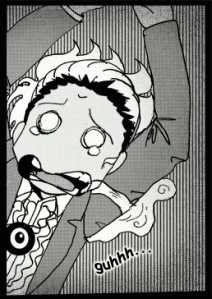
  2. Never run a LARP gamescared drool
  3. Never PLAYED a LARP Game.

I’ve been told by a friend that I’d take to a LARP like a duck to a cracker buffet. It’s mostly due to a lack of opportunity, but maybe on some subconscious level, I’m holding out for “Dresden Lives” to be released. This I know the basics, and this is an attempt to whip up a quick one-shot game using the Fate Accelerated Rules. The original dream involved Transformers of the non-Michael Bay variety, but I think the idea still stands without them.

However, I’m past my deadline for a game project I’m actually getting PAID to do, so rather than post the entire game, I only have time to post a proposal for adapting FAE to LARPing. More on the setting later.

LARP RULES – Each player is given a character sheet, a name tag, a writing utensil & notecards and three Fate Points. They are also given ribbons to represent damage.

Green – tied around permanent Flaws/Errors. (i.e. a robot with a missing leg might have a green ribbon around their leg; a robot that is processing slow has a ribbon around his head.)

Red – Tied around consequences. Once a consequence is repaired, remove the ribbon.

Rolling off: Instead of using Fate dice or cards, one alternative is to use Rock, Paper Scissors (RPS). If so, this is how it works:

OVERCOME / PASSIVE RESISTANCE
To make a roll against passive resistance, ask for a GM, Assistant GM, or any nearby player. Your result:

Tie – Both people throw the same sign. Treat this as you rolled 0, and add your Approach.

You Win – Treat it as if you rolled a +2. Also, throw RPS again: if you lose or tie, stop, but if win, you gain an additional +1 (total +3,) and may throw RPS a third time –if you win again, you get a total of +4. You cannot roll higher than +4. Add your approach.

You Lose – Treat it as if you rolled a -2. You may also throw RPS again: if you win or tie, stop, but if lose, you suffer an additional -1 (total -3,) and must throw RPS a third time –if you lose again, you get a total of -4. Add your approach.

VERSUS A PLAYER / ACTIVE RESISTANCE

Tie – Both people throw the same sign. Treat this as if both people rolled 0- add your Approach, and see who was higher.

One Person Wins – Treat it as if the winner rolled a +2, while the loser rolled a 0. Also, throw RPS again: if the winner loses or ties on the second roll, stop, but if they win a second time, they gain an additional +1 (total +3,) and may throw RPS a third time –if they win a third time, they get a total of +4. You cannot get more than +4. Both players take that result, add their approaches, and see who comes out higher.

GMProv Part 3 – Verily, And More (Or “Yes And”)

Standard

For this installment of “Improv for GMs,” I wanted to tackle something that is less of a trick and more of a philosophy. When I first learned about improv in middle magic zip it scaryschool, one of the golden rules was “No Negation.” Negation is not just the act of responding to a question with no, it’s an entire frame of mind. However, it was a decade before I learned of that rule’s opposite: “Always say ‘Yes And.’” (If this sounds familiar to you, they made fun of it on “Arrested Development.”) First, a small shameless plug:


As a part of BrigadeCon, I’m hosting a game of Skeleton Crew RPG live online at 6pm EST, Sat Nov 15th. Spots still available!

Also, the Skeleton Crew RPG is finished, and is now open for playtesting! Sign up here to get your free copy! [/ Shameless plug]


“Yes And” is a rule, but to demonstrate it, I’m going to walk you through an exercise I stole from a Second City book, appropriately named “Yes And.” This is how the game works:

> All the players sit in a circle and pretend they are a part of a company developing a new product.

>Each player takes a turn adding a new idea about the product.  They can focus on any angle of the product’s development and promotion (ex. features, construction, packaging, advertising, etc.)

> Every statement must start with “Yes, And…”

>No statement can repeat what anyone else said.

>NO Statement can contradict any statement made by another player.
Unacceptable: Player A says “Yes, and the t-shirts are red.” Player B says “Yes, and the t-shirts are blue instead.”
Acceptable: Player A says “Yes, and the t-shirts are red.” Player B says “Yes, and they ALSO COME in blue.”
>Play ends when everyone has had at least one turn. (If it’s a small group, wait until each player has contributed 2-3 times, or until everyone’s bored).

I encourage students that the ideas can be as simple as “Yes, and the t-shirt’s made of cotton,” or as far-fetched as, “yes, and the t-shirt lets you travel back in time and kill your enemies before they were born.” Nothing is wrong, so long as it doesn’t repeat or negate a previous statement.

In this game, we see what the “Yes And” mindset accomplishes:

Yes – It affirms the creative elements of others. The statement does not try to edit or undo anything already established.

And – It doesn’t just affirm what others do, it requires you to add something that others can build on, creating a mutual created world.

Now that you got the jist, let me clarify Negation a little further. Here’s a hypothetical scene I love to propose in improv classes:

Imagine two improvers starting a scene. They are not assigned characters or a situation, and are supposed to create the scene from scratch. Person A turns to person B, grabs them by the hand, and says, “C’mon, Grandma, let’s go to the zoo?”

The question: What’s the WORST possible thing Person B can answer?

Inevitably someone will answer, “No, I don’t want to go to the zoo.”  I tell them that’s the second worst answer they can give. The number one worst answer would be: “I’m not your grandma.”

The second worst answer negates the action- this results in a boring scene that goes nowhere, and establishes a competitive relationship between the players- subconsciously, if their idea isn’t taken, they lose.

The worst answer negates not just the action, but the universe- if a player makes a statement (i.e. “you’re my grandma,”) that is establishing a FACT. To negate a fact is the same as saying “I don’t exist in the same universe as you,” or, alternatively, “your universe isn’t good enough for me.” This creates a disconnect between players, and an adversarial relationship- on a subconscious level, you’re not just competing, you’re playing two separate games.

Practical Applications: When Would I Ever Use This?

Brainstorm! – The most direct version of this is when brainstorming a new concept. When doing panels on collaborative fiction, I always advise people, write down EVERY idea, and don’t shoot anyone else down. It might seem like a bad idea to you, but everyone else might love it; or, what seems like a weak on idea on its own might be fantastic when coupled with an idea that comes later. If you start a brainstorm by saying “no, that’s stupid” to everyone else, the “storm” will fizzle in no time, with only the most aggressive and swaggering people contributing. Here are further examples:

Brainstorm: Campaign – Use this when setting up a campaign setting with the players. This is especially true of Fate games, which encourage collaborative world and character building. If you have a playful group, you might even play a round of the “Yes And” game, just to warm everyone up.

Brainstorm: Establishing Facts – Even after the campaign is started, don’t be afraid to have the players held shape the world. If a player wants to try a magical ritual that is only loosely defined in a rulebook, before you tell them what’s required for the ritual, ask them; they might come up with something that’s not just fun, but sets a precedent for how magic works in the universe. Once again, Fate has a great precedence for letting players establish scene aspects whenever you come to a new setting- this is a great way to ease players into making small facts, without giving them the reins or throwing them in the deep end.

Brainstorm: Atomic Robo – I have yet to have the pleasure of trying it out in the flesh, but the Fate Core game Atomic Robo actually has a mechanic built around Brainstorming, as the various scientists deduct the origins of a threat and concoct a plan to defeat it. As written, the Brainstorming system is a little competitive, but for a twist, why not make it that the final solution has to be built on the ideas of ALL members present?

Adventures – The Yes And is also really important to keep in mind when running adventures. Whenever a player asks for permission to attempt something off of the beaten path, ask yourself: is my response negating the idea or Building on it? That’s not say that everything a player wants falls into their laps without a catch (some would reclassify this as “Yes, But,”); however, remember that the perfect story in your head isn’t a game, it’s a novel. A game requires collaborators, who are writing the story with you.

Lost in Translation – Muddling Messages

Standard

LOST IN TRANSLATION

This week, I’m going to focus on translation. Certain rpgs, like Skeleton Crew (open playtesting starting soon!), require characters to translate a message from one language to another. If the researcher was perfect, you could just hand over the “translated” message in English exactly as you wrote it. However, perfection is boring, and PCs are seldom as skilled as they think they are.  So, what are some ways you can mangle the message, but still make it feel like a translation?research barron

Answer: Google Translate! Of course this requires an internet connection, and copy/paste is lot easier on a keyboard. However, with a little bit of goofing around, you can get great results.

The Message: As a test, I wanted something that had a few complex words; more important, if the words are put in the wrong order, it could mean the difference between life and death for a character. So, I borrowed a line from the classic movie, The Court Jester (which stars Danny Kaye, the mom from Mary Poppins, and a hot Angela Lansbury… yeah, you read that sentence right.) Here it is:

The pellet with the poison’s in the flagon with the dragon, but the vessel with the pestle has the brew that is true.

MANGLING METHOD #1

The first way to mangle the phrase is to post the phrase in English, translate it into another language, and then retranslate the translated phrase back into English. For example:

In Spanish, that translates as:

El pellet con el veneno está en la jarra con el dragón, pero la vasija con la mano del mortero tiene el brebaje que es cierto.

If you paste the Spanish into the first box and translate it back into English, you get:

The pellet with the poison is in the jar with the dragon, but the vessel with the pestle has the brew that is true.

Now that you got the idea, I’ll just skip to the end result for different languages. I was really amazed how many translations came back perfectly (some even having the “Brew that is True” rhyme.) However, here are few more of the interesting results:

Urdu: Poison in the flagon with the dragon, the vessel with the pestle has the brew that is true with the tablet.

Catalan – The pellet with the poison is in the jar with the dragon, but go with the pestle has the brew that is true .. (Not that different, but I found the fact that it added advice interesting)

Georgian – Precipitation venom in a flagon dragon, but the vessel with the pestle has the brew, that’s true .. (Interesting punctuation swap there).

Gujarati – Flagon with the dragon’s venom, but with the pestle has the brew that is true pellet with the ship .. (Where’d the ship come from?)

Haitian Creole – Lead is poisonous and in the flagon with the dragon, but the vessel with the pestle has the brew that is true ..

Hungarian – The poison pellets in the pitcher of the dragon, but the ship breaks the brew that is true .. (Fluid sounding, but not quite right)

Igbo – The pellet with the poison from the flagon dragon, and utensils and pestle to make a beer that is true .. (Utensils and beer?)

Irish – The brew is truly the pellet with the poison in the flagon with the dragon but the vessel with the pestle .. (Right words, wrong order!)

Persian – The pellet with the poison is in the vessel with the pestle is the missing dragon tail that is true .. (This is flipped too! Bwah ha ha!)

Japanese – Poison of dragons, pellets of container and flagon with a pestle is have the brewing is true .. (The rhythm is almost a haiku.)

Korean – The pellet with the dragon the neck of the bottle of poison in a narrow; the pestle has the brew that corresponds to the vessel. (To contrast with Japanese, this feels like it came from a text book.)

Latvian – TheGranulu with poison years in the bottle with the dragon; thekuģis with the pestle has the brew that is true .. (The second part’s perfect, but the first part leaves you unsure what IS poisoned.)

Maori – Knead with the poison in the bottle against the dragon; the vessel to crush the silica is a true ..

Marathi – Flagon with the dragon of the poison in the paper; The vessel has a beam that is true drink ..

Slovenian – ThePeleta sthe otrov u carafe with a dragon, or the cup with a pestle to cook the Truth ..

Finnish – ThePelletti kanssathe poison nthe bottle of wine kanssathe dragon, muttathe alusthe pestle onthe drink that is true ..

Mongolian -Poisonous dragon, but the pestle in a pot Flagon Rolling distillation is that true ..

Somali – Size is toxic in raisins demonic But container with tuntid brew has to be true .. (Almost Post-Modern sounding.)

Tamil – The pellet with the poison dragon, but the truth is that God’s brew flagon is shipping ..

Turkish – the dragon Amath Zehirth rammer ileth ship in unity ileth Vials The pellet doğrudurth to brew ..


Which to use? That depends on how mean you are and what you want to achieve:

German, French, Russian – I didn’t put these on the list above, because the result was near perfect. You might lose some of the poetry, but keeps all of the meaning. If you want to make it less fluid but equally clear, try Japanese or Korean.
(Above paragraph in Korean, retranslated): German, French, Russian – because the result was near perfect, I did not put the following in the list above. You lose some of the city, but you can keep all the implications. If you want to make less fluid, however, equally clear, consider Japanese or Korean.

Finnish, Slovenian & Turkish- These one resulted in a few properly translated words and a lot of nonsense ones. This gives the translator a lot of doubt, but they know where the doubt lies. It feels like you were given half of the puzzle. Finnish seems to go extremely wonky when you have a lot of “the”s in the sentence.
(Above paragraph in Finnish, retranslated): Finnish, Slovenian and Turkish, which together resulted in very few translated words share a lot of nonsense about them. This antaathe the translator a lot of doubts, but they know missäthe doubt lies. It seems as if you had puoletthe puzzle.

Marathi, Mongolian & Maori – These resulted in real words, but a nonsense sentence. The narrator is unsure about what to trust, and what to dismiss. It hints at a story, but the true meaning eludes you.
(Above paragraph in Marathi, retranslated): Marathi, Mongolian and Maori – the real untranslated results, but only a foolish statement. Feature dismiss faith CEO, Chief Executive Officer and is unsure about. It hints at a story, but only one true meaning eludes.

Irish & Persian – These are deceptive, in that they sound like they are fully formed (and poetically beautiful), but the information might come out skewed. This feels like the perfect result to give a researcher who is overconfident- it sounds right, until they make their fatal error.
(Above paragraph in Persian, retranslated): Irish and Persian – this is deceptive, in that they sound like they are fully formed (and beautiful poetic), but may come out skewed data. It feels so good to be a researcher’s right, it sounds overconfident-, either to his fatal error.

MANGLING METHOD #2

So, what can we do to mix it up even more? What if we went through a few other languages before we return back to English?

SO, Let’s try English – > Chinese, Chinese – > Russian, Russian -> English

End result: Poison in a bottle with a dragon, but with pestle container particles with BREW’s true.

Good, let’s add in Norwegian & Arabic too into the chain:

Poison in a bottle with a dragon, but the container stump particles with the right mixture.

MANGLING METHOD #3

Now, what happens if you mess with the translation itself? For example, what if you add a random letter to every forth word in the translation?

Norwegian translation (normal) Pelleten med giften sin i flagon med dragen, men fartøyet med stampe har brygg som er sant.

Norwegian (with added letters in bold): Pelleten med giftren sin i flargon med dragen, mein fartøyet med stamper har brygg sqom er sant.

Result: The pellet with giftren her in flargon with the dragon, mein vessel with tubs have brew sqom is true.

You end up with a most of it being genuine, some of it sounding like it could mean something (“mein vessel,”) and some that is clearly messed up (mmm… sqom.)

Adding random letters helps with language that use the same alphabet, but you can also use mess with languages with different alphabets.  For example, in the following Russian, I copy/pasted the “д” symbol in every few words.

Russian (with added д s): Осаддок сthe ядом-х в бутылди с драконом, но содсуд с пестиком имеет варевдо, что истинно.

You get: Osaddok sthe poison’s in butyldi with the dragon, but sodsud pestle has varevdo that is true.

Or, instead of messing with letters, why not mess with the spacing? In Traditional Chinese, hit the Enter button after every character, putting each character on its own line.

So: 与毒在

Becomes:


This turns a clear translation into:

Chinese Traditional (with spaces): Versus Poison In Versus Dragon Of Liqueur Pot, But Versus Pestle Allow Device In Of Stars Grain Tool There is BREW This Are Really A.

To me, this sounds like a great way of faking hieroglyphs or translations other pictographic languages; each word has its own strong, individual meaning, but fails to connect to the others in a coherent sentence.

MANGLING METHOD #4

  1. Translate from English into One language. Copy it.
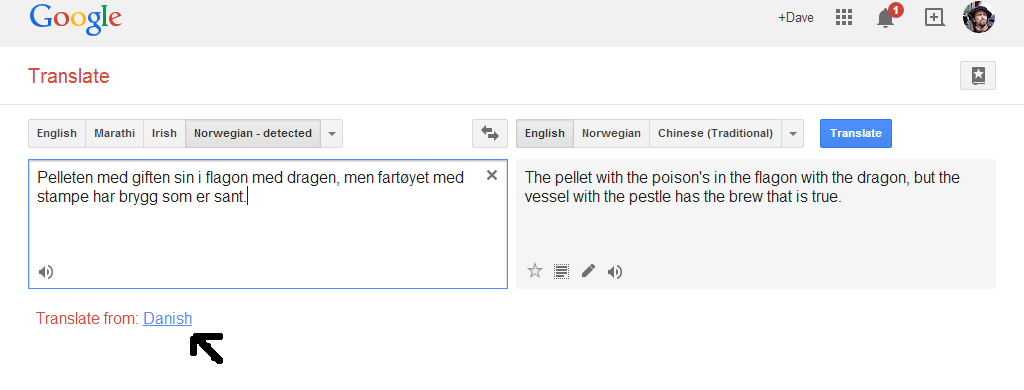
  2. Next, Paste it into the first box. Instead of using Detect Language but tell it that it’s a language SIMILAR to real one, and translate it to English.

screen capture

Chinese text translated as if it were Japanese gives you: Azukadoku Jae given 龙的 Sake壶, however Azukakine container medium basis granulocytes androgynous BREW 这是 true basis.

Japanese translated as Chinese: There ド poison fu ra ra Oligo Oligo nn nn To で na ku pestle で container To Paint Ritz ッ Suites ga really で thou ru Niang who made wo ~ te I ma si.

Spanish translated as Italian: El pellet está en el veneno the jarra with el dragón, but the vasija with the hand holding the mortero brebaje el que es cierto.

Latin as Italian – Cum lagena in blood cell veneni cum dracone, Has Ceruisam stack vas verum.

Norweigan as Danish- The pellet with the poison’s in the flagon with the dragon; fartøyet with tamping has brygg which is interesting.

Croatian as Slovenian – ThePeleta sthe otrov u carafe with a dragon, or the cup with a pestle to cook the Truth ..

Marathi as Hindi – Cya in to Batli poison dragon co Daruchi official documents; The drink contains Musla Naukela This is true ..

Nepali as Hindi – The vessel with the pestle with Dskko Ajidagar saturate with poison pill Sacho flagon that the solution g ma ..

Have some methods of your own? Share them below!

GMprov Part 2 – Bargains & Interrogations

Standard

Last week, I talked about peppering conversations with information so that any eavesdroppers can learn something useful. Today, I discuss how to improvise bartering and interrogations.

Before I do, let me share with you one of my favorite Improv exercises: the Bus Stop.  These are the rules:

  1. There is a bus stop with a short bench next to it. The bus is a very full bus (due to arrive soon), and it will only have enough room for one more person.
  2. Player 1 starts on stage, sitting in the first seat at a bus stop. This person is first in line, and thus is the only person guaranteed to get a spot on the bus. Goal: Player 1 wants to stay in the first seat so they can get on the bus.
  3. Player 2 enters the stage. This person is next in line for the bus, and will not get a spot on the bus, unless they can convince Player 1 to give up their seat. Goal: Player 2 wants that seat, so they will get the last seat on the bus.
  4. There is a second seat next to the first one, which is “behind” it in the line for the bus. The Second player can sit there if they like.
  5. Safety Rules: The second player cannot directly or indirectly touch Player 1, Player one’s chair or anything touching that person. They cannot cause Player 1 any real harm. (Threatening with pretend harm, such as revving up a pantomimed chainsaw, is perfectly fine.)
  6. If/When Player 1 is convinced to give up, Player 2 sits in the #1 chair. Player 2 stops being the character they were, and becomes a new ordinary person. If there is another willing participant, that person is the new Player 2, and a new scene begins.
  7. (There’s one more rule, but I’ll discuss it later)

That’s the set-up. If you’re playing with students new to improv, it might require showing them first, but they quickly get the hang of it. Players will quickly devise a wide range of ways to get Player 1 to move, but most of them fall into 2 tactics: the Carrot and the Stick.

The Carrot: Like a carrot dangling in front of a donkey, the player is tempted with something better than sitting in the Number 1 seat. Examples include showering a player with imaginary money, giving them the keys to a brand new car, and telling them that the pet store down the street is giving away free magic puppies.

The Stick: A form of negative reinforcement. The player is led to doubt whether the Number 1 seat is worth enduring their current situation.

As you can imagine, most players find the Stick far more fun, as they put on strange characters that are creepy, disgusting or downright terrifying.

bonejack tied up comical

So, the essential question is: what is the point of this game?

Answer: To see what happens when two people have conflicting objectives.

Two people want the seat, but only one can have it. Both people have an Objective, which gives the scene purpose (get the seat), energy (I want the seat now!), and a means of measuring success (I got the chair!)

Using this with rpgs: When running an adventure, it is important that you keep the Bus stop game in mind because both sides must have a stake in the outcome. If the opposition has no interest in the seat, there’s no conflict. If players have no interest, they won’t waste their time. If both sides want something they cannot share, that’s when conflict occurs.

Of course, this can be a literal thing (a MacGuffin like the Maltese Falcon or the Dragon Balls), but it can also be an intangible thing, like fame or love. A classic goal that shows up, especially in Superhero stories, is the Status Quo. Bad guys want to establish a status quo of pain, darkness and oppression, while the heroes try to maintain a status of truth, justice and the American way. Now, such finalized “there can be only one” goals are great for long term, campaign long objectives. For a simple bartering session or interrogation, though, it might not work. Before I tell you how to do it RIGHT, let me tell you how it’s often done wrong.

Back in college, I encountered a similar version of the Bus Stop game, simply called “The Chair.” Like Bus Stop, Person 1 sat in a chair, and Person 2 wanted to sit in the chair. No other rules were established, which led to the following problems:

  1. Person 1 would refuse to move for any reason, and those the scene would drag out forever, went nowhere, and often concluded without any feeling of closure.
  2. The only time Person 1 left the chair was when the person was physically removed (remember, no other rules,) which was a little scary to watch, and was quite unfulfilling on an intellectual level.

Now, why did Person 1 refuse to let go? Because they had no idea why they wanted the chair, or how important the chair was to them. They wanted the chair because they were told they wanted the chair- which is shallow and two-dimensional. More importantly, they didn’t know what the chair was worth to them, and thus the Carrot and the Stick have no effect- they only work if you can present something better / worse than possession of the chair.

Likewise, whenever I run the Bus Stop game, I’ll always have a student who refuses to leave the chair, no matter what the reason. A player could point an imaginary howitzer at them, and Player 1, 3 seconds away from annihilation, would still refuse to budge. This leads me to the last rule when I run a game of Bus Stop:

  1. If Player 2 can give Player 1 a legitimate reason to leave the seat, Player 1 must move. (Legitimate is defined as “if this actually happened to you in real life, you would not stay.”)

This means that in most cases, Player 2 will always win (which, if you’re a teacher running a class, means more people get to play.) However, not all Player 2s win on their first attempt. Some of the shyer or less experienced players will attempt to creep out a player, but in an underwhelming way. They quickly learn that they have to up their game, and begin pushing the character to a greater and greater extreme. Likewise, some players attempt to bait someone with a Carrot, and when that fails, resort to the Stick.

How does this apply to rpgs: You, the GM, are Player 1.  You have the thing that Player 2 wants. Nine times out of ten, Player 2 is going to get SOMETHING, be it information, assistance, or something shiny- if negotiations are completely closed and they walk away with nothing that can help them, then everyone just wasted their time.  They need to get closer somehow, even if it’s the knowledge that they need something better to bargain with.

When improvising dialogue with a player, keep in mind two things:

The Carrot – What does the NPC want even more than the thing they have?

The Stick – What repulses the NPC so greatly that it surpasses their desire to hold on to the thing?

Your NPC can start at a ridiculously high asking price, and then bargain down from there. Alternatively, let the players offer greater and greater Carrots and increasingly threatening Sticks until the NPC is significantly motivated. (When in doubt, refuse the first offer.)

Interrogations: Remember that earlier rule “you can’t touch the player?” That might seem like a good rule for middle schoolers, but surely that doesn’t apply to your bastard-sword wielding murder hobos, right? Wrong!

In an interrogation, there are limits to what Sticks you can use (and that’s assuming you don’t have pesky things like “morals”).  If the interrogated party has priceless information that only they can share, they know that the players can’t kill them, thus removing the harshest Stick available the players.

Bartering on the Fly

In a perfect world, you’ll have plenty of prep time to plan what the NPCs truly want, and what strange errands you can send them on before you will yield.

However, we don’t live in a perfect world, and you might find your party bartering with an NPC you created 38 seconds ago.  In addition to all of the above advice, a few other ideas:

  • Money is pretty much worthless to players- it’s numbers on a page. Sure, you can accept it when bargaining, but it doesn’t create any dramatic tension. However, what if the NPC takes a liking to a minor piece of equipment that a player has? (Not their treasured heirloom, but something useful that they like.) Now the player is forced to choose: which is more important, their Wand of +2 Lightning, or the mission?
  • The exception to the above idea is if an NPC asks for an exorbitant amount of money in a very narrow window. For example, what about half-a-million dollars in 48 hours? Suddenly, the players feel the pressure to come up with a very large sum under possibly desperate circumstances. If you didn’t have time to plan an even trade for the players, this buys you time, and puts the emphasis on the players to come up with ways to scrounge up the money. Now they’re the ones brainstorming various side quests they can do to raise dough, rather than making you come up with it.
  • Get Personal – If the thing they are after is relatively insignificant (but you want to draw it out a little, so it’s not too easy,) sell it at the cost of a little public humiliation. Ask for a small favor from a character that is their least favorite thing to do. Make the raging berserker sit still, or the proud noble ask “pretty please with a cherry on top.” Make sure you differentiate between humiliating characters and humiliating people; some players have no problem singing and perform, but for others that’s a fate worse than death.
  • Mediator – To switch things up a little, make the players the impartial middle between two opposing forces, and make the players come up with the compromise. For example, they might need the help of a magistrate, but the magistrate is so busy settling a local quarrel over a stolen pig. If the players want help from the magistrate (they can’t wait), they must first act as the mediators between two feuding forces. This requires a little bit of prep work, but for a change, the GM doesn’t have to come up with what the terms of the compromise are; rather, the players must concoct a winning solution on their own.
  • Pay it Forward – If the players catch you completely unaware by their attempt to barter, let them have it- but like the Godfather, do it on the condition that they owe the enemy a favor in the future.

GMprov – Part 1

Standard

GMprov – Spontaneous Dialogue – Part 1: Eavesdropping

I only have a few years experience with GMing, so there’s little I can  offer in that field that others haven’t said before. However, I do have experience as an Improvisational Performer, and I’ve found the two have a lot of overlap.

Today, I’m going to focus on dialogue, specifically on the noble art of eavesdropping.

GETTING A CLUE

Inevitably, in any given adventure, the players will need to find out information. They might get this from a written clue, or from going zomb take off zigJack-Bauer on some captive, but sometimes they’ll just eavesdrop on a conversation already in progress. The first thing you need to figure out is:
What information needs to come across?

If these are allusions to a major villain that won’t show up for 5-6 adventures, be as vague as you want. However, if the essential information is simply “Players need to get a key or they’re stuck here,” subtlety can result in PCs sitting around in a cell until they’re rescued by divine intervention or they starve.

Recent Example: In the adventure I mentioned last week, a group of Ghost Pirates raided the city for gold, jewels, and anything else shiny (including hubcaps). Our heroes successfully discovered the evil Captain Blackstache’s weakness. Now, the goal was to steer them back to his ship for an epic showdown.  To guide the way, I had a spectral rowboat float over their heads. *I* knew it was heading back to the ship (so all they’d have to do is follow it,) but the vampire of the group volunteered to scurry to the bottom of the boat and listen on what they’re talking about.

In this case, the essential information I had to convey was “We’re going back to the ship, where Blackstache is waiting!” Now, I could just have a character say, “Hurry up, back to the ship, where Blackstache is waiting,” but that wouldn’t have been any fun, especially for a zany series like Skeleton Crew. What other ways are there?

  1. Slip of the Tongue – Rather than stating the info it outright, slip it into a longer sentence or a paragraph. If it’s a minor part of a natural sounding dialogue, it will seem less forced.

So what should you talk about? Ask a man to give a minute-long speech, he’ll likely fail. Ask him to share what irks him, he’ll go on for ten minutes. Which leads us to…

  1. Rant and Rave – People love to complain. If you want to get a character talking, give him something to complain out.

To continue with the Ghostly Rowboat, I wanted to convey the essential “back to the ship,” but I wanted to slip it into a rant. So, to make the rant realistic, I grabbed a random piratey name, Anais (I recommend stashing a few names before any adventure. Personally, I love the Writer’s Digest Character Naming Sourcebook). Thus, the ranting went a little like this:

“Man, that Anais thinks he’s such hot stuff. I saw that shiny set of spoons first, and he ripped it right out of my hands. You saw it, didn’t you? I bet you, by the time we get back to the ship, he’s already there, waiving them spoons under Blackstache’s nose. ‘Ooooooh, look at me, I’m such a good pirate.’. And he’s going to get first dibs on the loot, and he’s going to have that smug expression on his boney little face the whole time. What a jerk.”

This feels REAL because the character’s goal is not to relay information—however, he gives the same useful information across, as well as a whole bunch of useless stuff. Also, with an angry rant like the above, I could carry on until Wizards puts out D&D 6th Edition.

(As an added bonus, it sets up a great minor character for the pirate character. In the same adventure, Blackstache barked an order to the nearest NPC, which I declared was Anais. When a PC sent him flying off the ship into the water, a nearby pirate muttered, “Y’know, I never liked that guy. What a jerk…”)

Don’t be afraid to use your own real pet peeves as inspiration. Sure, it might be hard to work your pro/anti “Phantom Menace” rant into a medieval fantasy world, but most problems are timeless: coworkers, relationships, traffic, bad food / service. Given a reshaping, you can even make technological rants work for any age.

Grok: And then  Warlord call for Grok.. only Warlord call Grok’ IT Guy,’ ‘cuz Warlord no know Grok’s name. Grok is “It Guy” cuz Grok fix the Its.  Warlord say, ‘Catapult no work. Kicked it with boot, still no work.’ Grok say, ‘Haz Warlord kicked catapault again? Re-boot?’ And Grok re-boot catapult, and it work. And does Warlord thank Grok? No! Warlord glare at Grok, like it Grok’s fault it no work in first place. Grok no built stupid catapault, Grok only fix stupid catapult. Grok say long time go to Warlord, ‘Warlord need buy new catapults.’ Did Warlord listen to Grok? No! No one listen to Grok.

  1. Teaching Moment – The rant is great when you have only a small bit of information, but what if you got a lot to explain? Answer: Nature abhors a vacuum. Or, in other words, knowledge must gracefully goes from those who know to those who don’t know. If both people know the info, why would they spend valuable time speaking it aloud?

Note: Author Dan Brown is notorious for breaking this rule. He’ll have Prof Langdon racing against the clock, running for his life- only to spend 20 pages explaining something to an expert who’s ALSO AN EXPERT IN THE SAME SUBJECT.

However, if a PC eavesdrops on one NPC who knows and one who doesn’t know, they might be lucky enough to overhear an info dump. Here’s a sample that only slightly steals from a certain Monty Python movie (Bad Yorkshire / Cockney accents optional).

Mean voice: Okay, you stay here and make sure he doesn’t leave.

Gruff voice: Right. Will do. Um…

Mean: Yes?

Gruff: Who is “he”?

Mean: Him. In there. The prince. The one locked up.

Gruff: Oh right. Yes of course. Ummm…. Which prince?

Mean: Of Freedonia. The one the emperor kidnapped. To hold as hostage, so the Freedonian Queen will agree to the trade agreement. Is anyone of this getting through to you?

Gruff: Oh, yes sir, of course sir. Only… um, could you repeat that again sir?

Mean: Starting with what?

Gruff: Just everything after the uh… time you opened your mouth…

Gruff: [Exasperated Cry!]

  1. Magic Lampshade – If you don’t have the time or the confidence, simply break one of the golden rules above, and have another NPC call yourself out it.

Pirate Bosun: Row harder! We got to get back to the ship!
Lackey: What are you telling me for?! I know that already!
Pirate: Quite yer yapping!

OR

Pirate Bosun: We’ve got the prize!
Lackey: Quiet you idiot! If you keep yelling it out like that, someone most overhear and find out that we got the prize.
Pirate: Oh, right.

FINAL TOUCHES

Here are a few other tips to make your overheard conversations pop:

  1. Stuck in the Middle – It’s rare that an eavesdropper hears the beginning of a conversation. One of my favorite lines from the Simpsons is Bart saying, as someone else rushes through, “So I says to Mabels, I says ‘Mabels…’” I don’t know WHY it cracks me up, but between the New Yorker improper grammar and the idea that Bart knows someone named “Mabel,” but it’s a wonderful non-sequitor that feels real. If I have the forethought, it’s sometimes fun to start with the punchline of a joke, hinting at a strange story. Here’s a fun one:

“And then I said, ‘but Madame, that’s NOT my broadsword!’ Get it? Get it??”

<shameless plug> If you want more Punchlines, you can find more in our “Handbook for Saucy Bards,” available in the Tangent Tidbits Store </shameless plug>

  1. Asymmetric Games – All conversations need two or more people. However, trying to play two different characters at the same time can be tricky, especially if you love silly voices. However, it doesn’t have to be an EQUAL conversation. One can do all of the explaining and ranting, and the other person can just answer in “y-ups,” grunts, Hodors, or, depending on the species, “gronks.” One of my favorite episodes of the anime Cowboy Bebop is Episode #2, Stray Dog Strut. It involves a pair of minor scientists, one of which is lamenting who deep in trouble they are (with a heaping side dish of exposition.) His lackey, for 90% of the episode, only responds with a nasal “Seems that way.” It’s the perfect example of how a non-committal sycophant can turn an everyday expression into a catchphrase.
  2. The Purloined Letter – If you’re weaving a mystery, you will have to drop some hints along the way. One of the best ways to hide the info is in plain sight, i.e., in the middle of a wide info dump. For example, if the PCs overheard a butler saying,

Jeeves: Make sure you near the back door around 7 to answer it, the shop man is coming by with a delivery, and make sure he has every item: 4 jars of varnish, 2 cans of lye, 1 roll of butcher’s paper. And make sure you count this time before you sign!”

Roger: Do I have to wait down there? I here funny noises sometimes, when it gets dark.

Jeeves: That’s just the boiler room. Now move it!

When the players hear it, the first thing they might notice is poor Roger’s complaint about the noises. However, it’s only later that they realize the true info hidden— when they learn that lye was the poison used to kill Great Aunt Tabitha. Did Roger miscount, or did someone sneak off with a jar of lye when Roger was distracted?

NEXT WEEK: Intentions and Bargaining!

Open the Gates! – Open Ended Adventures & Skeleton Crew

Standard

In the GM scheme of things, I’m relatively new. I’ve created several adventures for Skeleton Crew and my other games, and heard positive feedback. However, they would definitely fall under the “on the rails” category. In the case of the Masters of Umdaar game, the characters were literally in a single hallway, without a single side branch they could veer down. Of course, that was a 2-hour demo game, but Sophie Lagace’s blog inspired me: could I create a really short adventure that wasn’t on the rails? If New Manchester, the SC city, was so such a great setting, why not show it off some?

SPOILER WARNING:  If you’re signed up for the Skeleton Crew game this Saturday at Victory Comics at 12pm in Fairfax, VA, this contains a few spoilers. If you’re in the Northern Virginia area and you’re not signed up, WHY NOT?! Post here to reserve a spot!


maria eyes serious

THE EXPOSITION: BLACKSTACHE’S REVENGE!

When I started writing the adventure, the following quote was bouncing around in my head:

“I will get Peter Quince to write a ballad of this dream: it shall be called Bottom’s Dream, because it hath no bottom;” – Nick Bottom, in A Midsummer Night’s Dream.

That was my goal: to create an adventure with a strong start, but no predetermined “bottom.”  Here’s the premise I used for the story, based on a comic idea cowritten by Monica Marier.

The story begins in Oldetown New Manchester, next to the old Town Hall, which is now a historically protected building. It is the local holiday Name Day, and the streets are filled with tourists, small-fry politicians, vendors, and street performers.  The smell of funnel cake permeates the evening air.

Mayor Mayer reaches the podium and gives an unenthusiastic speech, which includes the following exposition:

The city of New Manchester is celebrating Name Day because, on this day in 1689, a group of ragtag villagers and tradesmen defeated an invasion by vicious pirates. Until then, the community had been nameless waypoint between other settlements, but after their victory, they christened the area New Manchester.

As Mayor Mayer is wrapping up, storm clouds blanket the sky, and a glowing rowboat descends from the sky, landing on the steps. Enter Blackstache, a skeletal pirate of glowing green light, dust, and hate (with a surprisingly well kept mustache.)

“These be nuttin’ but lies! I know, for I was there- Captain Blackstache! (Not Blackbeard, that poser came later.) Me and me mates weren’t invaders… this was OUR home! It was our place of refuge, and them traders wouldn’t have been nuttin’ if it weren’t for us. This town ‘ad a name- it was Pirateton! And in the name of the Skull Dogs, the Sea Vultures, and meself, I claim it Pirateton once more!” [Insert Arrs and other piratey language here.]

From his rowboat, several other skeletal pirates (these looking a little more solid) join Blackstache’s side. Together, they grab Mayor Mayer, and make their way through the crowd to the street. Overhead, a dozen more spectral rowboats glide overhead, heading inland under a canopy of darkness.

THE FIRST BLOW

The heroes will hopefully get involved at this point (the precon character Zomboy has the aspect “Superhero in his own mind,” which can definitely be compelled for this purpose.) If the players don’t give a reason, maybe the skeleton henchmen start robbing the crowd members, including your heroes. In my Roll20 Game, the person playing the little girl Peek-a-boo demanded Blackstache give her his awesome tricorn hat.

As soon as a conflict occurs, I want to establish the following things:

  • The Crew is divided into two gangs of pirates, the Skull Dogs and the Sea Vultures- for the sake of the session, I had the Skull Dogs be the melee fighters, and Sea Vultures be the long range marksmen. They CAN suffer stress from mental and physical attacks. (If Caomh Culainn is in the party, he’s the only one who can Intimidate them, or it’s +2 harder for everyone else). If beaten, they can be questioned.
  • During the first scene, Blackstache is invulnerable to all physical and mental attacks. All physical attacks go straight through him, and because he’s invincible, he laughs off any intimidation attempts. I go more in depth about Invulnerabilities in the Skeleton Crew rpg rulebook, but in a nutshell, it’s a Compel- the first player to discover a physical or mental immunity gains a Fate point at the end of the scene. Any attempts to capture him will ultimately fail. More on that later.
  • Blackstache’s objective in the first scene is to kidnap the Mayor- it IS possible for him to fail, meaning the player do have a way of winning the Conflict. If the Mayor is rescued and is not recaptured in the next turn or two, Blackstache will give a conditional defeat; automatically escaping without his prize. If the players don’t rescue her in a few turns, he’ll leave with her. After he leaves, any crew still around will continue fighting until they are defeated or concede.
  • Blackstache and his crew are greedy to the Nth degree, but not very well organized, and a bit on the dump side. It’s pretty clear that they hadn’t really planned this whole thing in depth. If questioned about their demands, they’ll start with “take what is ours!” and then waffle a bit if you ask for specifics.

Making them Care: At this point, hopefully the party is eager to twart Blackstache. If not, you’ll have to make them interested. Some options:

  • Have a skeleton crew mate hint about gold on the ship.
  • Have the mayor (or, she’s abducted, the deputy mayor) pay you.
  • Have the pirate rampage take out the city’s power and cell towers (thus, disrupting all TV watching.)
  • Have the skeletons kidnap a love interest or family member of the party. (Stupid boyfriend, always getting kidnapped!)

Beating Blackstache

So, to repeat what is established above, the players cannot beat Blackstache as they are at the beginning of the adventure?

Q. How do they break through Blackstache’s invulnerability

A. Anyway they come up with.

Really, any scheme they concoct can potentially work. For a comedy/adventure game like this, no scheme is too stupid, so long as it requires a little effort. That’s the goal: an adventure that can go anywhere the players want. In a more complex system, this might be a bit harder, but luckily Fate is loose enough that it can be done on the fly.

Of course, to be safe, I have a few things preplanned:

  • Weapon / Invention: If they want to build an invention, I would use the “Building Invention” rules, as they appear in the SC book (it’s essentially a variation on the Challenge rules). This makes the players struggle as they scrounge the city for essential parts, even as the pirate gangs create chaos around them.
  • Ritual: Using the same rules as Invention, but with a magical twist.
  • Book Run: If they want more info, they can swing by the library, where they’ll find the condescending Librarian Dezi Dewey.  She greets them on the steps, and tells them the essential book they need, “Journal of Goody Goodwife,” is a blue book in the Reference section (no, you’re NOT allowed to check it out!) Upon entering the library, you find the place ablaze, as some lesser skeleton pirates are wrecking havoc. Getting the book can be run as a Challenge or a Contest. For results, see “Useful Info” below.
  • Achilles Heel: maybe Blackstache has a secret weakness, such as a magical talisman that gives him invulnerability. Maybe it’s closer to a horcrux, such as a part of him that is stashed somewhere else, like his heart in a music box, or his soul in a hourglass. This is a good plan b if the party is adamant in charging after Blackstache (who’s residing on the ship) before learning how to hurt him. No doubt his weak spot would be kept near him for safekeeping, probably in his cabin.
  • Séance: If your members try to gather information from the dead (in their lair or in the Oldetown cemetery) they’ll be able to talk to actual colonial residents. Using the info from them (or even bringing the spirits along), and leverage, shame or even scare Blackstache for good.

What info can you find? There are several options:

  • Blackstache had united two warring pirate factions based out of Pirateton, the Skulldogs and the Sea Vultures (who were bitter rivals.) It is possible to wedge them apart.
  • Blackstache was honest that the pirates were the founders of Piraton, but he neglected to mention that the mob that drove them off consisted of their fed-up wives and lovers. The very name of these old flames wills them with shame and fear. If you can resurrect or impersonate them, expect them to run for the hills (perhaps after a Mental Conflict?)
  • Blackstache’s real name, Bartleby Briganmeyers. Names have power, and potentially, the name is all you need to cause him to quake. This can be used in a binding ritual, or be added on top of an attack spell. If there’s no spell caster in the party, maybe just mentioning the name will break the shield. Of course, you can always start a social conflict and shame “Bartleby” with just how ridiculous his name is.
  • Burial Site – this one is not information I would OFFER, as I imagine Blackstache as dying out at sea. However, if players insist on finding his burial spot, your sources will reveal that his corpse wound up on a small island off the coast. As any Supernatural fan knows, you can always salt n’ burn the body.

What else did I prepare?

  • Blackstache’s stats.
  • Several levels of skeletal henchmen. Taken strait from the SC RPG rulebook, plus a few pirate aspects:
Skeletons are puppets of dried bone, controlled by a necromancer from the outside. They have no memory or emotion, and no connection to person they used to be- they are practically robots with a grim skeletal smile.
Skeleton Aspects –Undead – Skeletons are undead, and as such, might have weaknesses to holy magic, silver, and other magical purities.; No Pain; Rattling Bones.
Commonly Level: Average (+1)
Stunts: Brainless – Skeletons are immune to normal mental attacks. They may not actively resist any mental Aspect placed on them (ex. attempts to lure them to a better spot, attempts to distract them.)
Autonomous Parts – It is possible for a skeleton’s body part to keep moving, even after it has been severed from the rest of the body.
Wight Stuff (Good +3 Only) – Skeletons of Good +3 or higher are considered Wights. They lose the Brainless stunt. However, they grant +1 to any Attacks they make with Fight (but not defending.)
Alternative: You may have the skeletons be resurrected marksmen (musket men, pirates, crossbowman.) If so, replace all Fight skills with Shoot.
AVERAGE (+1)
Physique   +1, Fight +1
Stress: No stress boxes—a one shift hit is enough to take them out.
FAIR (+2)
Physique   +2; Fight  +2
Intimidate   +1; Wilderness +1
Stress: One stress box—a two shift hit is enough to take them out.
GOOD (+3)
Aspect:  Undying Rage
Physique   +3; Fight  +3
Intimidate   +2; Will +2, Wilderness +2
Notice +1, Athletics +1
Stress: Two stress boxes—a three shift hit is enough to take them out.
  •  Some useful locations, like Hubris University, Bell & Cat Magic & Book Shop.
  • Phone a friend: If the players are lost or failing to come up with an idea, I was prepared to have an NPC call them up and guide them to a conclusion, such as Ol’ Man Jenkins, the Caretaker at the Library and/or Graveyard; or Prof Ephipany at BIFZAP Research labs.
  • Had a list of funny colonial names:
    Bartleby Briganmeyers
    Goody Goodwife
    Upton Ecclaire
    Charity Miser
    Amias Cork
    Primrose Hedge
    Jotham Lazarus
    Winston Ermergaurd
  • Because this was a Roll20 game, I had a few maps handy, like an Oldetown cobbled street, a modern city street, a library (with flame tokens), a pirate ship (inside and out), a graveyard, etc. Roll20 isn’t perfect, but it’s darn handy (I could write a whole blog on it, and probably will.

My first test with it was a huge success. It ran about 3.5 hours, but at least 30 minutes of that was figuring out how Roll20 worked.

What are your thoughts? Share your awesome stories.

If you haven’t already, sign up for the Skeleton Crew Beta test, and receive a FREE copy when we release.

Skeleton Crew Beta Test – GET OUT OF THE KITCHEN!

Standard

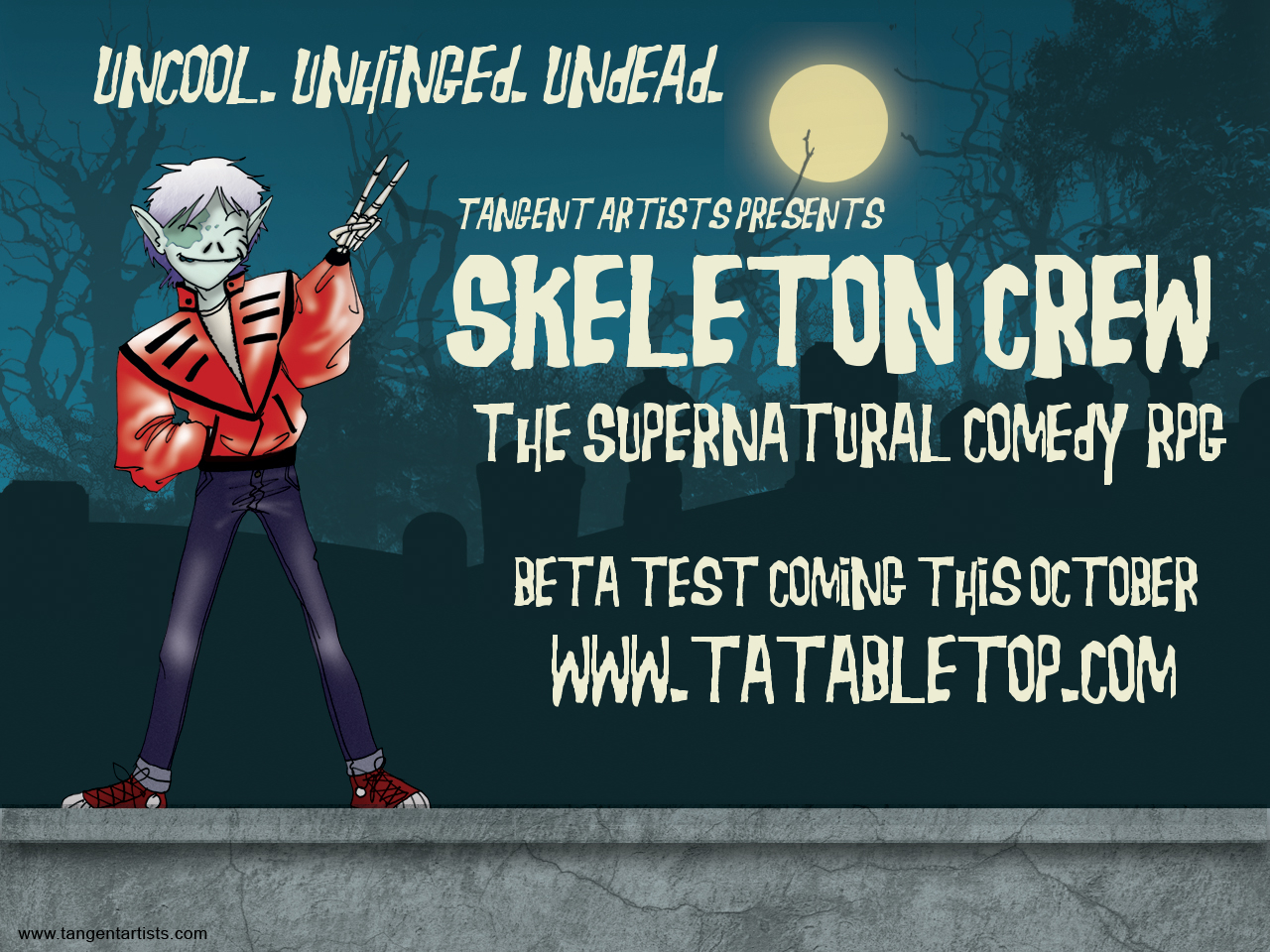
It’s official: this October, we’re releasing the Beta Test for the Skeleton Crew RPG! If you’re an interested in being a playtester, watch this spot- very soon, we’ll give you information on how you can sign up.

sc rpg beta ad

In the meantime, here’s sneak preview of one of the Pre-generated character :

Enchanter – Jynx Goldie, Muffinmancer

Jynx is an Enchanter, who focuses on creating potions, charms, and artifacts on the spot.

Jynx is a natural at aleuromancy- or as Jynx’s teammates dub it, a muffinmancer.  Jynx’s baked goods used have strange effects on its consumers, changing their moods or energy. After years of practice, Jynx’s treats now have an effect even if they’re not eaten- breaking open a devil’s food cake can release demonic energy, while the gingersnaps actually snap.  Jynx always preps dozens of treats before every mission, but also brings a battery-operated EZ-Cook Oven into the fray, just in case.

High Concept (Permission): Young Bread-based Crafter Mage

Example Trouble Aspects –All Bark, Little Bite; Barely in Control;

Example Normal Aspects for your Sorcerer: Eccentric Genius; Here’s One I Made Earlier (Somewhere); Doing It On the Fly; Don’t Bother Me, Magicking!; Perfectionist; Handy Work Bench


Enchanter Skill Set (Intrinsic Magic)

  • Great (+4) skill –   Fabricate
  • Good (+3) skills –  Shooting (Magic Muffins), Rapport
  • Fair (+2) skills –   Mythos, Resources, Sixth Sense
  • Average (+1) skills – Notice, Investigate, Athletics, Will

Enchanter Stunts-

Weaponized Magic – Flour Power Spell – Once per scene, you may summon a spectral fist of flour, and may use Fabricate as if it were Fight, to deal a close range Attack. Alternatively, you may use this once to defend against a Fight attack.

Specialized Magic – Tantalizing Aroma – You gain +2 Rapport to Overcome rolls when convincing weak willed individuals (aka mobs and lesser NPCs) to eat one of your baked items, if you have an item handy.

Derived Magic – Enchant Grain – You may use Fabricate to Create an Advantage to attempt to quickly make a baked good with a magical aspect attached to it, or place an aspect on an existing baked good. This aspect can be a property belonging to the food (ex. Luminescent Crescent; Exploding Nut Muffin), or a property that is passed on to anyone who eats it (Love-Potion Lemon Square; Naan Bread of Nausea). You can also use this to bake useful items and tools, like rock-hard battle baguettes or a sturdy pumpernickel ladder. Likewise, you may spend a Fate Point or a muffin-based invoke to already have a baked good with that aspect all ready to go.

Stress: Physical: 2                           Mental: 3                             Refresh: 3
Permission to copy for personal use!

Monster Gallery – Gloom Cart

Standard

For our first RPGee-Whiz entry, we thought we’d showcase on of the monsters that shows up in the Skeleton Crew RPG: The Oboro-guruma, aka the Gloom Cart.  This is a fun monster for any supernatural Fate Core game, as it merges two things together: Driving and Combat. Know, any epic chase scene doesn’t have to include stats for the cars AND for the mooks driving it- they’re one in the same.  Though the skills are slightly different, feel free to try it in your Dresden Files game.

Oboro-guruma – Gloom Cart

It used to be said that if a woman was killed by an ox cart, her spirit would merge with the cart, resulting in a terrifying cart that roamed on its own, bearing a woman’s face.  Luckily, ox-carts are not that common in New Manchester, but it appears that victims of other wheel-based accidents (cars, trolleys, shopping carts, segways) are starting to surface.For Oboro minions, here’s our recommended sizes: tiny vehicles (scooters, segways, etc) as Average (+1); small vehicles (motorcycles, hot dog carts, mini-coups) as Fair (+2); mid-sized cars as Good (+3).  While we do not cover them here, we recommend you treat large vehicles (vans, SUVs, food trucks, semis) as Great (+4) Named PCs.Racial Aspects

Ghost in the Machine – Oboros are undead, and as such, might have weaknesses to holy magic.  Unlike most undead, silver and salt doesn’t hurt the “ghost” inside much, as it’s protected by a metal shell.

Hell on Wheels – Uses dark energy for speed.

Vengeance Against Bad Drivers!

STUNTS: Aggressive Driving – If the Oboro is given enough room to maneuver, it may use Drive to make close combat physical attacks against characters and other cars. It may also use Drive to make Overcome rolls to overcome minor obstacles.

Hit & Run (Good +3 Oboros only) – If the Oboro makes an Attack and succeeds with style, instead of taking the Boost, it may immediately move up to two zones away.

AVERAGE (+1)+1Drive, Physique, WillStress: No stress boxes—a one shift hit is enough to take them out. FAIR (+2)+2 Drive, Physique+1 Will, Intimidate

Stress: One stress box—a two shift hit is enough to take them out.

GOOD (+3)Aspect: Two-Ton Menace+3  Drive, Physique

+2 Will, Intimidate

+1 Engineering, Notice

Stress: Two stress boxes—a three shift hit is enough to take them out.